

Female Body Education: 7 Gentle Steps to Reclaim Your Body #BodyNeutrality #IntimacyReset
Female body education matters because too many women grow up knowing how to care for everyone else while remaining silent about their own bodies. You may know how to be polite, responsible, and emotionally available, but when it comes to your own discomfort, pleasure, boundaries, or pace, the silence can create shame. You are not broken—you were simply missing the right language, support, and shame-free knowledge.
This guide offers a gentle path forward: clear body names instead of vague words, daily check-ins instead of perfection, and self-trust built through noticing, not fixing. Understanding your body is not about meeting another standard; it is about coming home to yourself.
Here is how we can begin.
What Is Female Body Education? (And Why It Matters)
Female body education is a shame-free approach to understanding your body that goes beyond risk and danger to include body literacy, emotional safety, clear language, and self-trust. Unlike traditional sex education that focuses primarily on pregnancy prevention and disease, shame-free education teaches women to listen to their bodies, name their experiences accurately, and build confidence through knowledge rather than fear.
According to the American College of Obstetricians and Gynecologists (ACOG), comprehensive sexuality education should include accurate, age-appropriate information about human development, relationships, and personal safety. Yet, many women received education that emphasized what could go wrong rather than how to understand what feels right.
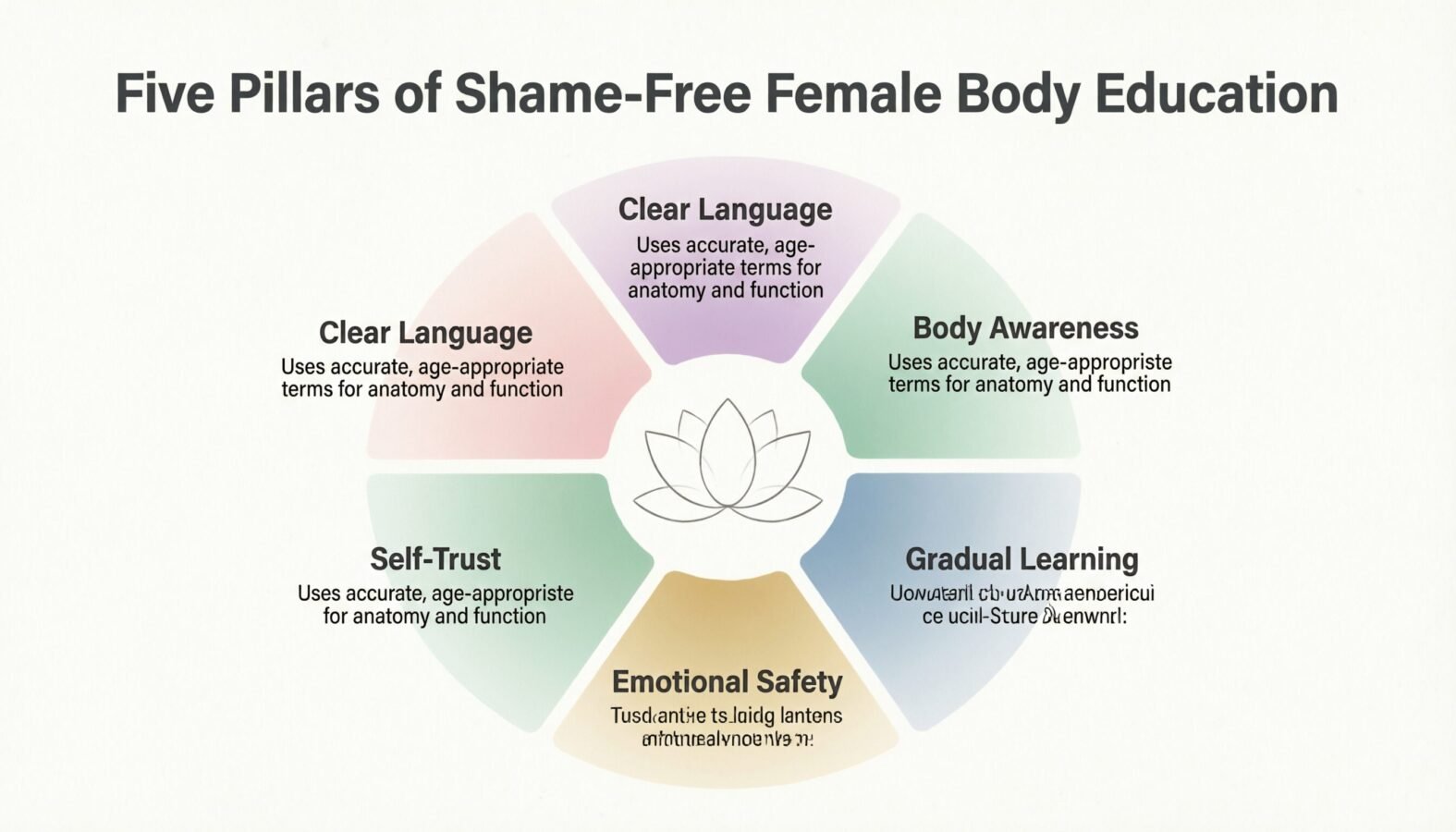
When you learn through shame-free education, you discover that your body is not a problem to solve or a reputation to protect. It is a home to inhabit with curiosity and kindness. This approach recognizes that body awareness develops gradually through practice, not overnight through perfection.
Learn more about why women feel disconnected from their bodies →The Difference Between Risk-Based and Shame-Free Education
| Risk-Based Education | Shame-Free Education |
|---|---|
| Focuses on danger, pregnancy, and disease | Includes pleasure, boundaries, and self-trust |
| Uses vague or clinical language only | Encourages clear, comfortable anatomical names |
| Teaches bodies as problems to manage | Teaches bodies as homes to understand |
| Emphasizes what NOT to do | Explores what feels true for YOU |
| Creates fear and silence | Builds confidence and communication |
| One-size-fits-all approach | Honors individual experiences and pace |
The table above shows the fundamental difference. Risk-based education is not wrong; it is simply incomplete. When safety messages are all you receive, your body becomes associated with potential mistakes rather than personal wisdom.
Why Female Body Education Feels Difficult for Many Women
If learning about your body feels uncomfortable, confusing, or even shameful, you are not alone. This difficulty is not a personal failing. It is often the result of inherited body shame passed down through generations and reinforced by cultural messages.
Many women struggle with intimacy disconnect because they were taught to prioritize others’ comfort over their own awareness. You may have learned to read other people’s emotions, anticipate their needs, and adjust your behavior accordingly. However, when it comes to your own body’s signals, that same attentiveness may feel foreign or even selfish.
Explore more resources at the Reset Intimacy Blog →The Messages You May Have Heard Growing Up
Think back to what you learned about your body. The lessons often sounded like:
- Be careful.
- Stay modest.
- Do not talk too much about it.
- Do not be too curious.
- Protect your reputation.
- Keep your body hidden.
- Good girls do not…
Safety, consent, and health matter deeply. But when risk-based education is all you receive, the body can start to feel like a problem instead of a home. The entire message becomes about avoiding mistakes rather than building understanding.
The Painful Gap Between Caring for Others and Knowing Yourself
This creates a painful gap. A woman may know how to care for everyone else but not know how to name her own discomfort. She may know how to stay quiet but not how to ask what her body needs. She may know how to appear confident but not feel safe inside herself.
That is not failure. That is incomplete education. Self-trust is not something you are born with; it is something you build through practice, language, and permission to learn at your own pace.
How Risk-Based Sex Education Creates Shame
Understanding how risk-based sex education shapes your relationship with your body is crucial for healing. When education centers entirely on pregnancy, disease, reputation, danger, and mistakes, the body becomes a source of anxiety rather than a source of wisdom.
Research published by organizations like ACOG shows that comprehensive sexuality education, including topics like consent, pleasure, and body autonomy, leads to better health outcomes and healthier relationships. Yet, many women received abstinence-only or fear-based curricula that left critical gaps in their understanding.
Discover 5 gentle ways to build body confidence and self-trust →When Safety Messages Become Shame Messages
When you hear “be careful” without also hearing “listen to yourself,” body shame can take root. Safety messages become shame messages when they:
- Focus only on what could go wrong.
- Use fear as the primary motivator.
- Treat curiosity as dangerous.
- Equate modesty with worthiness.
- Suggest that bodies are inherently risky.
Bold truth: Your body is not a threat. It is a source of information.
The Impact on Body Trust and Intimacy
This educational gap creates real consequences. Women who received only risk-based education often experience:
- Intimacy disconnect during physical closeness.
- Difficulty identifying pleasure versus discomfort.
- Hesitation to communicate needs or boundaries.
- Belief that wanting to understand their body is selfish.
- Spectatoring—watching themselves instead of experiencing.
Somatic healing practices can help rebuild this trust by teaching you to notice sensations without judgment, regulate your nervous system, and reconnect with your body as a source of wisdom rather than worry.
Shame-Free Education Begins With Naming, Not Judging
One of the simplest yet most powerful parts of shame-free education is language. Many women are taught vague words for their body parts or encouraged to use euphemisms that create distance. You may hear “down there,” “your lady parts,” or “private areas” instead of clear, specific names.
But when a part of the body has no name, it becomes harder to understand, discuss, care for, or seek help for it. Clear body language is not about being clinical or uncomfortable; it is about having the vocabulary to advocate for yourself.
Learn about boundaries for women and intimate communication →Vague Language vs. Clear Body Names: Real Examples
| Vague Language | Clear Body Names |
|---|---|
| “Down there” | Vulva, vagina, clitoris, labia |
| “Your time of the month” | Menstruation, period, cycle |
| “Private parts” | Genitals, pelvic region |
| “Feeling funny” | Nausea, cramping, bloating, tension |
| “Not in the mood” | Low desire, fatigue, discomfort, pain |
| “It hurts” | Sharp pain, dull ache, burning, pressure |
Using clear body language helps you:
- Have better medical conversations with healthcare providers.
- Develop more honest self-awareness.
- Experience less fear around normal body experiences.
- Build more confidence in intimate communication.
- Create a stronger sense of ownership over your body.
Shame says, “Do not look.” Education says, “You are allowed to understand.”
Why Clear Names Build Confidence (Not Discomfort)
Knowing anatomical names does not mean you have to use clinical language in every conversation. It means you have options. You can choose words that feel comfortable while still maintaining accuracy.
Clear names support body confidence because they:
- Remove mystery and shame from normal anatomy.
- Make it easier to describe symptoms to healthcare providers.
- Help you identify what feels good versus uncomfortable.
- Reduce anxiety about “not knowing.”
- Create a foundation for self-trust and advocacy.
Body Awareness Is Not Body Perfection
Many women approach body awareness with pressure. They think they must become more confident immediately, love every part of themselves, or fix every insecurity before they can feel worthy.
That is not the goal. Body awareness is not about perfect confidence. It is about noticing. It is about slowly learning the language of your own body.
Stop comparing yourself: 5 gentle ways to build confidence →The Pressure to “Love Every Part” Immediately
The body positivity movement brought important conversations about acceptance. However, for women healing from deep inherited body shame, the pressure to “love every part” can feel like another impossible standard.
Body neutrality offers a gentler alternative. Instead of requiring constant admiration, it invites you to view your body with respect and curiosity. You do not have to love your body to listen to it. You do not have to admire it to care for it.
What Body Neutrality Actually Means
Body neutrality is the practice of viewing your body as worthy of care and respect without requiring constant love or admiration. It focuses on what your body does and feels rather than how it looks.
This approach might sound like:
- “My body carries me through the day.”
- “I notice my shoulders feel tense.”
- “My body needs rest right now.”
- “I am learning what feels comfortable for me.”
Body neutrality creates space for body awareness to develop without the pressure of performance. It is a gentler, more accessible path for those healing from shame.
Understanding Your Body’s Signals Without Judgment
Learning to notice your body’s signals is a foundational skill in female body education. This practice draws from somatic healing principles, which recognize that the body holds information that the mind may overlook.
Take the Intimacy Presence Quiz to explore somatic grounding tools →Physical Sensations: What to Notice
During a body check-in, notice physical sensations without trying to change them:
- Tightness or tension (where in your body?)
- Warmth or heat
- Heaviness or lightness
- Softness or hardness
- Numbness or tingling
- Comfort or discomfort
- Energy or fatigue
These sensations are information, not problems. A body check-in helps you build a vocabulary for what you are experiencing.
Emotional and Mental Cues
Beyond physical sensations, also notice:
Emotional cues:
- Anxiety or calm
- Sadness or joy
- Frustration or peace
- Overwhelm or ease
Mental cues:
- Racing thoughts or mental clarity
- Mental fog or focus
- Self-criticism or self-compassion
- Worry or trust
These cues help you understand how your nervous system regulation affects your overall sense of safety and well-being.
The Difference Between Discomfort and Danger
One of the most important skills in body awareness is distinguishing between discomfort and danger.
Discomfort might feel like:
- Stretching during exercise.
- Emotional vulnerability.
- Trying something new.
- Temporary muscle soreness.
Danger signals include:
- Sharp, sudden pain.
- Difficulty breathing.
- Chest pressure.
- Severe dizziness.
Understanding this difference builds self-trust. You learn that discomfort is often part of growth, while danger requires immediate attention. This knowledge helps you make informed decisions about your body without fear ruling every choice.
A Gentle Practice: The 7-Day Body Check-In
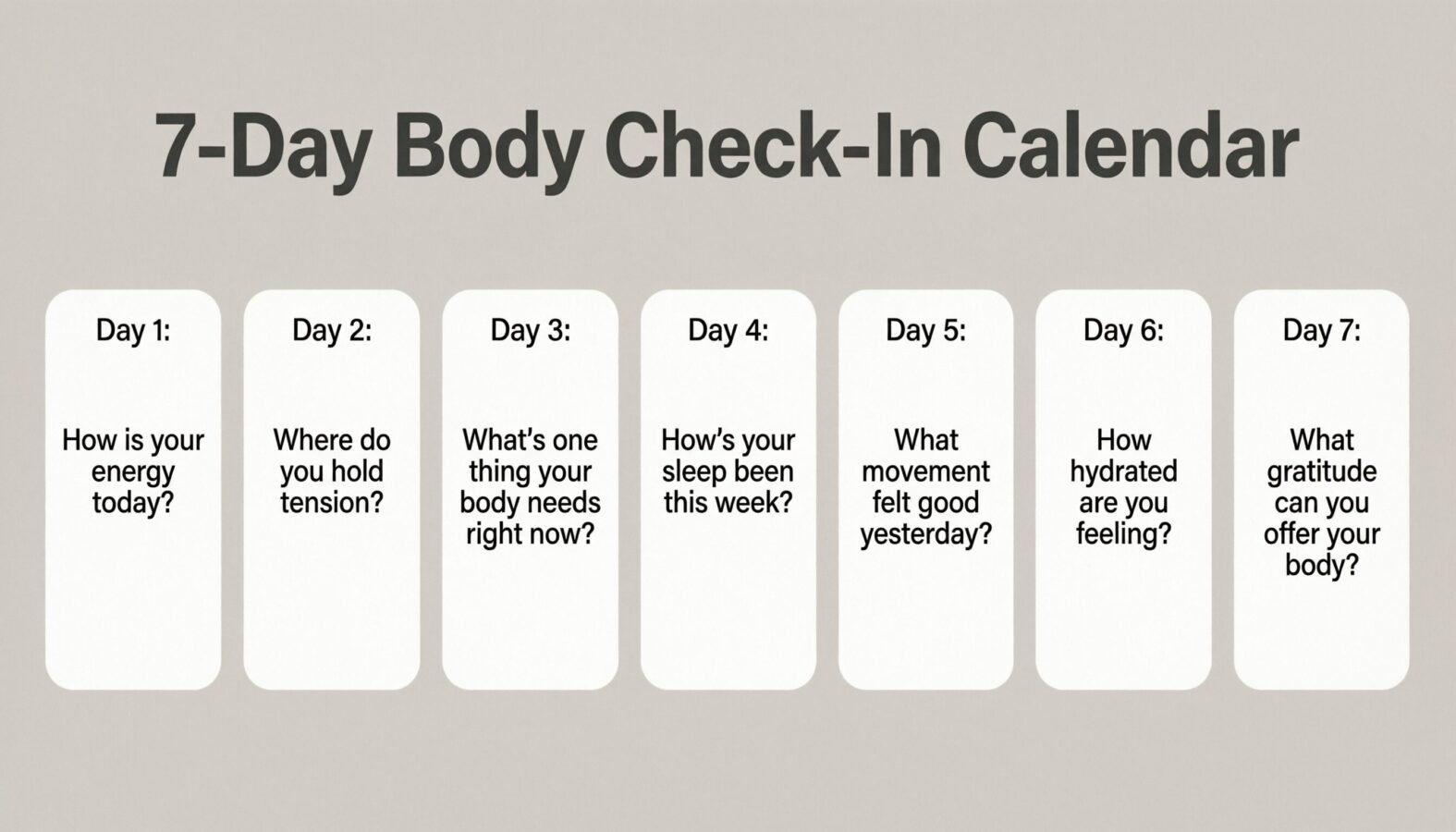
Here is one simple practice you can begin today. This 7-day body check-in has been used in coaching scenarios to help women rebuild connection with their bodies gradually and without pressure.
How to Start (Even If You Feel Disconnected)
If you feel disconnected from your body, start small. Set a timer for 2-3 minutes once per day. Find a quiet space where you will not be interrupted. Sit or lie down comfortably.
Remember: The goal is not to fix your body or achieve a certain feeling. The goal is simply to notice what is already there. There are no wrong answers.
Daily Prompts for Each of the 7 Days
- Day 1: What am I feeling in my body right now? Notice without judgment. Your answer might be: “My shoulders feel tight” or “My stomach feels calm.”
- Day 2: Where do I feel tension or ease? Scan from head to toe. Notice areas of holding and areas of softness.
- Day 3: What is my breathing like? Is it shallow or deep? Fast or slow? Held or flowing?
- Day 4: What emotions am I carrying in my body? Emotions live in the body. Notice if sadness sits in your chest or anxiety buzzes in your hands.
- Day 5: What does my body need right now? Rest? Movement? Water? Stretching? Quiet? Connection?
- Day 6: Where do I feel most alive or energized? Notice areas that feel vibrant, even if briefly.
- Day 7: What surprised me this week? Reflect on patterns, changes, or discoveries from your check-ins.
What to Do With What You Notice
After your body check-in, you do not need to fix anything. Simply acknowledge what you noticed. You might:
- Write it in a journal.
- Share it with a trusted person.
- Adjust your day (take a break, drink water, stretch).
- Simply hold the information with kindness.
A body that is not listened to during the day may struggle to feel safe during intimate moments. This practice matters because awareness comes before confidence. Before you can express what you need, you have to notice what is true.
How to Do a Body Check-In for Anxiety
When anxiety arises, a targeted body check-in can help you regulate your nervous system and ground yourself in the present moment.
Explore the somatic grounding tool for anxiety support →Recognizing Anxiety in Your Body
Anxiety shows up physically before you may recognize it mentally. Watch for:
- Racing heart or palpitations.
- Shallow, rapid breathing.
- Tightness in chest or throat.
- Clenched jaw or fists.
- Restlessness or inability to sit still.
- Stomach discomfort or nausea.
- Tingling in hands or feet.
Recognizing these signals early gives you the opportunity to respond with somatic healing techniques rather than spiraling into panic.
A 3-Minute Grounding Check-In
When anxiety strikes, try this quick practice:
- Minute 1: Notice. Pause and name three physical sensations you are experiencing. “My heart is racing. My shoulders are tight. My breathing is shallow.”
- Minute 2: Breathe. Place one hand on your belly. Breathe in for 4 counts, hold for 4, exhale for 6. Feel your hand rise and fall.
- Minute 3: Ground. Name 5 things you can see, 4 things you can touch, 3 things you can hear, 2 things you can smell, 1 thing you can taste.
This body check-in for anxiety helps regulate your nervous system and reminds you that sensations are temporary. Understanding your body’s stress responses builds self-trust and reduces fear of the sensations themselves.
Why Shame-Free Body Knowledge Supports Intimacy
Intimacy education is not only about physical knowledge. It is also about emotional safety, communication, self-respect, and pace. When you understand your body without shame, intimacy becomes a space for connection rather than performance.
Discover how boundaries support confidence and intimacy →From Self-Knowledge to Honest Communication
Many women struggle silently because they believe they should already know what they want. But female body education is not instant. It is gradual. It includes learning, noticing, reflecting, and communicating.
Self-knowledge helps you say things like:
- “I need more time.”
- “This creates pressure for me.”
- “I want to learn what feels good.”
- “Can we slow down?”
- “I am not sure yet.”
Those sentences are not selfish. They are honest. Intimate communication becomes possible when you know what you are feeling and have the language to express it.
Setting Boundaries Through Body Awareness
Body awareness is the foundation of intimate boundaries. When you can notice discomfort, pressure, or misalignment in your body, you can set boundaries before resentment or disconnection builds.
Learn why saying no creates guilt and how to reset boundaries →Boundaries might sound like:
- “I am not ready for that.”
- “I need to check in with myself first.”
- “That does not feel comfortable for me.”
- “Can we try something different?”
A woman’s body does not need to be forced into confidence. It needs safety, patience, and respect. Emotional safety creates the conditions where body awareness can flourish and intimacy can deepen.
Special Considerations: Postpartum, Menopause, and Trauma
Female body education looks different at different life stages and for different experiences. Understanding female body changes through various transitions requires trauma-informed care and patience.
Body Education After Pregnancy
Postpartum bodies have undergone profound physical and hormonal changes. Pelvic floor awareness becomes especially important during this time. You may experience:
- Changes in sensation or sensitivity.
- Pelvic floor weakness or tension.
- Shifts in body image and identity.
- New relationship with comfort and discomfort.
Female body education after pregnancy honors that your body has done something extraordinary and needs time, gentleness, and specific knowledge to heal.
Navigating Menopause and Body Changes
Menopause brings another wave of female body changes. Hot flashes, sleep disruption, mood shifts, and changes in intimacy are common. Body awareness during this time helps you:
- Identify what supports your comfort.
- Communicate needs to partners and healthcare providers.
- Adjust expectations with compassion.
- Honor your body’s wisdom through transition.
This is not decline; it is evolution. Body neutrality can be especially helpful during menopause, focusing on function and care rather than appearance or performance.
Trauma-Informed Body Awareness
For women with trauma histories, body awareness practices must be approached with extra care. Trauma-informed care recognizes that:
- The body may hold traumatic memories.
- Certain sensations may trigger distress.
- Reconnection must happen at your pace.
- Professional support may be essential.
Somatic healing with a trauma-informed therapist can help you rebuild safety in your body gradually. You are not broken. Your responses made sense given what you experienced. Healing is possible with the right support.
When to Seek Professional Support
While female body education and self-practice are powerful, some situations benefit from professional guidance. Knowing when to reach out is itself an act of self-trust.
Signs That Professional Support May Help
Consider seeking support if you experience:
- Persistent pain during intimacy.
- Inability to feel pleasure or connection.
- Trauma responses during physical closeness.
- Severe anxiety around body or intimacy.
- Pelvic floor dysfunction.
- Ongoing intimacy disconnect despite self-work.
These are not failures. They are signals that specialized support could accelerate your healing.
Types of Support Available
Several professionals can support your journey:
- Pelvic floor physical therapists specialize in pelvic health and pelvic floor awareness.
- Somatic therapists use somatic healing approaches to release trauma from the body.
- Sex therapists address intimacy concerns with specialized training.
- Trauma therapists provide trauma-informed care for deep healing.
- Gynecologists trained in sexual health can address medical concerns.
Organizations like ACOG and the American Psychological Association can help you find qualified providers in your area.
Common Myths About Female Body Education
Let us address some common misconceptions that may be holding you back from your body awareness journey.
Myth 1: “I Should Already Know My Body”
Myth: If you are an adult, you should naturally understand your body.
Truth: Female body education is not automatic. Many women were never taught to listen to their bodies, only to manage them. Not knowing is not failure; it is the result of incomplete education. You can learn at any age.
Myth 2: “Body Education Is Only About Sex”
Myth: Learning about your body is primarily sexual.
Truth: Body awareness encompasses your entire relationship with yourself: how you move, rest, communicate, set boundaries, manage stress, and experience pleasure in all forms. While intimacy is one aspect, female body education supports your whole life.
Myth 3: “I Have to Love My Body to Understand It”
Myth: You must achieve body love before you can practice body awareness.
Truth: Body neutrality offers a gentler path. You can notice, name, and care for your body without constant admiration. Understanding comes from curiosity, not perfection. Respect is enough to begin.
Key Takeaways
- Female body education should reduce shame, not increase pressure.
- Many women were taught risk and silence before they were taught clear body knowledge.
- Clear body language supports confidence, medical care, and communication.
- Body awareness begins with noticing, not fixing.
- Shame-free education helps women rebuild self-trust at their own pace.
- A daily body check-in is a simple starting point for deeper awareness.
- Intimacy education works best when it includes emotional safety, boundaries, and self-respect.
- Body neutrality offers a gentler alternative to body positivity for those healing from shame.
- Somatic healing and nervous system regulation support reconnection with the body.
- Professional support is available and valuable when needed.
Frequently Asked Questions About Female Body Education
How do I stop feeling ashamed of my body?
Start with gentle noticing, not fixing. Practice a daily body check-in to observe sensations without judgment. Replace vague language with clear body names. Remember: shame grows in silence, but understanding grows with compassionate attention. This is a gradual process, not instant perfection.
What is shame-free sex education?
Shame-free education goes beyond risk and danger to include body literacy, consent, pleasure, boundaries, and self-trust. It uses clear anatomical language, validates diverse experiences, and teaches that bodies are worthy of understanding, not just protection. It is education that builds confidence, not fear.
How do I do a body check-in?
Pause once daily. Ask: “What am I feeling in my body right now?” Notice physical sensations (tightness, warmth, heaviness), emotions, and mental states. Do not judge or fix, just observe. Write it down if helpful. Over 7 days, patterns emerge that build self-awareness and trust.
What are the signs of body shame?
Signs include: avoiding looking at or touching your body, using vague language about body parts, feeling your body is a problem to fix, struggling to name discomfort or needs, comparing yourself constantly, feeling disconnected during intimacy, and believing you should already “know” your body without learning.
How does body shame affect intimacy?
Body shame creates disconnection, making it hard to communicate needs, set boundaries, or feel present. It can lead to spectatoring (watching yourself instead of experiencing), difficulty expressing pleasure or discomfort, and avoiding intimacy altogether. Shame-free body knowledge rebuilds the self-trust needed for authentic connection.
What is body neutrality?
Body neutrality is the practice of viewing your body as worthy of care and respect without requiring constant love or admiration. It focuses on what your body does and feels rather than how it looks. It is a gentler, more accessible alternative to body positivity for those healing from shame.
How does female body education differ from traditional sex education?
Traditional sex education focuses on risk, pregnancy, and disease prevention. Female body education includes those topics but adds body literacy, pleasure, boundaries, emotional safety, self-trust, and clear language. It is holistic, shame-free, and designed to build confidence, not just prevent problems.
Why do I feel disconnected from my body?
Disconnection often stems from risk-based education, cultural shame messages, trauma, or learning to prioritize others’ needs over your own signals. When bodies are treated as problems or objects rather than homes, disconnection is a protective response. Reconnection is possible through gentle, shame-free practice.
Can body education help with anxiety?
Yes. Body check-ins help you recognize anxiety’s physical signals early (tightness, racing heart, shallow breath). Somatic grounding techniques regulate the nervous system. Understanding your body’s stress responses builds self-trust and reduces fear of sensations, making anxiety more manageable.
Is body education only for women?
While this article focuses on female body education due to unique cultural shame patterns women face, body education benefits all genders. Everyone deserves clear, shame-free knowledge about their body, boundaries, and needs. The principles of body neutrality and somatic awareness are universally applicable.
A Gentle Next Step
Female body education is not a destination you reach when you finally “love” every part of yourself. It is a daily practice of noticing, naming, and honoring what is true for you, without judgment, without pressure, and without shame. You are not behind. You are learning.
Remember: clear language builds confidence, body check-ins create awareness, and self-trust grows gradually through gentle attention. Whether you are healing from risk-based education, navigating postpartum changes, or simply meeting your body honestly for the first time, this work is yours to claim at your own pace.
Resources to Continue Your Journey
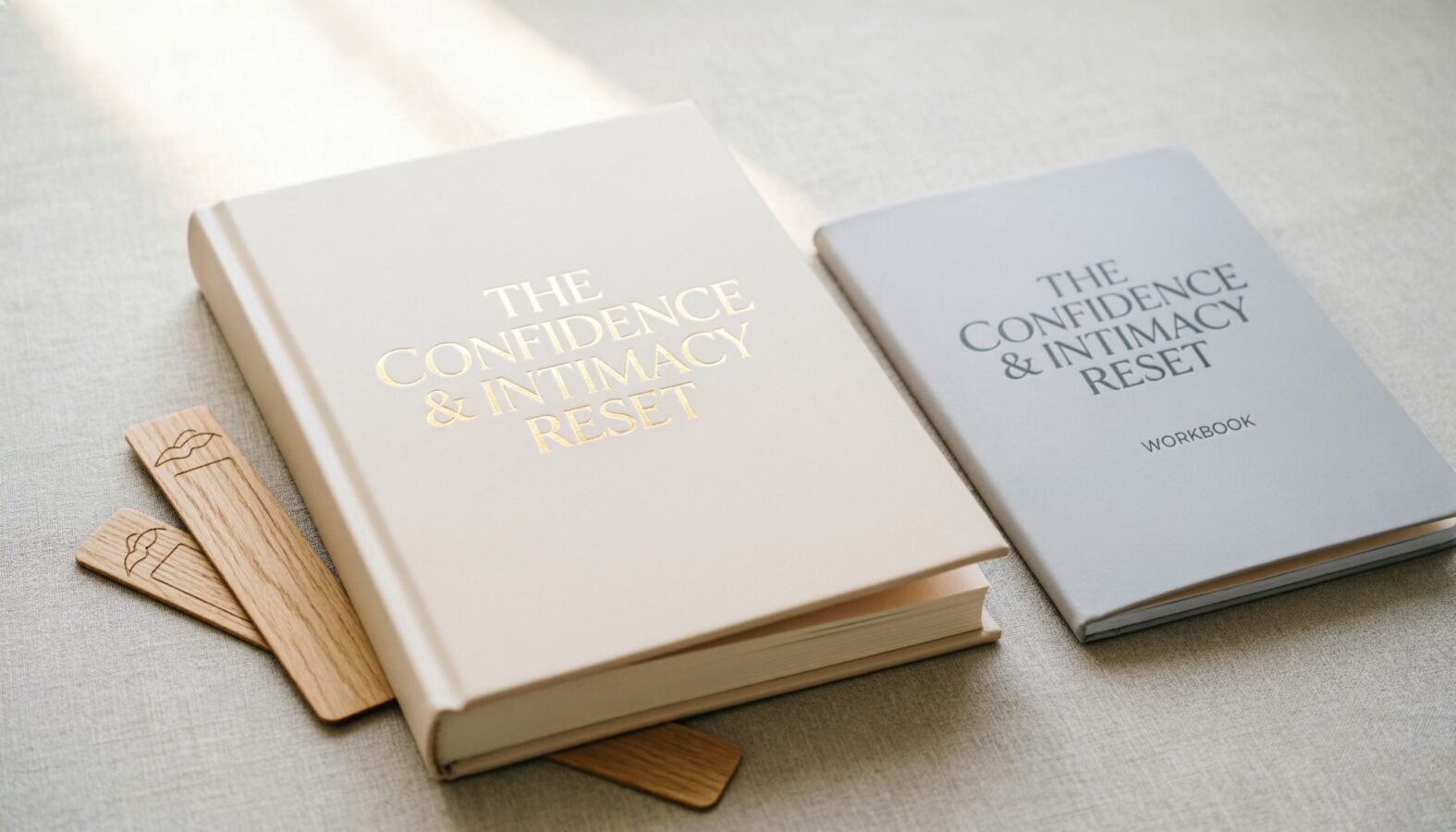
If you are ready for deeper support, with reflection prompts, communication scripts, and guided workbook exercises, explore these resources:
- Main Book: The Confidence & Intimacy Reset For Women
- Workbook (A4 & US Letter): Guided Workbook Exercises
- Complete Package: Main Book & Workbook Bundle
What’s Inside The Confidence & Intimacy Reset
This intimacy reset guide offers more than information; it provides a complete pathway for rebuilding body confidence and self-trust. Inside, you will find:
- Step-by-step body awareness practices.
- Scripts for intimate communication.
- Reflection prompts to uncover your unique needs.
- Guided workbook exercises that transform knowledge into embodied wisdom.
- Tools for setting boundaries with kindness.
- Strategies for healing inherited body shame.
Your body has been waiting for this kindness. The journey from silence to self-trust is not always easy, but it is always worth it.