

Overcoming Shame: How to Rewrite Your Inner Story and Reclaim Your True Self

Healing shame begins when you realize it has been acting as the invisible author of your life.
If you feel guilty for resting, say yes before checking with yourself, or hide your desires to keep the peace, you are not broken—you are carrying a learned story. The good news: shame is not your identity. In this guide you will learn how shame writes the inner story, why the fawn response keeps it in charge, and five gentle steps to reclaim your inner power.
Educational only—not medical or therapeutic advice.
1. What Does It Mean When Shame Writes Your Inner Story?
Read that slowly. It does not say shame is your story. It says shame has been guiding choices—quietly, early, and usually without your consent. A woman may appear strong outside while feeling small inside. She may care for everyone else, be praised for her patience, and still drift a little farther from herself each month.
This pattern can touch everything: body confidence, communication, desire, emotional intimacy. And because it is so quiet, most women never question the author. They question themselves. That is exactly why healing shame starts with noticing the pen, not fighting the person holding it.
The Quiet Sentences Shame Writes
Shame rarely shouts. It writes small, reasonable-sounding sentences like these:
- “Do not ask for too much.”
- “Be easy.”
- “Stay quiet.”
- “Do not disappoint anyone.”
- “Your desire is dangerous.”
- “Your needs are a burden.”
- “Your body must be approved before it can be trusted.”
Over time, these sentences can feel like truth. But many of them are learned stories, not personal identity.
Learned Story vs. True Identity
Family rules, body comments, silence, comparison—these are places stories come from, not places identity comes from. So the work of healing shame is not self-improvement in the punishing sense. It is authorship: noticing which sentences you inherited, and deciding which ones deserve a vote in your life.
2. Guilt vs. Shame: The Difference That Changes Everything
Before going deeper, we need one clear distinction, because guilt and shame are not the same feeling. Guilt says “I did something hurtful.” Shame says “I am bad.” Guilt focuses on behavior; shame attacks identity. Researcher Brené Brown, whose work on shame and vulnerability is widely cited in psychology, describes shame as the intensely painful belief that we are flawed and therefore unworthy of love and belonging—essentially, the fear of disconnection.
| Guilt says | Shame says |
|---|---|
| “I made a mistake.” | “I am a mistake.” |
| “I hurt someone.” | “I am hurtful.” |
| “I want to repair this.” | “I want to hide or disappear.” |
| Focuses on behavior | Focuses on identity |
| Can motivate apology and change | Tends to isolate and silence |
Getting this difference right matters for healing shame, because it tells you which feelings are signals and which are liars.
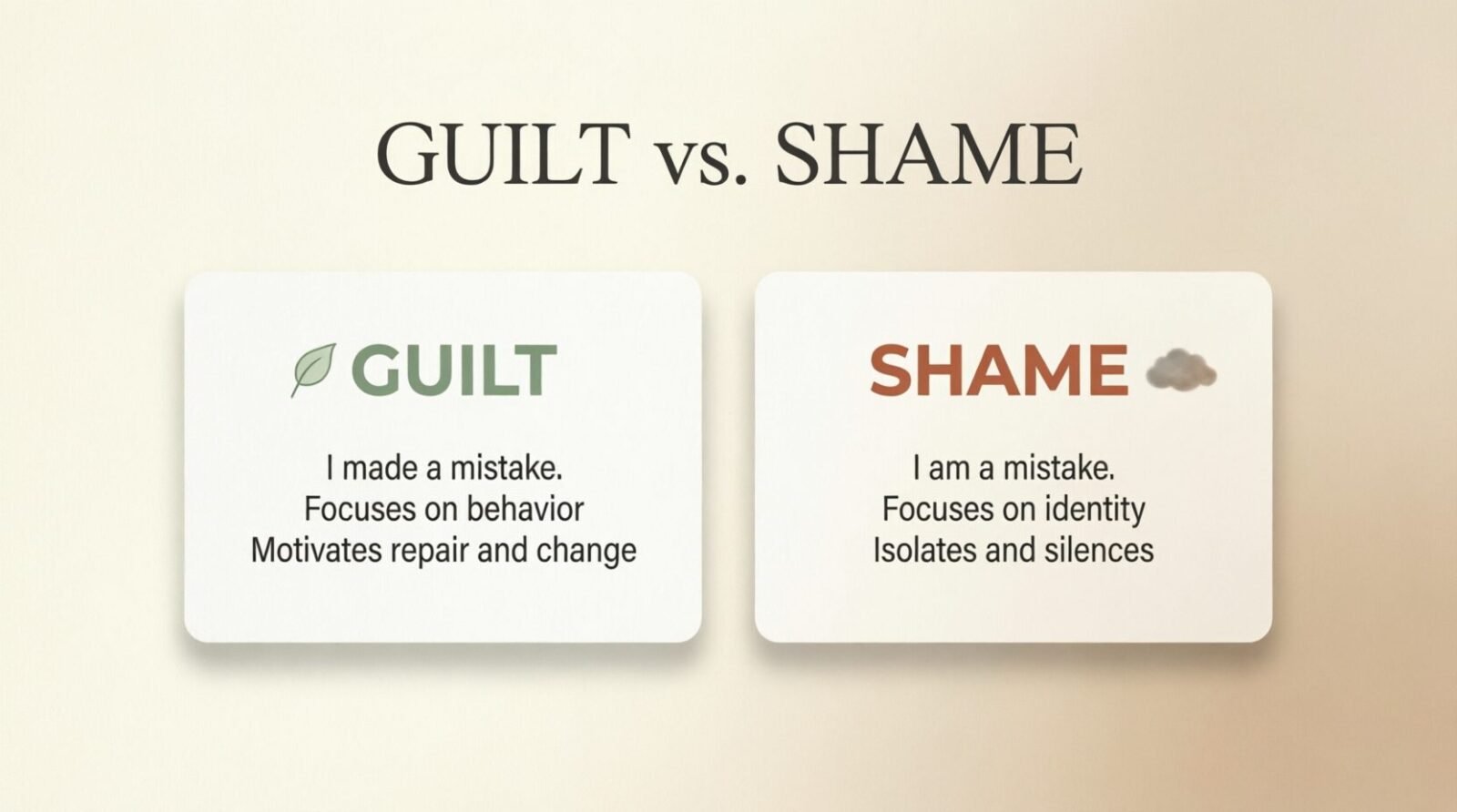
Guilt vs. Shame comparison card
Why Guilt Repairs and Shame Isolates
Healthy guilt is relational glue. It nudges you toward apology, repair, and a different choice next time. Shame does the opposite: it hides, because hiding feels safer than being seen as “bad.” That is why shame rarely produces change—it produces silence. And silence, repeated for years, becomes an inner story.
3. Understanding the Root of Healing Shame and the Fawn Response
Have you ever said yes while your whole body whispered no? That reflex is not a character flaw. It is a survival strategy with a name.
Trauma literature, and summaries in outlets such as Psychology Today and the American Psychological Association, describe fawn as the fourth stress pattern: fight, flight, freeze—and fawn. In relationships, it looks like agreeing before checking with yourself, over-explaining a simple no, or soothing someone else’s mood to stay safe.
What Is the Fawn Trauma Response?
The fawn response develops when appeasing was once the safest available option—perhaps with a volatile parent, a critical partner, or a culture that rewarded “easy” women. Common fawn habits include:
- Agreeing instantly, then resenting it later
- Over-explaining boundaries until they collapse
- Managing other people’s emotions as if they were your job
- Apologizing for existing, wanting, or resting
None of these habits mean you are weak. They mean your nervous system learned a strategy that once protected you—and that healing shame can gently retrain it.
How Your Nervous System Learns That “No” Feels Unsafe
Polyvagal theory, developed by Dr. Stephen Porges, helps explain the biology here: your nervous system constantly scans for cues of safety and danger. If saying no once led to anger, withdrawal, or abandonment, your body may file “no” under danger. So when you try to set a boundary today, your chest tightens before your thought finishes. That is not drama; it is nervous system regulation working exactly as it learned. And it is why healing shame must include the body, not just the mind.
4. Simple Definitions: Personal Power, Values, and Self-Authorship
Before the steps, let’s keep the vocabulary simple. Three words will carry this whole guide—and most of healing shame.
Personal Power
Notice what is missing from that definition: winning, controlling, proving. Personal power is not force. It is presence with choice.
Values
Examples include honesty, safety, rest, dignity, mutual care, presence, emotional intimacy, self-respect, and joy. Values do not erase fear; they simply give fear a wise adult to sit beside.
Self-Authorship
Practically, you stop asking, “What will keep everyone comfortable?” and begin asking, “What is true, wise, safe, and respectful here?” That single question is a doorway to reclaiming inner authority, and our companion guide to reclaiming inner authority walks through it step by step. When self-authorship grows, healing shame stops being a battle and becomes a practice.
5. Why Shame Feels So Powerful: Where the Old Story Comes From
Shame often feels powerful because it arrives early and repeats often. It may come from family rules, cultural expectations, old relationships, body comments, religious fear, comparison, silence, or the repeated message that women should be low-maintenance.
The Messages Women Are Taught
Many women can trace the old story to sentences like these:
- Be helpful before you are honest.
- Be calm before you are real.
- Be pretty before you are comfortable.
- Be desired before you know your own desire.
- Be agreeable before you know your no.
These messages shape how a woman sees her body, her voice, and her needs—often for decades.
Why Empowerment Feels Wrong at First
Later, when she finally tries to choose herself, shame reacts quickly: “Are you becoming selfish? Are you asking too much? Will love decrease? Will someone be disappointed?”
Here is the reframe that changes things: empowerment feels wrong at first not because it is wrong, but because the old story is being challenged. The discomfort is evidence of growth, not proof of selfishness. Knowing that is a quiet turning point in healing shame.
6. 8 Practical Signs Shame May Be Leading Your Life
You may notice shame writing your inner story through small, repeatable patterns. Scan this table slowly; the goal is to notice, not to judge.
| Sign | What it may mean |
|---|---|
| You say yes before checking with yourself | Approval may be leading |
| You feel guilty for resting | Usefulness may feel tied to worth |
| You hide desire | Wanting may feel unsafe |
| You over-explain your no | Your limits may feel like they need permission |
| You perform confidence | Outer strength may not match inner safety |
| You feel responsible for everyone’s emotions | You may be carrying too much |
| You silence body signals | Your body may not feel included in your choices |
| You wait to be perfect before acting | Shame may be delaying self-trust |
If several rows felt like a mirror, that is not a verdict; it is a map. Many of these patterns connect directly to why saying no creates guilt, which we unpack in a companion guide. Recognizing the signs is already step one of healing shame.
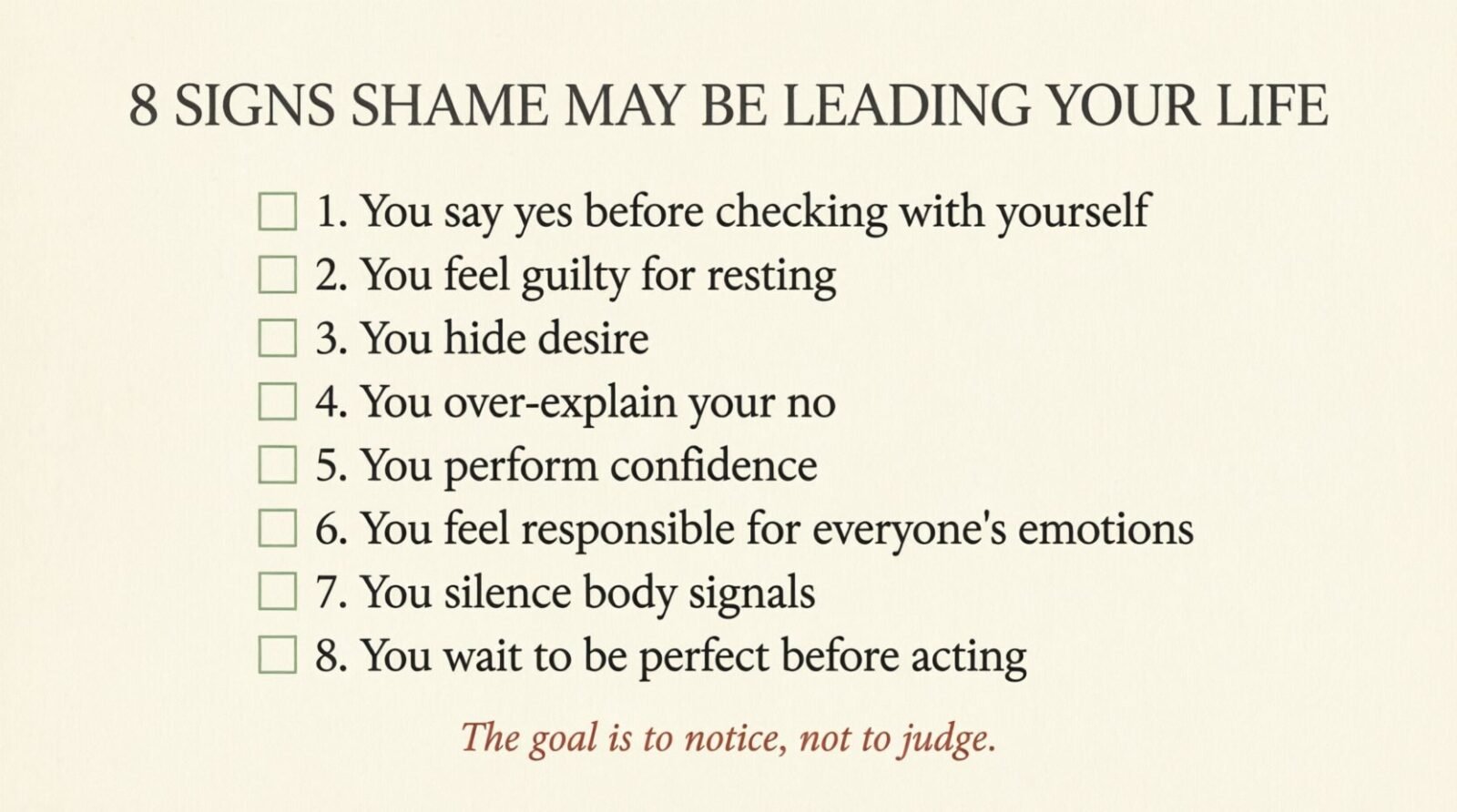
Printable-style checklist of the 8 signs
7. Emotional Examples of Shame Writing the Story
Concepts land better as people. These four composite sketches—drawn from patterns that appear again and again in women’s emotional education work, and in our own teaching of healing shame—show what shame-led living looks like from the inside.
The Woman Who Cannot Rest
She is exhausted, but resting makes her feel guilty. The dishes can wait, yet her mind will not let her sit down.
The Woman Who Says Yes Too Quickly
Someone asks for her time, touch, energy, or attention. Her mouth says yes before her body answers. Then she spends the evening quietly resenting a request she never actually agreed to inside.
The Woman Who Hides Desire
She wants affection, romance, privacy, slower intimacy, more emotional closeness—but she feels embarrassed wanting anything at all. Wanting, to her, reads as needy.
The Woman Who Performs Confidence
She looks confident outside—capable, composed, unbothered—while inside she is afraid of being too much, not enough, or difficult to love. The performance is exhausting, and loneliness grows right next to the applause.
None of these women are failures. They are carrying a story that can be rewritten—and when the rewrite finally reaches the voice, communication confidence is usually where the new story becomes audible. These sketches are also where healing shame stops being abstract.
8. How Shame Affects Emotional and Physical Intimacy
Perhaps the most hidden cost of shame lives in intimacy. Shame teaches that wanting is dangerous and that the body’s no must be swallowed, so closeness slowly turns into performance—which is exactly why healing shame and intimacy work belong together.
When Desire Goes Quiet
Desire rarely dies loudly; it goes quiet. A woman who learned that her wants are a burden may stop noticing them altogether. In sexual intimacy, this can look like going along while checking out, or feeling nothing until the moment passes. Understanding responsive desire helps here: for many women, desire is responsive—it wakes up in safety, context, and connection, not on command. Shame removes exactly those conditions.
Performing Confidence Instead of Feeling Safe
Research from the Gottman Institute consistently points to emotional safety as the foundation of lasting intimacy. Shame builds the opposite architecture: a partner may sense distance even when you look agreeable, because agreement is not the same as presence.
- Shame pattern: perform, please, hide, endure.
- Safety pattern: pause, tell the truth, ask, adjust together.
The encouraging part? The same gentle skills that support healing shame—pausing, naming signals, speaking one honest sentence—are the skills that rebuild intimate safety.

Couple seated calmly, listening with warm neutral tones
9. Force vs. Rooted Power: A Gentle Difference
A warning before the steps: shame sometimes pushes women to swap people-pleasing for hardness. That is not healing; it is the same fear wearing armor. Force tries to control, prove, fix, win, and hide weakness. Rooted power does something quieter.
| Force | Rooted power |
|---|---|
| Over-explains or slams the door | Says a clear, kind sentence once |
| Says yes while hiding anger | Pauses, then answers honestly |
| Needs to win | Needs to be true |
| Pushes | Chooses |
| Screams to be real | Rests in roots |
Power sounds like this:
- “I can choose.”
- “I can pause.”
- “I can speak clearly.”
- “I can ask for what I want.”
- “I can be kind without becoming invisible.”
- “I can love without giving myself up.”
You do not need to become hard to become powerful. You need to become rooted.
That sentence is the heart of spiritual confidence—and of healing shame that actually lasts.
10. Healing Shame in 5 Gentle Steps to Reclaim Your Inner Power
Here is the practice. No grand declarations, no dramatic confrontations—just five gentle moves that return authorship to you, one small promise at a time.
Step 1: Notice the Shame Sentence
For one week, simply listen. When guilt spikes, write down the exact sentence underneath it—”You are lazy,” “Do not disappoint,” “Wanting makes you needy.” Do not argue with it yet. Naming the sentence separates you from it, and separation is the first movement of healing shame.
Step 2: Pause Before Your Yes
Buy yourself ten minutes. When someone asks for your time, touch, energy, or attention, practice one script: “Let me check and get back to you,” or simply, “I need time.” A pause is a micro-boundary. It costs little, it teaches your nervous system that choice exists—and it is where healing shame gets practical.
Step 3: Name One Body Signal
Before answering, scan: throat tight? chest heavy? stomach sinking? Or soft, open, calm? Your body is not interrupting your decisions; it is attending the meeting. Naming one signal—out loud or on paper—builds the somatic awareness that people-pleasing bypasses.
Step 4: Write Fear Beside Value
On a blank page, draw two columns: Fear says / My value says. Write one honest pair (examples in the next section). Then ask: What is one small action that honors my value today? This step moves healing shame from insight to choice.
Step 5: Keep One Small Value-Based Promise
Choose something realistically small: pause before yes, ask for ten minutes alone, write one truth privately, choose rest, ask for a slower pace, stop apologizing for one basic need. Then do it. This is healing shame as identity work: repetition is the mechanism, small promises become evidence, evidence becomes identity, and identity eventually says, “I was not born only to survive.”
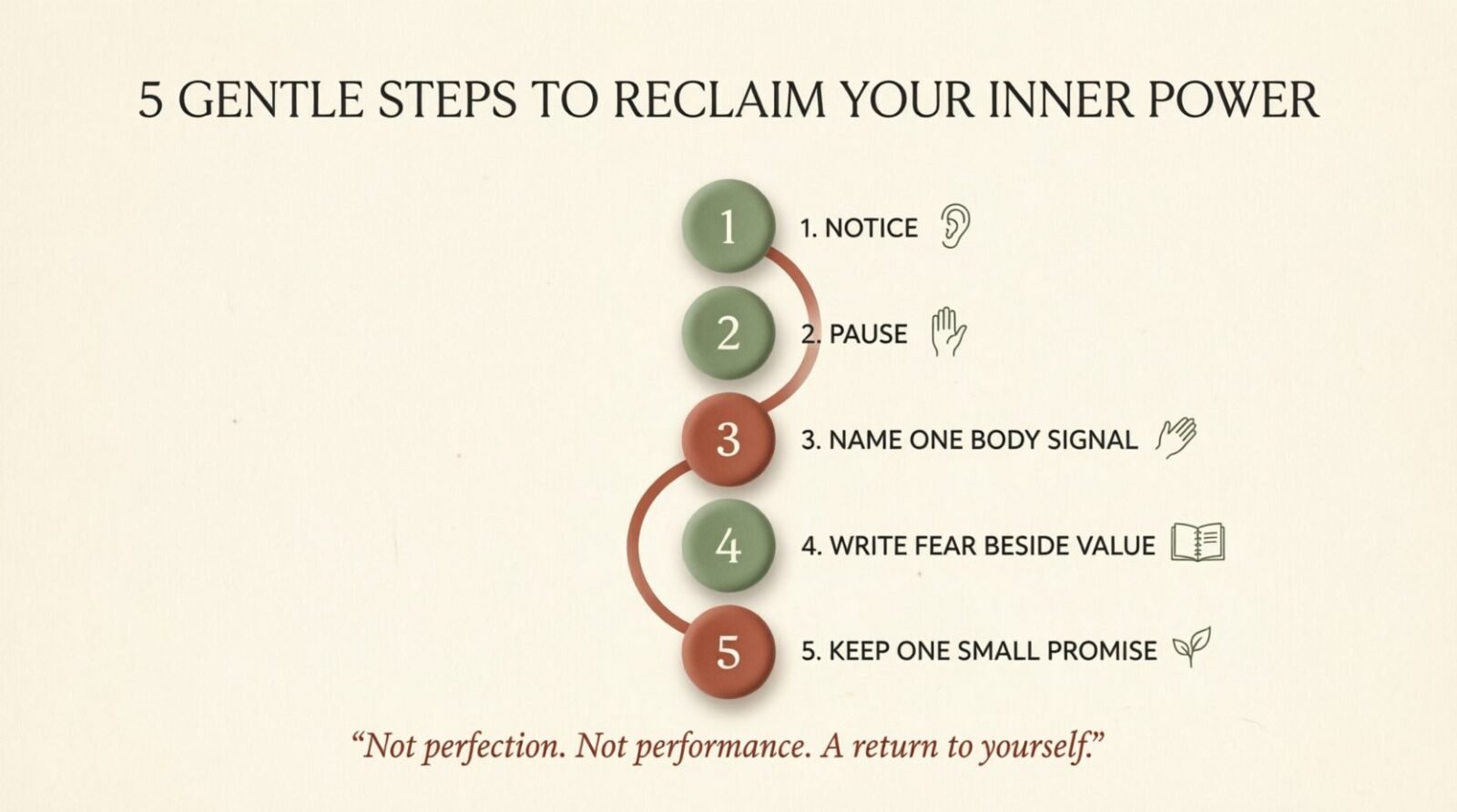
Vertical 5-step path: Notice → Pause → Name one body signal → Write fear beside value → Keep one small promise
11. The “Fear Beside Value” Journaling Method and Prompts
This two-column method is the core journaling tool of the whole guide, because it externalizes the author. Fear on paper is a sentence you can look at; fear in your head is a voice you obey.
| Fear says | My value says |
|---|---|
| “If I rest, I am lazy.” | “Rest protects my body and mind.” |
| “If I say no, I am selfish.” | “My limits deserve respect.” |
| “If I ask for more, I am needy.” | “My joy matters too.” |
| “If I speak honestly, I may lose love.” | “Truth belongs in safe intimacy.” |
Six more journaling prompts to heal shame and build self-trust:
- What sentence did I inherit about wanting things?
- When did I first learn my no needed a permission slip?
- What does my body feel like when I am truly safe?
- Which value did I abandon today, and what would repair look like?
- What would I do this week if approval were not on the menu?
- What is one honest sentence I have never said out loud?
Used weekly, these prompts turn healing shame into a conversation instead of a verdict.
12. Somatic Healing: Listening to Your Body’s Quiet “No”
Thoughts alone cannot finish this work, because shame lives below the neck too. Somatic healing simply means including the body in the conversation—using breath, touch, and attention to teach your nervous system that honesty is safe now.
Three Gentle Somatic Practices
- Hand-on-chest pause. Before a yes, rest one hand on your chest for three slow breaths. Ask: expansion or contraction?
- Scan-before-yes. Notice throat, shoulders, stomach. Tension is information, not disobedience.
- True-sentence exhale. On a long exhale, say one true sentence quietly—”I am tired,” “I want to stay home,” “I like this.” Let the body hear that you are on its side.
Practiced alongside journaling, these small rituals deepen healing shame by giving the body a vote in authorship.

Woman standing at a window, hand on chest, eyes closed
13. When Healing Shame Needs Professional Support
Let’s be honest about limits: education is not therapy. This guide—and the workbook that accompanies it—is educational and reflective, not medical, legal, or therapeutic advice.
Consider a licensed, trauma-informed therapist if:
- Your shame is tied to trauma, abuse, or violence
- You feel overwhelmed, numb, or depressed more days than not
- Shame loops stay rigid despite journaling, rest, and support
Modalities such as trauma-informed CBT, EMDR, and somatic experiencing are recognized paths for deeper work, and the American Psychological Association offers guidance on finding trauma-informed care. Seeking help is not a failure of the steps above; it is the steps above, practiced with backup. That honesty is part of healing shame too.
14. How The Confidence & Intimacy Reset for Women Supports a Fuller Reset
A blog article gives language. Deeper change usually needs repeated reflection, written practice, and small kept commitments—which is exactly why The Confidence & Intimacy Reset for Women eBook and workbook bundle exists. It turns healing shame into a repeated practice instead of a one-time read.
What’s Inside the eBook and Workbook Bundle
The bundle walks a fuller intimacy reset path through:
- Self-esteem and body confidence
- Emotional language and boundaries
- Communication and self-trust
- Desire and intimate safety
- Guided journaling prompts, identity statements, scripts, and exercises
Chapter 9 frames confidence as commitment → action → recognition → integration: small promises that become evidence for the body. If the five steps above resonated, the workbook is simply those steps, repeated until they belong to you.

Clean product mockup of the eBook and workbook bundle
15. Frequently Asked Questions About Healing Shame
16. Conclusion: Shame Is Not the Final Author
Shame may have written old chapters, but it was never the true author—and it does not have to write the next one. Remember the five moves:
- Notice the shame sentence.
- Pause before your yes.
- Name one body signal.
- Write fear beside value.
- Keep one small value-based promise.
If you want repeated practice rather than just language, continue with The Confidence & Intimacy Reset for Women eBook and workbook bundle, or keep reading: reclaiming inner authority and why saying no creates guilt.
Not perfection. Not performance. A return to yourself.