
Pleasure Education: 5 Gentle Steps to Close the Pleasure Gap
Why Pleasure Education Matters
Pleasure education is the foundation of healing intimacy disconnect, yet many women are taught to view it as a performance review. For many, intimacy quietly becomes something to manage, filled with pressure to respond quickly, appear satisfied, or protect a partner’s feelings. This leaves the body feeling tense, unsure, and disconnected, sparking the silent fear: “Is something wrong with me?”
The answer is no. The orgasm gap is a documented, systemic pattern shaped by culture and missing education, not a personal failure. Healing begins not with blame, but with honest, pressure-free awareness. Below are five gentle, research-backed ways to rebuild your body autonomy and begin a calmer reset through informed pleasure education.
What Is the Orgasm Gap? A Clear Definition
The orgasm gap is the documented disparity in orgasm frequency between men and women during heterosexual encounters. Research from institutions like the Kinsey Institute consistently shows that women experience orgasms less frequently than men in partnered sexual encounters. This isn’t a personal shortcoming—it’s a systemic pattern shaped by multiple factors.
The orgasm gap emerges from a complex web of influences:
- Unequal education: Many women never received accurate information about their own bodies, particularly regarding clitoral anatomy and what actually creates pleasure.
- Outdated intimacy scripts: Cultural narratives that prioritize penetration over other forms of stimulation.
- Silence around female physiology: The historical taboo against discussing women’s sexual needs openly.
- Performance pressure: The expectation that orgasm should happen quickly, easily, and on command.
- Lack of communication: Partners who don’t know how to talk about pleasure without shame or embarrassment.
- Penetration-focused ideas: The assumption that intercourse alone should be sufficient for female orgasm.
If you’re struggling with these patterns, you’re not alone. Many women find themselves silencing the inner critic that tells them they should be “further along” or “know better by now.” But the truth is, most of us were never properly taught how our bodies actually work.
Understanding the orgasm gap as a systemic issue rather than a personal failure is the first step toward healing. It creates space for curiosity instead of shame, for learning instead of self-judgment.
The Science Behind the Pleasure Gap: Female Physiology Basics
To truly close the orgasm gap, we need to understand the biological and psychological mechanisms that shape female sexual response. This isn’t about memorizing anatomy diagrams—it’s about understanding how your nervous system, hormones, and brain actually work together during intimacy.
When you understand female physiology, you stop fighting your body and start working with it.
The Dual Control Model of Desire
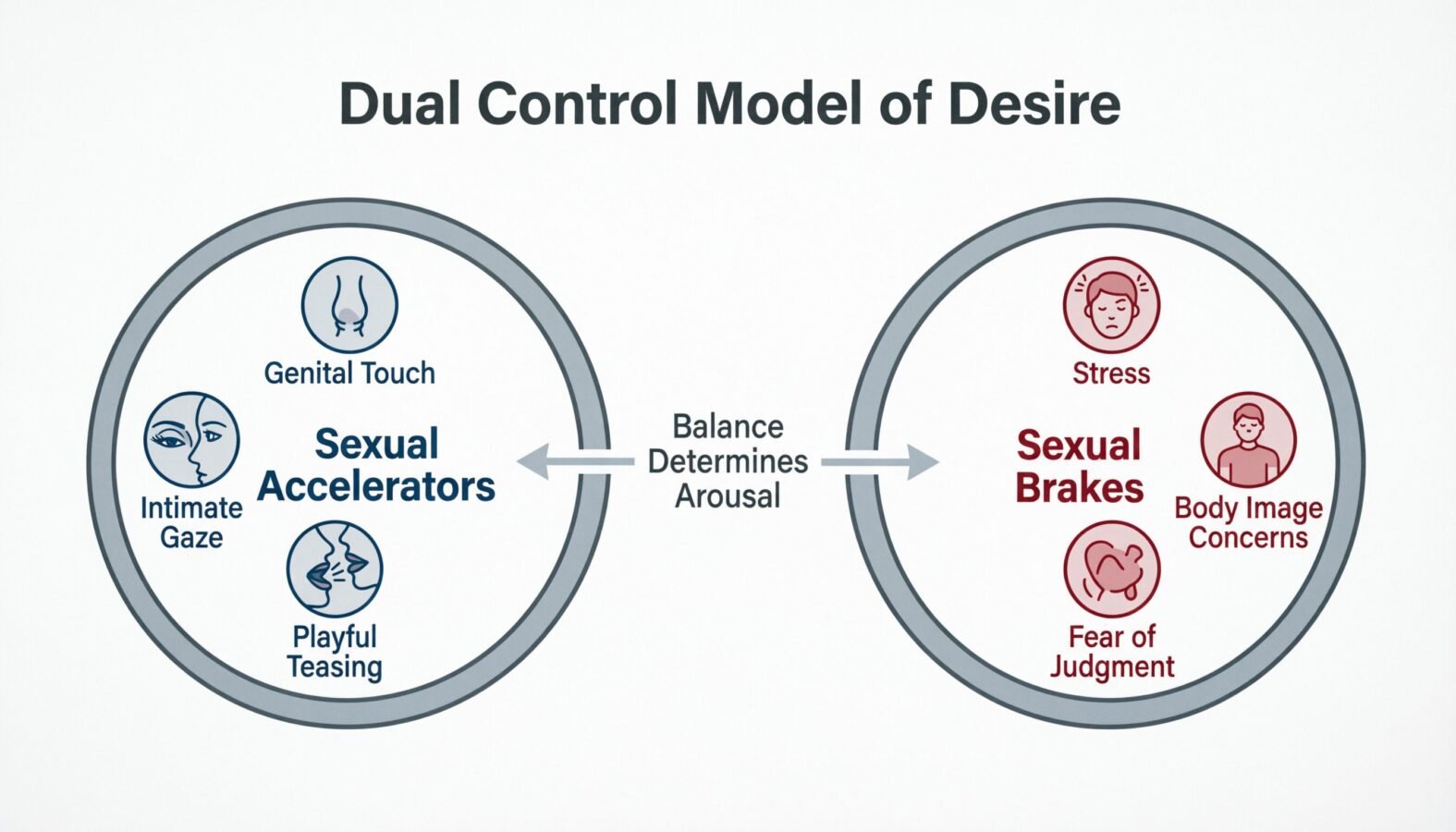
One of the most important frameworks in modern sexology is the Dual Control Model, developed by researchers like Emily Nagoski. This model explains that sexual response operates through two interconnected systems:
- The Accelerator (Sexual Excitation System): This is what turns you on. It responds to erotic stimuli, emotional connection, physical touch, fantasy, and anything else that creates sexual interest.
- The Brake (Sexual Inhibition System): This is what turns you off. It responds to stress, distraction, fear, performance anxiety, relationship tension, body shame, and anything that signals “this is not a safe time for sex.”
Here’s the critical insight: Effective pleasure education focuses on releasing the brakes, not just pressing the accelerator.
Many women spend years trying to “turn themselves on” through more stimulation, better techniques, or stronger fantasies—while completely ignoring the fact that their brake pedal is slammed to the floor. Stress about work, worry about body image, fear of disappointing a partner, or pressure to orgasm can all activate the inhibition system so strongly that no amount of acceleration will work.
The Dual Control Model explains why “just relax” advice is both frustrating and scientifically accurate. When your nervous system perceives threat (even subtle threat like performance pressure), it prioritizes survival over pleasure. This isn’t a malfunction—it’s your body working exactly as designed. Understanding this model helps you identify what’s pressing your brakes and create conditions where your accelerator can actually function.
Clitoral Anatomy and the Arousal Template
Let’s talk about something that should be basic education but often isn’t: clitoral anatomy.
The clitoris is not just a small external nub. It’s an extensive internal structure with roots that extend several centimeters into the body, wrapping around the vaginal canal. The visible glans is just the tip of a much larger organ designed specifically for pleasure.
This matters because many women have been taught—explicitly or implicitly—that vaginal penetration alone should lead to orgasm. But research consistently shows that the majority of women require direct or indirect clitoral stimulation to reach orgasm. This isn’t a problem to fix; it’s normal female physiology.
Your arousal template—your unique pattern of what creates desire, what builds excitement, and what leads to satisfaction—is shaped by:
- Your individual anatomy and nerve distribution
- Your emotional state and stress levels
- Your relationship context and sense of safety
- Your past experiences and learned associations
- Your cultural and personal beliefs about pleasure
There’s no universal “correct” template. Some women experience spontaneous desire (feeling horny out of nowhere). Others experience responsive desire (becoming aroused in response to stimulation). Both are normal. Some need emotional closeness first. Others can separate physical pleasure from emotional connection. Both are valid.
The problem arises when we’re taught there’s only one “right” way to experience pleasure. When your reality doesn’t match the script, you might think something is wrong with you. But you’re not broken—you just have a different template than the one you were taught to expect.
If you want to build body confidence and self-trust, start by learning what’s actually true about your body instead of what culture says should be true.
Step 1: Understand That the Orgasm Gap Is Not Personal Failure in Pleasure Education
The first step in your pleasure education journey is perhaps the most important: removing shame from the conversation.
Many women carry silent thoughts that sound like:
- “Something is wrong with me.”
- “My body takes too long.”
- “I should know what I want by now.”
- “I should be able to enjoy intimacy more easily.”
- “I shouldn’t need to explain this.”
These thoughts feel like truths, but they’re actually internalized messages from a culture that doesn’t prioritize comprehensive pleasure education.
Recognizing Old Intimacy Scripts
Old intimacy scripts are the unspoken rules we absorbed about how sex “should” work. They often include:
- Penetration should be the main event, with other activities as “foreplay” leading up to it.
- Orgasm should happen naturally without much communication or specific guidance.
- Women should be desired but not too desiring; receptive but not demanding.
- Good partners should just know what feels good without being told.
- Taking too long is a problem, not a normal variation.
- If you’re not orgasming from penetration alone, there’s something wrong.
These scripts create a framework where anything outside the “normal” pattern feels like failure. When your body doesn’t follow the script, you might blame yourself instead of questioning whether the script was accurate in the first place.
The reality is that these scripts were never based on comprehensive female physiology education. They were based on cultural assumptions, limited research, and often, male-centered perspectives on what sex should look like. When you experience a lack of communication about what actually feels good, or when penetration-focused ideas dominate your understanding of intimacy, it’s no surprise that the orgasm gap persists. This isn’t your fault.
The Shame-Free Reframe
Here’s how to shift from self-blame to curiosity:
Instead of asking: “What’s wrong with me?”
Ask: “What was I never properly taught?”
This simple reframe creates room for learning instead of self-judgment. It moves you from a deficit mindset (“I’m broken”) to an education mindset (“I’m learning”).
Other powerful reframes:
- Instead of: “I take too long to orgasm.” → Try: “My body has its own timeline, and that’s okay.”
- Instead of: “I should know what I want.” → Try: “I’m still discovering what feels good, and that’s a normal process.”
- Instead of: “I’m disappointing my partner.” → Try: “We’re learning together how to create pleasure for both of us.”
- Instead of: “I shouldn’t need to explain this.” → Try: “My partner can’t read my mind, and clear communication is an act of care.”
These aren’t just positive affirmations. They’re accurate reflections of reality. The orgasm gap exists because of missing education, not because of broken bodies. When you understand this, shame loses its power.
Step 2: Stop Turning Pleasure Into a Scorecard
Pleasure matters. Orgasm can matter. But orgasm should not become the only measure of intimacy success.
When orgasm becomes the “final score,” intimacy transforms from an experience into a test. You start monitoring yourself instead of feeling present. Questions like these creep in:
- “Did I respond correctly?”
- “Did I take too long?”
- “Did I disappoint my partner?”
- “Should I pretend?”
- “Was this successful or not?”
This pressure makes the body feel watched instead of safe. And when your nervous system feels watched, it activates those brakes we talked about earlier.
Performance Mindset vs. Presence Mindset
| Performance Mindset | Presence Mindset |
|---|---|
| “Did I orgasm?” | “Did I feel safe?” |
| “How long did it take?” | “Was I present in my body?” |
| “Did I satisfy my partner?” | “Did I feel respected?” |
| “Was this successful?” | “Did I honor my pace?” |
| Monitoring your responses | Noticing your experience |
| Goal-focused | Process-focused |
| Outcome = worth | Experience = valid |
| Pressure to perform | Permission to feel |
| Body as scorecard | Body as guide |
This table isn’t about eliminating goals or never wanting orgasm. It’s about expanding your definition of what makes intimacy meaningful. When you widen the lens, pleasure has room to breathe.
Redefining Intimacy Success
More informed pleasure education means asking better questions. Instead of only “Did I orgasm?”, consider:
- Did I feel safe? Safety is the foundation of pleasure. Without it, the nervous system stays in protection mode.
- Did I feel present? Were you able to stay connected to your body, or did you mentally check out?
- Did I feel respected? Were your boundaries honored? Did you feel like an equal participant?
- Did I honor my pace? Or did you rush to match someone else’s timeline?
- Did I communicate honestly? Even if it was uncomfortable?
- Did my body feel pressured or cared for? This is often the most telling question.
This doesn’t minimize the importance of orgasm. It protects pleasure from becoming pressure. Paradoxically, when you stop making orgasm the only measure of success, it often becomes easier to experience.
If you’re working on building intimacy confidence, remember: confidence isn’t about always knowing what to do. It’s about trusting yourself to navigate uncertainty with kindness.
Step 3: Notice How Pressure Appears in Daily Relationship Life
The orgasm gap isn’t only about what happens during intimacy. It shows up in daily relationship patterns, often in subtle ways that accumulate over time.
These patterns affect relationship wellness because silence slowly creates distance. What starts as self-protection can become a wall between you and your partner.
Identifying Silent Patterns and People-Pleasing
Pressure shows up in everyday moments:
- Saying “yes” too quickly because you don’t want tension or disappointment.
- Staying silent when something feels uncomfortable to avoid “making it a big deal.”
- Avoiding conversations about pleasure because they feel embarrassing or vulnerable.
- Feeling responsible for keeping your partner confident even when it costs you honesty.
- Comparing your body’s response to what you think is “normal” (often based on porn or cultural myths).
- Disconnecting from your body when stress is high instead of asking for support.
These patterns often start as protection. You might have learned early on that your needs were “too much” or that speaking up created conflict. So you adapted by becoming smaller, quieter, more accommodating.
But here’s what happens over time: pretending to feel pleasure to protect the moment, avoid hurting a partner, escape embarrassment, or because you don’t know what else to say—this creates distance, shame, and dishonesty. Not because you’re doing something wrong, but because authenticity is the foundation of real intimacy. You can’t truly connect with someone when you’re performing instead of being present.
How to Talk to Your Partner About the Orgasm Gap (Scripts)
Healing begins when honesty becomes safer than performance. But how do you actually have these conversations?
Here are some gentle, non-blaming scripts you can adapt:
For starting the conversation (outside the bedroom):
- “I’ve been learning about how pressure affects my body, and I’d love for us to explore intimacy without making orgasm the main goal. Can we talk about what that might look like?”
- “I want to feel closer to you, and I think being more honest about what I experience would help. Is it okay if I share some things I’ve been noticing?”
- “I’ve realized that when I feel pressure to perform, my body actually shuts down. I’m not saying this to blame you—I’m saying it because I want us to figure this out together.”
For in-the-moment communication:
- “I want to slow down and just focus on feeling close right now.”
- “Can we try this differently? I think I need more [specific thing] to feel comfortable.”
- “I’m not in my body right now. Can we pause and just cuddle, talk, or breathe?”
- “That doesn’t feel good for me. Can we try [alternative] instead?”
For addressing patterns:
- “I notice I sometimes say yes when I actually need more time. I’m working on being more honest about that.”
- “When we rush, I disconnect. I’d love for us to experiment with slowing down.”
- “I want you to know that when I’m quiet, it doesn’t always mean everything is fine. I’m learning how to tell you what I need.”
These aren’t rejection. They’re body awareness in language. They’re invitations to create intimacy that works for both of you. If you need more guidance on communicating sexual needs gently, remember: clear communication is an act of love, not criticism.
Step 4: Build Intimacy Confidence Through Self-Knowledge
Intimacy confidence doesn’t mean always feeling confident. It means having enough self-trust to keep learning, even when you feel uncertain.
A woman can build intimacy confidence by learning her body’s real patterns instead of fighting against them. This requires curiosity, patience, and a willingness to experiment without judgment. Start by exploring these questions:
- What helps me feel safe?
- What makes my body tense?
- What kind of pace feels better?
- What creates pressure?
- What helps me stay present?
- What do I need more time to understand?
These aren’t questions you answer once. They’re ongoing conversations with yourself as you grow and change.
Somatic Awareness and Pelvic Floor Relaxation Exercises
Somatic awareness is the practice of tuning into physical sensations without trying to change them. It’s different from “fixing” or “optimizing” your body. It’s about listening.
Here are practical exercises to build this skill:
The Body Scan (5-10 minutes):
- Lie down or sit comfortably in a private space.
- Close your eyes and take three deep breaths.
- Starting at your toes, slowly notice what you feel in each part of your body.
- Don’t try to relax anything—just observe. Is there tension? Warmth? Numbness? Tingling?
- When you reach your pelvic floor, simply notice: Is it tight? Relaxed? Can you feel it at all?
- Continue up through your torso, arms, neck, and face.
- End by noticing your overall sense of safety in your body.
Pelvic Floor Awareness:
Many women carry unconscious tension in their pelvic floor, especially if they’ve experienced pain, pressure, or trauma around intimacy.
- Sit or lie comfortably.
- Place one hand on your lower belly.
- Take a breath and imagine it flowing down into your pelvis.
- On the exhale, gently soften the muscles between your legs (as if you’re releasing a small amount of urine).
- Don’t force anything—just invite relaxation.
- Practice for 2-3 minutes, noticing any resistance or discomfort without judgment.
The Pressure Check-In:
Before and during intimate moments, pause and ask:
- Where am I holding tension right now?
- Is my jaw clenched?
- Are my shoulders tight?
- Is my breathing shallow?
- What would help me feel 10% more relaxed?
These exercises to build intimacy confidence aren’t about achieving perfect relaxation. They’re about developing the skill of noticing and responding to your body’s signals.
Journaling Prompts for Body Autonomy
Writing can help you process what you discover through somatic practice. Try these prompts:
After any intimate or emotionally close moment:
- What did I notice in my body before, during, and after?
- Where did I feel pressure (internal or external)?
- Where did I feel relaxed or safe?
- Did I communicate one honest thing, even if it was small?
- What would help me feel safer next time?
For deeper self-knowledge:
- What messages did I receive growing up about pleasure, desire, and my body?
- Which of those messages do I still carry, even if I don’t consciously believe them?
- What does my body need that I’ve been ignoring?
- What would it feel like to prioritize my comfort without guilt?
- What’s one small boundary I could practice setting this week?
For tracking patterns:
- When do I feel most present in my body?
- What conditions help me feel safe?
- What triggers my “brakes” (stress, shame, pressure, distraction)?
- What helps me release those brakes?
Self-knowledge helps women understand and express the true needs of their bodies. Bridging the gap takes learning, noticing, talking, and practicing. That path is gentle, but practical.
Step 5: Practice One Compassionate Habit: Redefine Success
Here is one simple habit to practice that can transform your relationship with pleasure.
After an intimate or emotionally close moment, pause and ask:
“Was I present, safe, and able to honor my pace?”
That’s it. Not “Did I orgasm?” Not “Was my partner satisfied?” Not “Did I do it right?” Just: Was I present? Was I safe? Did I honor my pace?
The “Pause and Check-In” Habit
This habit works because it:
- Shifts your focus from outcome to experience.
- Creates a feedback loop that helps you learn what actually works for you.
- Builds self-trust by honoring your own observations.
- Reduces shame by normalizing all experiences as valid data.
- Strengthens body awareness through regular reflection.
You can also journal with these expanded questions:
- What did I notice in my body?
- Where did I feel pressure?
- Where did I feel relaxed?
- Did I communicate one honest thing?
- What would help me feel safer next time?
Don’t overthink this. Even 2-3 minutes of reflection creates meaningful change over time.
Validating Your Needs Without Guilt
This practice isn’t about ignoring orgasm. It’s valid to want orgasm. It’s valid to grieve not having one. But reducing pleasure to only one outcome can place the body back under stress.
So the new goal becomes:
- Less performance. More presence.
- Less pretending. More honesty.
- Less pressure. More care.
This shift doesn’t happen overnight. It’s a practice. Some days you’ll remember to check in. Other days you’ll fall back into old patterns. Both are part of the process.
What matters is that you’re building a new relationship with your body—one based on curiosity instead of criticism, on care instead of performance. If you want to explore this methodology more deeply, the Confidence & Intimacy Reset methodology offers structured guidance for exactly this kind of transformation.
When to Seek Professional Support (Alternatives & Limitations)
While pleasure education and self-practice can be profoundly healing, there are times when professional support is appropriate and beneficial.
Consider seeking help if you experience:
- Persistent pain during intimacy that doesn’t resolve with relaxation and communication.
- Trauma responses (flashbacks, dissociation, panic) triggered by sexual situations.
- Relationship patterns that feel stuck despite honest communication.
- Medical concerns like hormonal imbalances, pelvic floor dysfunction, or medication side effects.
Professional resources may include:
- Pelvic floor physical therapy: Specialized therapists can help you identify and release chronic tension, strengthen weak muscles, and address pain.
- Certified sex therapy: AASECT-certified therapists provide evidence-based support for sexual concerns in a shame-free environment.
- Couples counseling: When intimacy issues are tangled with broader relationship dynamics.
- Medical evaluation: To rule out or treat physiological factors like thyroid issues, hormonal imbalances, or medication effects.
This article is educational and should not replace medical, legal, or therapeutic advice. If you’re experiencing significant distress or physical symptoms, please consult a qualified healthcare provider. For authoritative information on female sexual health, you can reference resources from the American College of Obstetricians and Gynecologists (ACOG).
Frequently Asked Questions About Female Pleasure Education
What is the female pleasure gap?
The female pleasure gap (or orgasm gap) is the documented disparity in orgasm frequency between men and women during heterosexual encounters. It is not a personal failure, but a systemic pattern shaped by unequal education, outdated intimacy scripts, and a lack of focus on clitoral anatomy. Research from the Kinsey Institute confirms this is a widespread phenomenon, not an individual problem.
Why do I feel pressured to orgasm?
Performance pressure often stems from “old intimacy scripts” that treat orgasm as the final score of a successful encounter. This mindset shifts focus from bodily presence to monitoring, making the body feel watched and triggering stress responses that inhibit natural arousal. The Dual Control Model explains this: when your nervous system perceives pressure as a threat, it activates the “brake” system, making orgasm harder to achieve.
How do I stop faking orgasms?
Start by redefining success. Shift your internal goal from “achieving orgasm” to “feeling present and safe.” Practice honest, low-stakes communication with your partner, using scripts like, “I want to slow down and just focus on feeling close right now,” removing the expectation of a specific outcome. Remember: pretending often starts as protection but creates distance over time. Healing begins when honesty becomes safer than performance.
How to talk to my partner about the orgasm gap?
Choose a neutral, non-intimate time to talk. Use “I” statements focused on your feelings, not their performance. For example: “I’ve been learning about how pressure affects my body, and I’d love for us to explore intimacy without making orgasm the main goal.” Frame it as a shared exploration, not a criticism. If you need more support with communicating sexual needs gently, practice with low-stakes conversations first.
What is the Dual Control Model of desire?
Developed by researchers like Emily Nagoski, this model explains that sexual response has two systems: an “accelerator” (things that turn you on) and a “brake” (stress, pressure, or distraction that turns you off). Effective pleasure education focuses on releasing the brakes, not just pressing the accelerator. Many women spend years trying harder to get aroused while ignoring the stress, shame, or pressure that’s keeping their inhibition system activated.
How can I start my pleasure education journey?
Begin with somatic awareness. Spend 5 minutes daily checking in with your body without judgment. Ask yourself: “Where do I feel tension?” and “What helps me feel safe?” Supplement this with reputable resources like the Confidence & Intimacy Reset workbook for structured guidance. Start small: one honest conversation, one moment of presence, one boundary honored. Pleasure education is a practice, not a destination.
Does the orgasm gap mean something is wrong with me?
No. The orgasm gap is a real, documented pattern, but it is absolutely not evidence of personal failure or a “broken” body. It is a reflection of cultural silence, missing education, and performance expectations that can be unlearned. Your body is not malfunctioning. It’s responding exactly as designed to the conditions you’ve been operating under. Change the conditions, and your experience can change too.
What are somatic awareness exercises for intimacy?
Somatic exercises involve tuning into physical sensations without trying to change them. Try a “body scan” before intimacy: notice your breath, relax your jaw and pelvic floor, and identify one thing that feels neutral or pleasant, anchoring yourself in the present moment. Practice the “pressure check-in”: pause and notice where you’re holding tension, then invite (don’t force) relaxation. These somatic awareness practices build the foundation for authentic pleasure.
Key Takeaways: Your Path to Intimacy Confidence
As you move forward in your pleasure education journey, hold these truths close:
- The orgasm gap is a real pattern, not proof of personal failure. You are not broken. Your body is not malfunctioning.
- The pleasure gap affects confidence, communication, desire, and relationship wellness. It’s not just about orgasm—it’s about how you experience intimacy and connection.
- Pleasure education should reduce shame, not create more pressure. If a practice or resource makes you feel worse about yourself, it’s not serving you.
- Pleasure should not become a scorecard for worth or intimacy. Your value isn’t determined by your sexual performance or orgasm frequency.
- Intimacy confidence grows through self-knowledge, communication, and practice. It’s not something you either have or don’t have—it’s something you build over time.
- One compassionate habit is to ask, “Was I present, safe, and able to honor my pace?” This simple question can redirect your entire relationship with pleasure.
These aren’t rules to follow perfectly. They’re guiding principles to return to when you feel lost, pressured, or uncertain.
Explore the Full Confidence and Intimacy Reset Bundle
This article gives you a gentle starting point. But deeper confidence often needs structure, reflection, and repeated practice.
The complete Confidence & Intimacy Reset For Women eBook and workbook bundle gives readers a fuller reset path with:
- Educational guidance on female physiology, the Dual Control Model, and the real causes of the orgasm gap.
- Practical examples of how to communicate with partners, set boundaries, and navigate difficult conversations.
- Worksheets for tracking patterns, identifying triggers, and celebrating progress.
- Scripts for in-the-moment communication and bigger-picture conversations.
- Reflection prompts to deepen self-knowledge and body awareness.
- Action steps to move from understanding to embodied change.
Available formats:
- Main Book: The Confidence & Intimacy Reset For Women (eBook)
- Workbook A4 Size: Workbook A4 Size (International format)
- Workbook US Letter Size: Workbook US Letter Size (US format)
- Main Book & Workbook Bundle: Complete Package for comprehensive support.
If you’re ready to move from gentle concepts to structured, repeated practice, these resources provide the exact tools you need to honor your pace and build lasting confidence.