

5 Gentle Ways to Build Deeper Personal Authority and Reclaim Your Voice
Personal authority does not always begin with a loud decision. Sometimes it begins with a quiet pause—a woman noticing she is about to say yes too quickly, feeling her body tighten, and remembering her values matter. She asks, “What do I actually want here?” Then she chooses one small, honest action. That is the beginning of deeper personal authority.
In this article, you will discover five gentle ways to build this inner authority, drawn from Chapter 9 of The Confidence & Intimacy Reset for Women. These practices help you choose from your values instead of shame, so your body, voice, needs, boundaries, and desires finally have a safe place inside your life.
What Is Personal Authority? A Gentle Definition
Personal authority is your inner capacity to make choices aligned with your values, even when fear or shame is present. Unlike traditional confidence, which often focuses on external performance and appearing fearless, personal authority is rooted in self-trust and self-loyalty. It is quieter, steadier, and grows through small, values-based choices rather than dramatic declarations or perfection.
Think of personal authority as inner authority. It is the steady knowing that your body, voice, needs, boundaries, and desires deserve a place inside your life. It is not about becoming the loudest person in the room or never feeling doubt. Instead, it is about developing spiritual confidence: the ability to choose from your values instead of from shame, even when your hands tremble or your voice shakes.
This form of authority does not require you to force yourself into strength or prove anything to anyone. It grows through evidence. These are small moments where you choose yourself, honor your limits, and trust that your needs matter. When you practice personal authority, you are not rejecting love or connection. You are making space for relationships that include all of you, not just the parts that are easy or convenient for others.
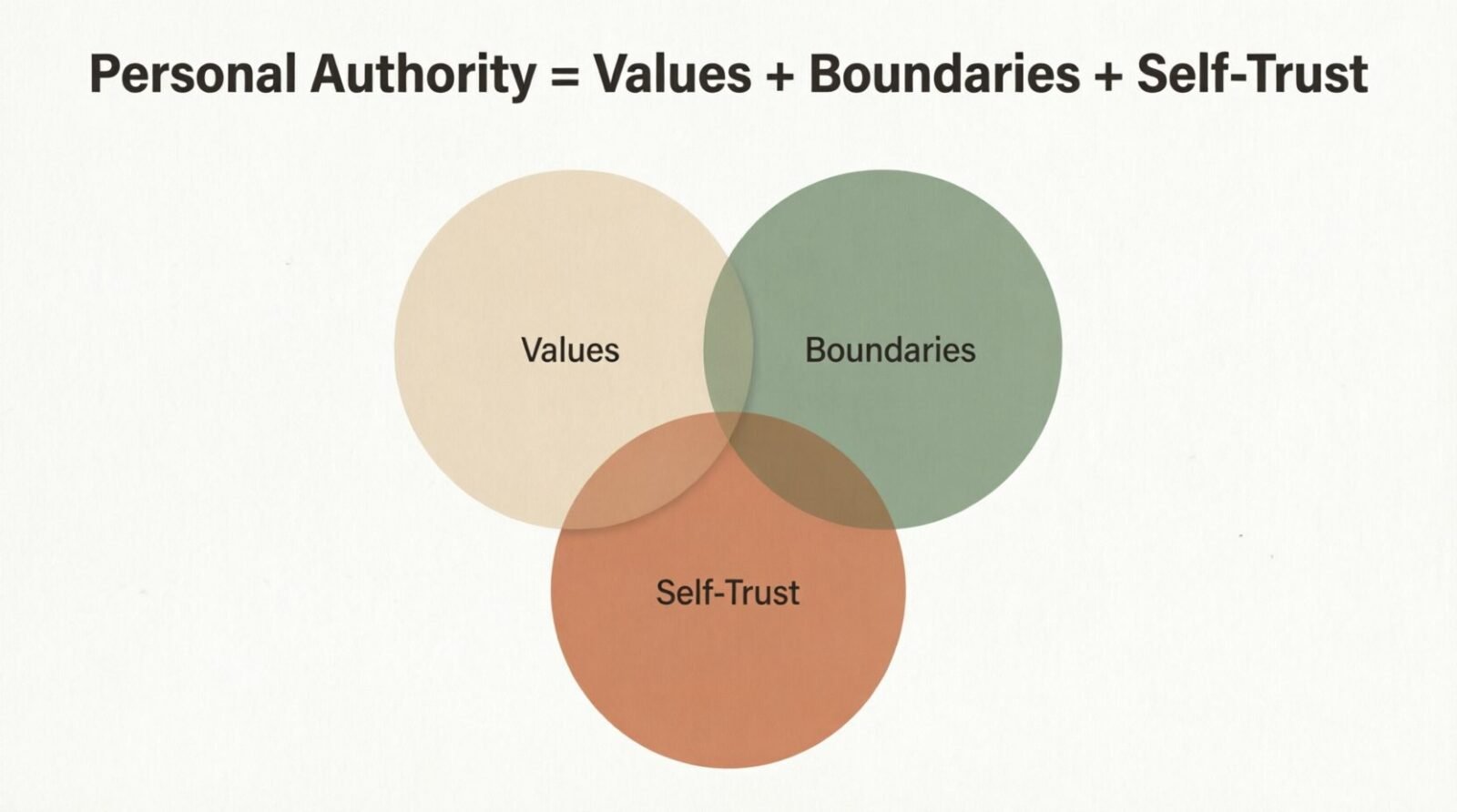
Simple visual showing “Personal Authority = Values + Boundaries + Self-Trust” with three interconnected circles in warm, gentle colors
Key Takeaways: The Essence of Personal Authority
Before we explore the five gentle ways to build deeper personal authority, here are the core principles that will guide your journey:
- Personal authority begins with small values-based choices, not dramatic transformations or perfect consistency.
- Shame often writes the inner story by telling women to stay quiet, easy, or useful—often at the cost of their own well-being.
- Spiritual confidence is not always loud; it can feel calm, steady, and self-trusting, like candlelight rather than lightning.
- Personal empowerment does not reject love; it makes love more honest by ensuring both people’s needs matter.
- A compassionate habit is to pause before yes and ask what your value says, then take one breath before responding.
These principles form the foundation for building lasting personal authority. They are not rules to follow perfectly, but gentle guides to help you return to yourself when you notice you have drifted away.
Why Personal Authority Matters for Women Today
If you are reading this, you likely know the exhaustion that comes from constantly measuring your desires against someone else’s comfort. You may have spent years asking for permission—to take up space, to have needs, to say no, to want something different. This pattern is not weakness. It is often a survival strategy learned early, shaped by messages that being “good” means being easy, quiet, and useful.
But here is what happens when you live without personal authority: your body keeps score. You feel chest tightness when you agree to something you do not want. Resentment builds after saying yes for the tenth time this week. Numbness creeps in when you have been “easy” for so long that you have forgotten what you actually want. This is not peace. It is disconnection from yourself.
Research on shame and vulnerability, including the foundational work of Brené Brown, shows that women often carry unique pressures around being likable, accommodating, and self-sacrificing. These expectations can make setting intimate boundaries feel dangerous, as if honoring your limits will cost you love or belonging.
Personal authority matters because it offers a different path. It is not about becoming aggressive or rejecting connection. It is about developing emotional regulation and self-advocacy skills that allow you to show up authentically in your relationships. When you build personal authority, you are engaging in people-pleasing recovery. This happens not through harsh self-criticism, but through gentle, consistent acts of self-loyalty.
This work is especially important for women because it challenges the deep conditioning that says your worth depends on how much you do for others. Personal authority reminds you: you are allowed to be included in your own life.
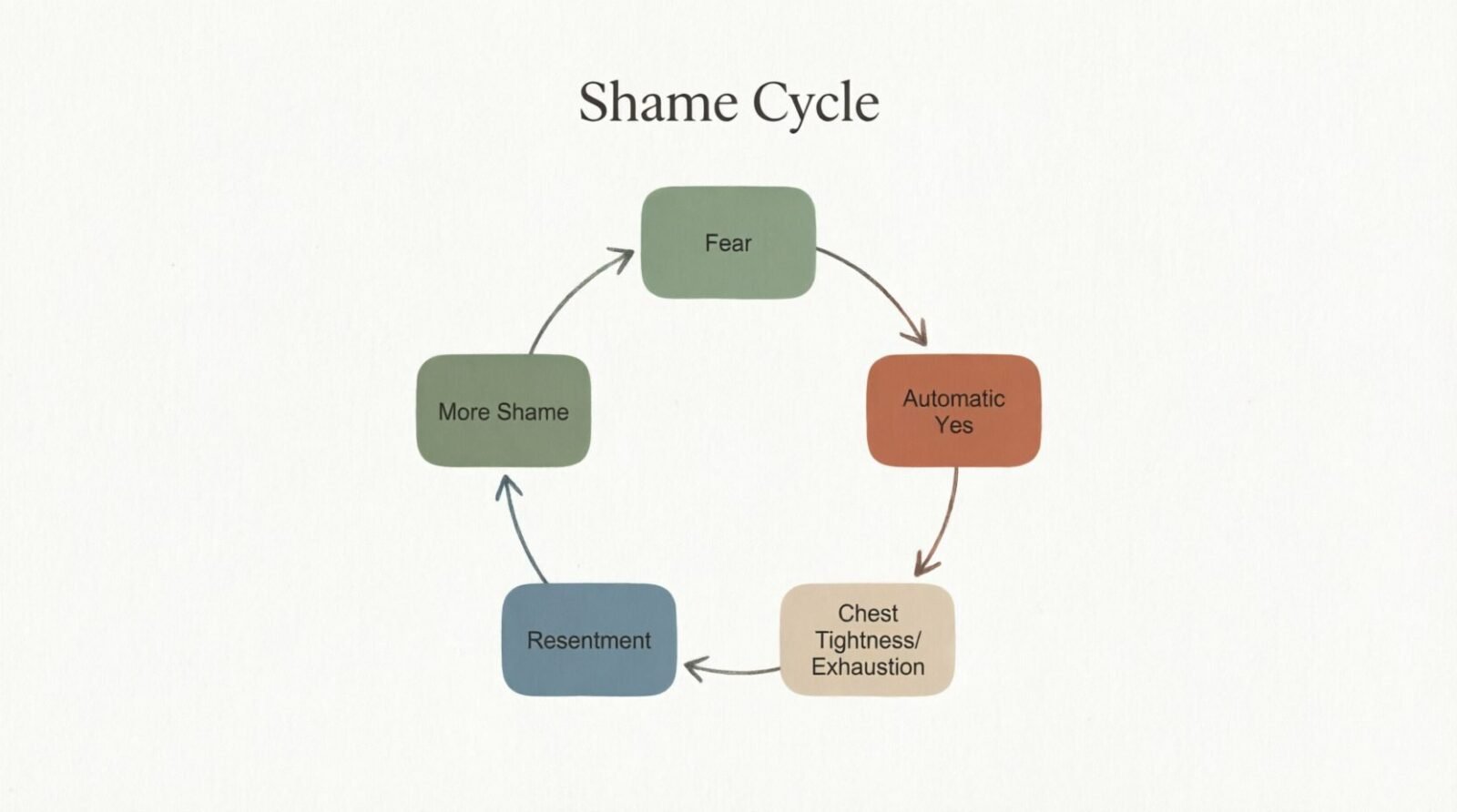
Way 1: Notice Where Shame Is Writing the Story
Building personal authority starts with awareness. You cannot choose differently if you do not notice when shame is driving the bus. This first way is about developing the skill of recognizing shame’s quiet rules in real-time, before they have already made the choice for you.
Shame operates through patterns. Once you know what to look for, you can start to catch it in action. Here are seven signs that shame may be writing your story:
- You say yes automatically without checking in with yourself first.
- Your body tightens (chest, stomach, throat) when you are agreeing to something.
- You feel resentful after saying yes, even though you agreed willingly.
- You over-explain your no, offering multiple reasons as if you need permission.
- You exhaust yourself trying to keep everyone else comfortable.
- You dismiss your own needs as “too much” or “selfish.”
- You feel responsible for other people’s emotions, especially their disappointment.
These signs are not failures. They are information. They are your body and your emotions trying to tell you something important: you are moving away from yourself.
When you notice these patterns, practice self-advocacy by pausing. You do not have to fix everything immediately. You do not have to dramatically change your behavior overnight. Simply noticing is itself an act of personal authority. It is you saying, “I am paying attention. I matter enough to notice what is happening inside me.”
This awareness creates space for values-based choices. Instead of automatically saying yes from fear, you can pause and ask: “What does my value say?” Maybe your value is kindness, and kindness includes being kind to yourself. Maybe your value is connection, and real connection requires honesty, not just accommodation. Maybe your value is integrity, and integrity means your yes and your no both mean something.
Learning to notice where shame is writing the story is foundational work for setting boundaries that actually stick. Without this awareness, boundaries become another rule to follow perfectly, another way to judge yourself. With this awareness, boundaries become expressions of your values, natural extensions of your personal authority.
Daily-Life Example: The Tight Chest and the Hidden Yes
You are at work, and a colleague asks if you can take on an extra project. Your chest tightens immediately, but you hear yourself saying, “Sure, no problem!” before you have even considered your current workload. That night, you are exhausted and resentful, scrolling through your to-do list wondering how you will fit everything in. The tightness in your chest was information. It was your body saying, “This is too much.” Next time, that tightness can be your signal to pause and ask the values question before answering.
Gentle Reset: The Values vs. Shame Question
When you notice shame’s patterns, ask: “Is this choice coming from shame or from my values?” Then take one breath. That is it. You do not need to have a perfect answer. You do not need to immediately change your behavior. Just asking the question creates a crack in shame’s automatic programming. It reminds you that you have a choice. And choice is where personal authority lives.
Way 2: Let Confidence Be Quiet
Many women believe confidence must look bold. They imagine a confident woman as someone who never trembles, never hesitates, never needs reassurance, and always knows exactly what to say. This image of confidence is loud, certain, and fearless. Unfortunately, it keeps many women waiting to begin.
But real confidence can be much quieter. Spiritual confidence does not always arrive like lightning. Sometimes it arrives like candlelight—small, soft, but still enough in the dark. It is where insight becomes choice, and choice slowly becomes identity.
This matters because many women wait until they feel fearless before they begin. They tell themselves, “I will set that boundary when I feel more confident,” or “I will speak up when I am sure of myself.” But deeper personal authority often begins before fear leaves. It begins in the trembling, in the uncertainty, in the small acts of self-trust that feel insignificant at the time.
Quiet confidence looks different from what we have been taught to expect. It is not about never feeling doubt. It is about acting from your values even when doubt is present. It is about trusting that you can handle discomfort, that you can survive disappointment, and that you are stronger than you think.
When you allow confidence to be quiet, you give yourself permission to practice building body confidence and self-trust in ways that feel accessible, not overwhelming. You stop waiting for permission or perfection. You start recognizing that small acts of self-honesty are themselves acts of courage.
This form of confidence grows through evidence, not affirmation. It is not about telling yourself “I am confident!” until you believe it. It is about noticing the times you chose yourself, honored your limits, or spoke your truth, and letting those moments accumulate into self-trust.
Daily-Life Example: The Power of “I Need Time to Decide”
You are about to say, “Whatever you want,” the automatic response that has kept you small for years. But this time, you pause. Your heart races. You feel the urge to fill the silence, to make it easy. Instead, you say, “I need a little time to decide.” That is it. No dramatic speech. No perfect boundary. Just those seven words. That is confidence. Not dramatic. Not perfect. But real. And it counts.
Gentle Reset: Six Small Acts of Quiet Confidence
Look for quiet confidence today through these small practices:
- Pausing before yes: Taking one breath before automatically agreeing.
- Asking for time: “I will think about it” is a complete sentence.
- Resting before burnout: Honoring your body’s signals before you crash.
- Saying one honest sentence: Sharing one true feeling, even if your voice shakes.
- Choosing body-kind clothing: Dressing for comfort, not just appearance.
- Not explaining your no six times: Offering one clear reason, then stopping.
Small confidence still counts. In fact, it counts more than you know, because it is sustainable. It is the kind of confidence that grows roots instead of burning out.
Way 3: Choose Power Instead of Force
Personal empowerment is not the same as forcing yourself to be strong. This distinction is crucial, because many women try to build personal authority through sheer willpower. They push through fear, override exhaustion, and demand perfection from themselves. This is force, not power. And force always comes from fear.
Force tries to control, prove, fix, win, or hide weakness. It may push, over-explain, say yes while hiding anger, or say no like a slammed door. Force is exhausting because it is fighting against yourself even as it tries to change your circumstances.
Power is different. Power comes from values and choice, not fear and compulsion. Power says:
- “I can choose.”
- “I can pause.”
- “I can speak clearly.”
- “I can ask for what I want.”
- “I can be kind without becoming invisible.”
- “I can love without giving myself up.”
Power has roots. It does not need to scream to be real. It does not need to prove itself or win every battle. Rooted power is steady, even when it is uncomfortable. It allows you to take one honest step without needing to know the entire path.
The difference between force and power shows up in how you feel afterward. Force leaves you depleted, resentful, or self-critical. Power leaves you tired maybe, but aligned. You might feel vulnerable, but you do not feel like you have betrayed yourself.
Choosing power over force is an act of emotional regulation. It is recognizing when you are operating from fear and giving yourself permission to slow down, check in with your values, and choose differently. This does not mean you will never use force again. It means you are developing the awareness to notice when you are forcing, and the compassion to try a different approach.
Daily-Life Example: From Proving to Choosing
Force says: “I must prove I am confident.” You rehearse what you will say ten times, trying to sound certain even though you are not.
Power says: “I can take one honest step.” You speak from where you actually are, trusting that honesty matters more than perfection.Force says: “I must make everyone understand.” You over-explain your boundary, offering justification after justification.
Power says: “I can speak clearly and let my truth stand.” You state your need once, clearly, and trust that it is enough.Force says: “I must win.” You turn every disagreement into a battle you cannot afford to lose.
Power says: “I do not have to lose myself.” You stay true to your values without needing to control the outcome.
Gentle Reset: The Rooted Power Check-In
Before acting, ask: “Am I trying to force myself, or am I choosing from rooted power?” Notice what each option feels like in your body. Force usually feels tight, urgent, and desperate. Rooted power usually feels steadier, even when it is uncomfortable. Let that feeling guide you toward choice instead of compulsion.
Way 4: Put Values Beside Fear
Fear does not disappear just because you decide to grow. This is one of the most important truths about building personal authority. You are not working toward a fear-free life. You are working toward a life where fear does not get to decide alone.
Fear may still say:
- “They will be disappointed.”
- “You are asking too much.”
- “You will ruin the moment.”
- “You should stay quiet.”
- “You should be easier.”
These fears are real. They are not wrong or irrational. They are based on real experiences, real conditioning, and real consequences you have witnessed or lived. The problem is not that fear exists. The problem is when fear becomes the only voice in the room.
Values do not erase fear. They place a wise adult beside fear so fear no longer has to make every decision by itself. This is cognitive reframing in action. It is not denying your fear, but expanding the conversation to include what matters to you.
When you put values beside fear, you are engaging in a different kind of decision-making. Instead of asking “What will keep me safe from discomfort?” you are asking “What aligns with who I want to be?” This shift does not make the choice easy. It makes it meaningful.
Daily-Life Example: Reframing Selfishness as Self-Respect
Fear says: “If I say no, I am selfish.”
Value says: “My limits deserve respect.”Fear says: “If I ask for more, I am needy.”
Value says: “Mutual care matters.”Fear says: “If I slow down, everything will be ruined.”
Value says: “Desire needs safety.”Notice what happens when you put values beside fear: the choice does not necessarily become easier, but it becomes clearer. You are no longer just avoiding pain. You are moving toward something that matters.
Gentle Reset: The Two-Column Exercise
When you are facing a difficult choice, try this:
- Write two columns: “Fear says” and “My value says.”
- Let fear speak: Write down what fear is telling you. Do not judge it. Just let it be heard.
- Ask your values: What matters to you here? What kind of person do you want to be in this situation?
- Write your value’s response: What would your value say to fear’s concerns?
- Choose one small action: What is one thing you can do that honors your value, even if fear is still present?
This is one of the simplest ways to build spiritual confidence in daily life. It does not require you to silence fear. It just requires you to invite your values into the conversation.
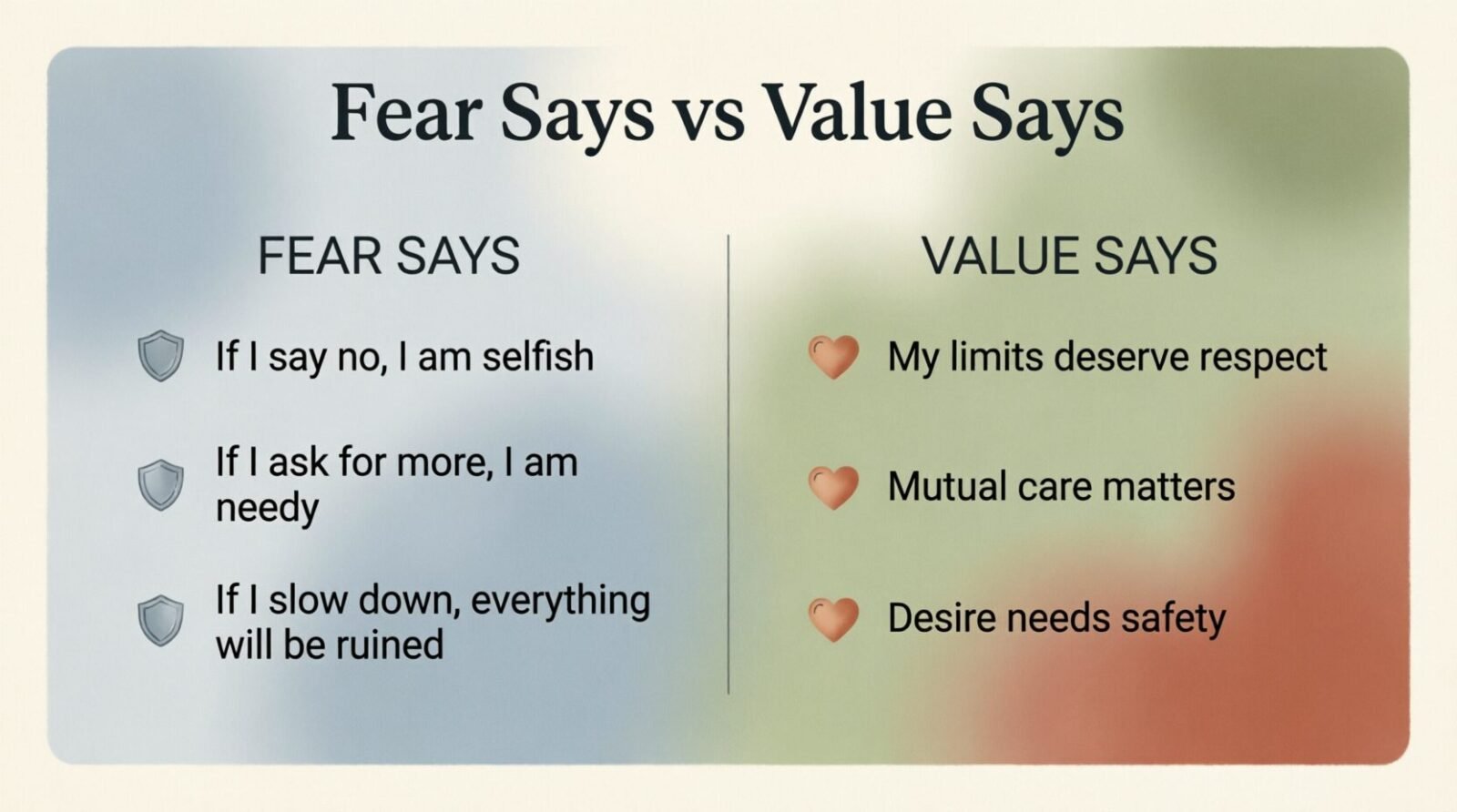
Two-column comparison showing fear-based thoughts versus values-based alternatives
Way 5: Keep One Small Promise to Yourself
Personal authority grows through evidence. Not pressure. Not perfection. Evidence.
This is where many women get stuck. They make big, dramatic commitments to change, then judge themselves harshly when they do not follow through perfectly. They skip the recognition phase, doing something brave and then immediately focusing on what is still wrong. But your body needs proof that you are learning to stand beside yourself.
The confidence cycle has four parts:
- Commitment: Making a small, specific promise to yourself.
- Action: Following through on that promise, even in a small way.
- Recognition: Noticing and acknowledging what you did.
- Integration: Allowing your body to absorb the lesson that you can trust yourself.
One small promise becomes one action, then one moment of recognition, then one lesson your body can absorb. This is how self-trust grows. It happens not through grand gestures, but through consistent, small acts of self-loyalty.
This is important because many women skip recognition. They do something brave, then immediately focus on what is still wrong. “Yes, I said no, but I should have done it more confidently.” “Yes, I set a boundary, but I felt guilty afterward.” This skips the recognition that builds self-trust.
Your nervous system needs evidence of safety, not pressure. Each time you keep a small promise to yourself, you are teaching your body: “I can trust me. I will stand beside myself. I am safe enough to listen to what I actually need.”
This work directly supports building self-trust because it shifts the focus from external validation to internal reliability. You are proving to yourself that you can count on you.
Daily-Life Example: The Pause That Builds Trust
Commitment: “Today, I will pause before saying yes.”
Action: You pause when someone asks for your time, even though your automatic response is ready.
Recognition: “I listened to myself.”
Integration: “My body felt less rushed when I gave myself time.”That is how self-trust grows. Not through perfection. Through evidence.
Gentle Reset: Six Tiny Promises You Can Keep Today
Choose one tiny promise today:
- “I will take one breath before saying yes.”
- “I will name one feeling.”
- “I will rest for ten minutes.”
- “I will write one truth.”
- “I will ask for time.”
- “I will not insult my body before sleep.”
Keep it small enough to live inside a real day. Small enough that you can actually do it. Then do it. Then notice that you did it. That noticing is where personal authority grows.
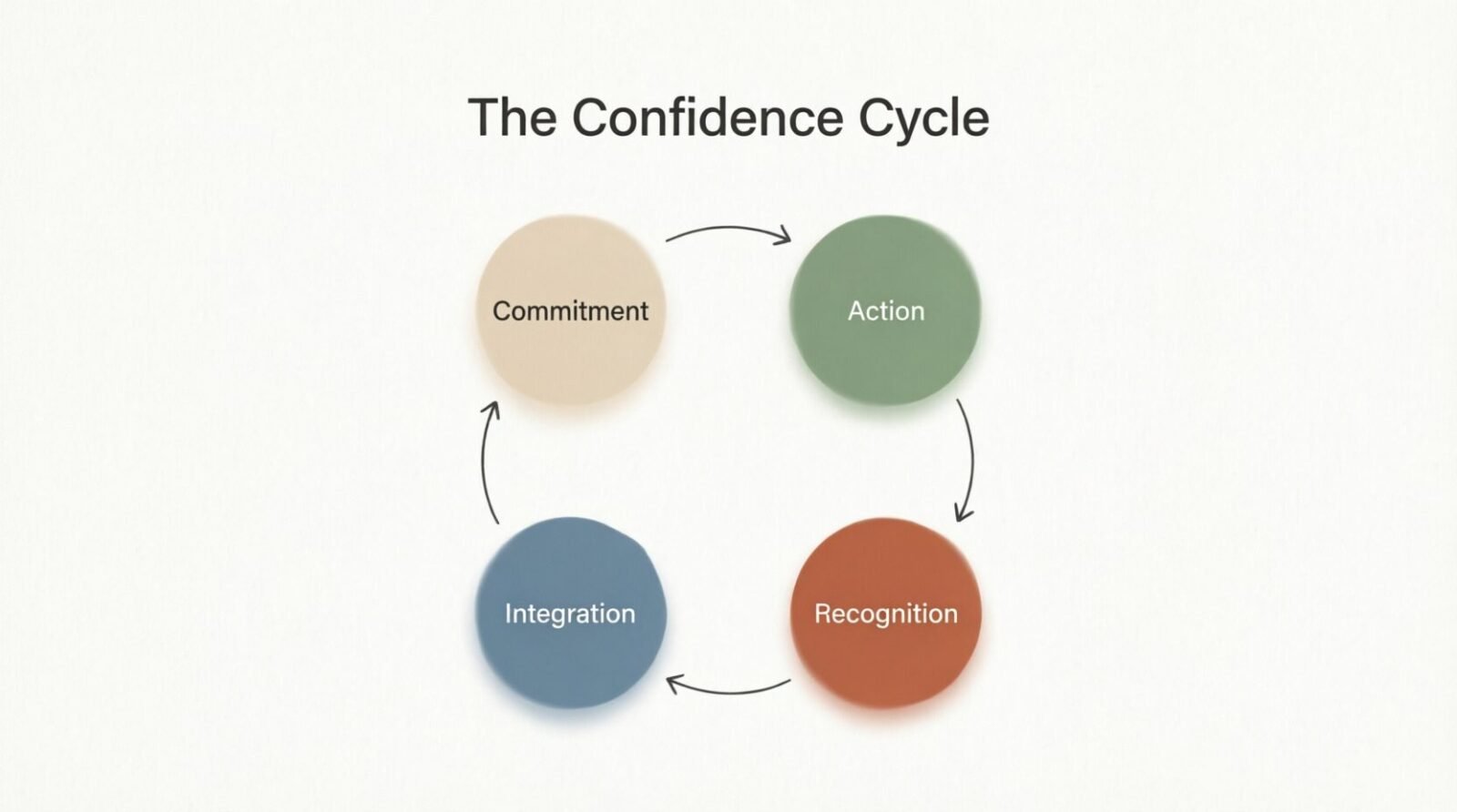
Circular 4-stage diagram showing: Commitment → Action → Recognition → Integration → (back to Commitment)
Force vs. Rooted Power: A Quick Comparison
Understanding the difference between force and rooted power is essential for building lasting personal authority. Here is a comprehensive comparison to help you recognize which approach you are using:
| Aspect | Force | Rooted Power |
|---|---|---|
| Source | Fear, shame, urgency | Values, choice, steadiness |
| Energy | Pushing, striving, exhausting | Grounded, sustainable, calm |
| Communication | Over-explaining, defending, attacking | Speaking clearly, once, without justification |
| Outcome Focus | Winning, proving, controlling | Choosing, aligning, honoring |
| Relationship to Self | Self-critical, demanding | Self-compassionate, trusting |
| Relationship to Others | People-pleasing or aggressive | Kind without becoming invisible |
| Sustainability | Burns out quickly | Builds over time |
| Aftermath | Resentment, depletion | Alignment, tired but peaceful |
| Example Phrase | “I must prove I’m strong” | “I can take one honest step” |
| Decision Driver | “What will avoid discomfort?” | “What aligns with my values?” |
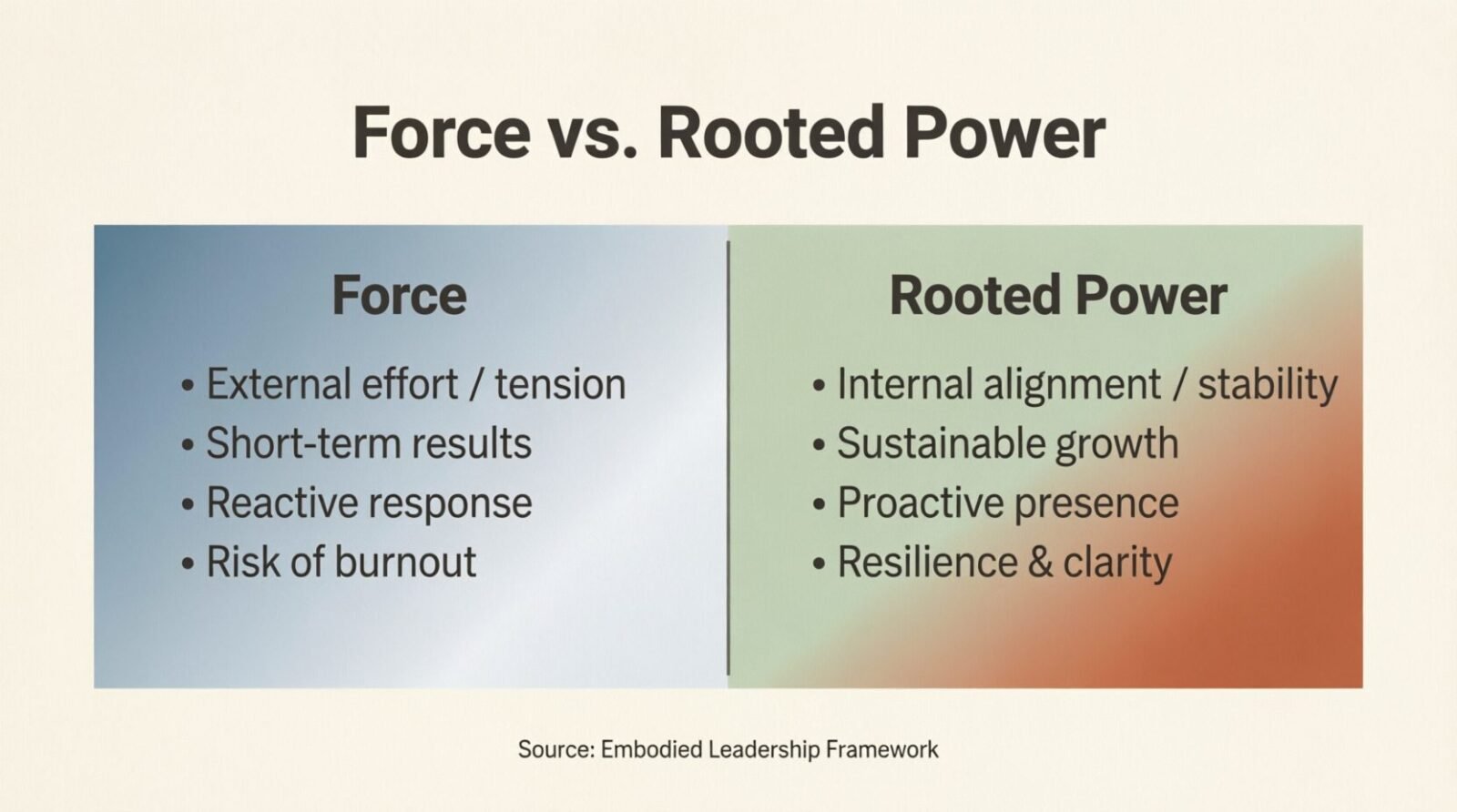
Comprehensive comparison table showing 10 key differences between force and rooted power approaches to personal authority
This table is not meant to judge you for using force. Force is often what we have learned. It is what we default to when we do not know another way. The goal is not perfection. The goal is awareness—recognizing when you are using force and gently inviting rooted power into the conversation.
One Compassionate Habit for This Week
If you take only one thing from this article, let it be this habit. It is simple. It is gentle. And it is powerful enough to shift your entire relationship with yourself.
Before saying yes to anything that asks for your time, energy, body, attention, or emotional labor, pause and ask:
“What does my value say?”
Then take one breath.
That is it. You may still say yes. You may say no. You may ask for time. You may choose a smaller version of what is being asked. The point is not to become difficult. The point is to stop disappearing.
This habit works because it interrupts the automatic yes—the reflexive agreement that has kept you small for years. It creates a tiny space between the request and your response. In that space, personal authority can begin to grow.
Here is how to practice it this week:
- Notice requests: Pay attention to when someone asks for your time, energy, or attention.
- Pause: Before answering, take one breath. Just one.
- Ask the question: “What does my value say?” Not “What will make them happy?” or “What will avoid conflict?” but “What does my value say?”
- Listen: Notice what comes up. Your body’s response. Your genuine desire. Your values.
- Respond: Answer from that place, even if your voice shakes.
You might feel uncomfortable at first. That is normal. You are practicing a new skill. You are teaching your nervous system that it is safe to include yourself in your own decisions.
This compassionate habit is the foundation of self-loyalty. It is how you practice including yourself in your own life, one small choice at a time.
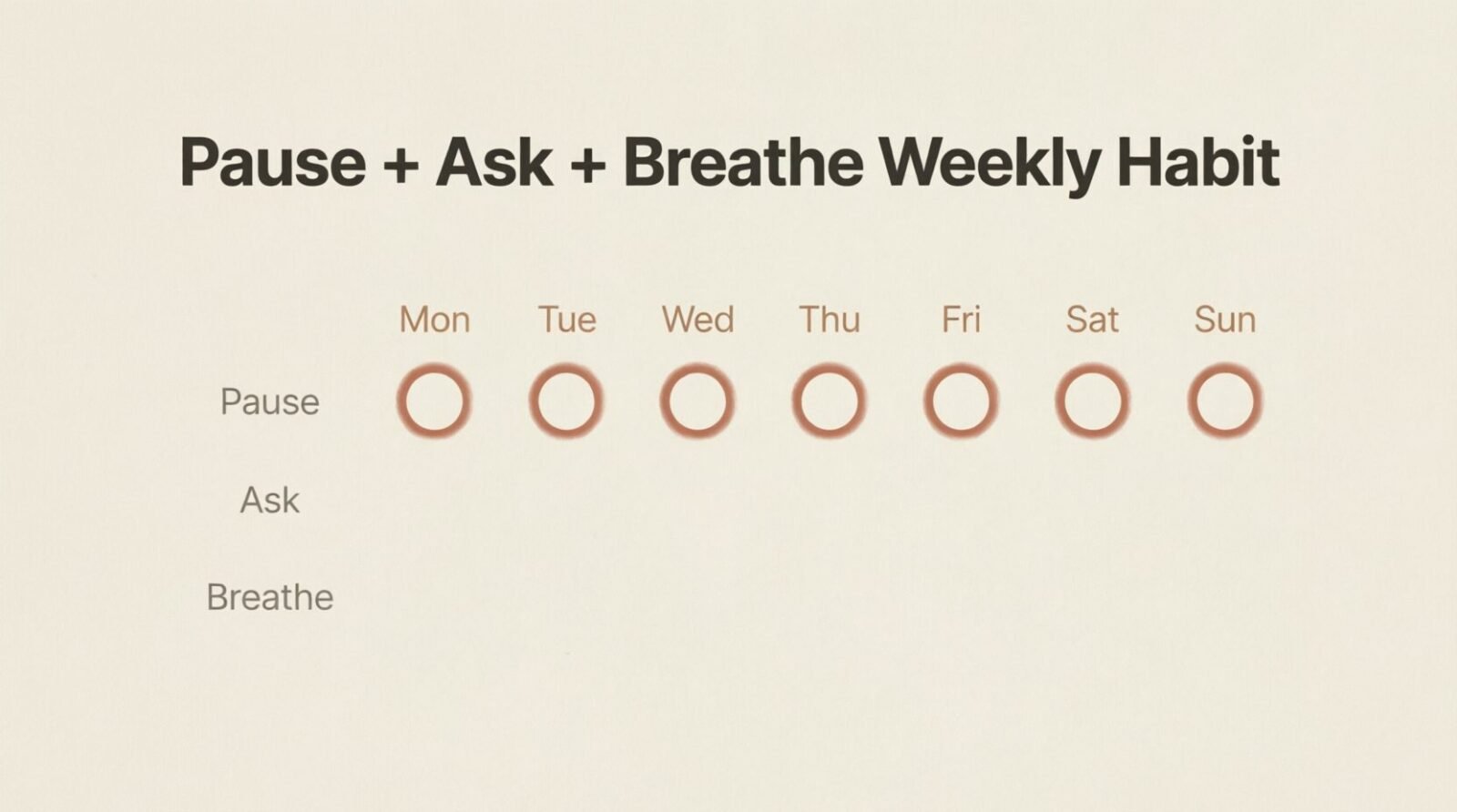
Weekly habit tracker for “Pause + Ask + Breathe” practice with 7 days to check off
How Deeper Personal Authority Supports Relationship Wellness
Deeper personal authority does not only change private self-talk. It can also transform your relationships and intimacy in profound ways.
When you listen to your values, you may communicate more clearly. Instead of hinting, hoping, or resenting, you can say what you actually need. This does not guarantee that everyone will give you what you want. But it does mean you are no longer asking people to read your mind while you silently keep score.
When you honor body signals, intimacy can feel less performative. You are no longer pushing through discomfort or pretending to want what you do not want. You are learning that your no is safe and your yes is free. This creates space for authentic connection, not just accommodation.
When you practice self-trust, you may stop asking shame to approve every desire. You begin to trust that your needs are valid, that your boundaries are reasonable, and that you are allowed to take up space in your relationships. This shifts the dynamic from “How much can I give?” to “How can we both be included?”
The referenced eBook explains that confidence creates an inner space where truth can breathe, where the body can speak, where desire can stand without shame, where no is safe, and where yes is free. That is why personal authority matters. It helps love include the self.
This does not mean every relationship will survive your growing personal authority. Some relationships are built on your silence, your accommodation, your invisibility. When you start speaking, those relationships may feel threatened. This is not a sign that you are doing something wrong. It is a sign that the relationship was dependent on your self-abandonment.
But other relationships—healthy, mutual, loving relationships—will deepen when you bring your whole self to them. These relationships can hold your boundaries, your needs, and your truth. They do not require you to disappear to stay connected.
Building personal authority is ultimately an act of relationship wellness because it creates the conditions for authentic connection. You cannot truly connect with others if you are not present with yourself. Personal authority brings you home to yourself, so you can show up fully in your relationships.
Signs You Are Building Personal Authority
How do you know if you are developing personal authority? Here are ten signs to look for:
- You pause before saying yes, even when the automatic response is ready.
- You notice body signals (tightness, exhaustion, resentment) as information, not weakness.
- You ask for what you want without over-explaining or apologizing.
- You rest before burnout, honoring your limits before you crash.
- You feel discomfort but do not automatically retreat; you can stay present with difficult emotions.
- Your no is clearer and requires less justification; you state it once and trust it is enough.
- You recognize shame’s voice without automatically obeying it.
- You make choices from values even when fear is present.
- You celebrate small acts of self-trust instead of only focusing on what is still wrong.
- You feel more aligned, even when situations are uncomfortable or uncertain.
These signs are not all-or-nothing. You might notice some of them some of the time. That is enough. Personal authority is not a destination you arrive at perfectly. It is a practice you return to, again and again, through small moments of self-loyalty.
Common Obstacles and How to Navigate Them
Building personal authority is not a straight line. You will face obstacles. Here are common challenges and gentle ways to navigate them:
- Obstacle 1: Fear of Disappointing Others
Navigation: Remember that disappointing someone is not the same as harming them. People can handle disappointment. You are allowed to prioritize your well-being. - Obstacle 2: Guilt After Setting Boundaries
Navigation: Guilt is often a sign you are doing something new, not something wrong. Let the guilt be there without letting it drive your choices. It will soften with practice. - Obstacle 3: Old Patterns Creeping Back
Navigation: Setbacks are part of the process, not proof of failure. When you notice old patterns, practice self-compassion, not self-criticism. Ask: “What did this teach me?” Then recommit to one small promise. - Obstacle 4: Pushback from Others
Navigation: Some people benefit from your silence and accommodation. When you start speaking, they may resist. This is not a sign you are wrong. It is information about the relationship. - Obstacle 5: Feeling Selfish
Navigation: Personal authority is about mutual care, not self-centeredness. When you honor your limits, you show up more authentically in relationships. You are allowed to be included in your own life. - Obstacle 6: Not Knowing What You Want
Navigation: After years of prioritizing others’ needs, you may feel disconnected from your own desires. Start small. Ask yourself throughout the day: “What would feel good right now?” Listen without judgment. - Obstacle 7: Perfectionism
Navigation: Personal authority grows through evidence, not perfection. You do not need to set boundaries perfectly or never feel fear. You just need to keep choosing yourself, one small moment at a time.
Each return to your values is itself an act of personal authority. The obstacles are not roadblocks. They are part of the path.
Frequently Asked Questions About Personal Authority
What is personal authority and how is it different from confidence?
Personal authority is your inner capacity to make choices aligned with your values, even when fear or shame is present. Unlike traditional confidence, which often focuses on external performance, personal authority is rooted in self-trust and self-loyalty. It is quieter, steadier, and grows through small, values-based choices rather than dramatic declarations or perfection. This framework is explored in depth in Chapter 9 of The Confidence & Intimacy Reset for Women.
How do I stop saying yes when I want to say no?
Start by pausing before automatically agreeing. Ask yourself: “Is this choice coming from shame or from my values?” Then take one breath. You do not have to give an immediate answer. Saying “I need time to decide” is a complete sentence. Personal authority grows when you honor your body’s signals—like chest tightness or exhaustion—as information, not weakness.
What are the signs of spiritual confidence in women?
Spiritual confidence shows up as quiet self-trust rather than loud certainty. Signs include: pausing before saying yes, resting before burnout, asking for what you want without over-explaining, honoring your body’s needs, and making choices from values instead of fear. It feels calm and steady, not perfect or fearless. Spiritual confidence allows you to include yourself in your own life.
How long does it take to build personal authority?
Personal authority is not built through one dramatic decision. It grows through small moments of self-loyalty practiced consistently. There is no fixed timeline. Some women notice shifts within weeks of daily “gentle resets,” while deeper patterns may take months. The key is evidence, not perfection: each small promise kept builds your body’s trust.
Is personal authority selfish?
No. Personal authority is about mutual care, not self-centeredness. When you honor your limits, communicate clearly, and make values-based choices, you show up more authentically in relationships. Personal authority does not reject love; it makes love more honest. It allows you to give from fullness rather than depletion.
What is the difference between force and rooted power?
Force comes from fear and tries to control, prove, or win. It pushes, over-explains, or slams doors. Rooted power comes from values and choice. It speaks clearly, pauses when needed, asks for what it wants, and remains kind without becoming invisible. Force needs to scream; power has roots and does not need to prove itself.
How do I know if shame is controlling my choices?
Shame speaks in quiet rules: “Do not ask for too much,” “Be easy,” “Your needs are selfish.” If you notice chest tightness when saying yes, resentment after agreeing, or exhaustion from being “easy,” shame may be writing your story. The test: after a choice, do you feel aligned or depleted? Learn more about the psychology of shame and people-pleasing.
Can I build personal authority if I have anxiety or trauma?
Yes, and the gentle approach is especially important. Personal authority is not about forcing yourself to be fearless. It is about placing values beside fear so fear does not decide alone. If you have anxiety or trauma, work with a therapist alongside these practices. Start with tiny promises and celebrate recognition. Your nervous system needs evidence of safety, not pressure.
How does personal authority improve relationships?
Personal authority creates an inner space where truth can breathe and desire can stand without shame. When you listen to your values and honor body signals, communication becomes clearer and intimacy feels less performative. Your no becomes safe, and your yes becomes free. This helps love include both people, not just one.
What if I fail or fall back into old patterns?
Setbacks are part of the process, not proof of failure. Personal authority grows through evidence, not perfection. When you notice old patterns, practice self-compassion, not self-criticism. Ask: “What did this teach me?” Then recommit to one small promise. Each return to your values is itself an act of personal authority.
Where can I learn more about building spiritual confidence?
Chapter 9 of The Confidence & Intimacy Reset for Women, “Confidence and Spiritual Empowerment: Becoming the Author of Your Own Life,” explores these themes in depth. The workbook includes simple prompts and practical guidance to help you express needs, set healthy boundaries, and speak with more confidence. You can also explore more resources on the Reset Intimacy blog.
Is this content a substitute for therapy?
No. This article and the referenced eBook are educational and reflective resources, not medical, legal, or therapeutic advice. If you are struggling with anxiety, trauma, or deep shame patterns, please seek support from a licensed mental health professional. These practices can complement therapy but not replace it.
Ready to Go Deeper? Your Next Steps
If this article resonated with you, you are not alone. Many women are discovering that personal authority is not about becoming someone different. It is about returning to who they already are beneath the layers of conditioning, shame, and people-pleasing.
Chapter 9 of The Confidence & Intimacy Reset for Women, “Confidence and Spiritual Empowerment: Becoming the Author of Your Own Life,” explores these themes in depth. The workbook includes simple prompts and practical guidance to help you express your needs, set healthy boundaries, and speak with more confidence.
This is not about adding more pressure to your life. It is about offering yourself a different way—a gentler path toward self-trust, one small choice at a time.
You can also explore more resources on the Reset Intimacy blog, where you will find articles on boundaries, body confidence, silencing the inner critic, and building intimacy with yourself and others.
Your journey toward personal authority starts with one small, values-based choice. What will yours be?
eBook cover for “The Confidence & Intimacy Reset for Women” with CTA button
Conclusion: Returning to Yourself
Deeper personal authority is not built through one dramatic decision. It grows through small moments of self-loyalty practiced consistently. You notice shame’s quiet rules. You allow confidence to be candlelight instead of lightning. You choose rooted power instead of force. You place values beside fear so fear does not decide alone. You keep one small promise to yourself, then another.
Spiritual confidence is not about becoming perfect, fearless, or unshakable. It is about returning. To your values. To your body. To your voice. To your truth. To the quiet knowledge that you are allowed to be included in your own life.
Ready to go deeper? The Confidence & Intimacy Reset for Women explores these themes in Chapter 9, “Confidence and Spiritual Empowerment: Becoming the Author of Your Own Life.” The workbook includes simple prompts and practical guidance to help you express your needs, set healthy boundaries, and speak with more confidence. Your journey toward personal authority starts with one small, values-based choice. What will yours be?
Disclaimer: This article and the referenced eBook are educational and reflective resources. They are not medical, legal, or therapeutic advice. If you are struggling with anxiety, trauma, or deep shame patterns, please seek support from a licensed mental health professional. These practices can complement therapy but not replace it.