

Female Body Education: 5 Steps to Reclaim Your Confidence #BodyAwareness #WomensHealth
Female body education matters because many women were taught to manage their bodies before they were taught to understand them. You were taught to be careful, modest, and protective of your reputation—but not how your body actually works, how desire responds to safety, or how to speak about your needs without guilt. This isn’t your fault. You weren’t broken; you were missing the right education, support, and language. This guide replaces silence with clear knowledge, offering shame-free ways to understand your body with respect. Healing begins not with pressure, but with patient attention.

1. What Is Female Body Education and Why Does It Matter?
Female body education is learning about your body, desire, comfort, discomfort, boundaries, and communication in a respectful, shame-free way. It goes beyond traditional sex education by focusing on body awareness, emotional safety, self-trust, and clear body language rather than just risk and prevention.
According to organizations like SIECUS (Sex Ed for Social Change), comprehensive sexuality education should include much more than disease prevention. It should encompass understanding your body’s responses, building healthy relationships, and developing self-advocacy skills. Yet, for decades, most women received education focused primarily on what could go wrong rather than how their bodies actually function.
This gap matters because when you don’t understand your body’s signals, you may interpret normal responses as problems. You might feel confused about your desires, guilty about your boundaries, or disconnected during intimacy. Comprehensive intimacy education resources can help fill this gap, but first, you need to understand what this foundational learning actually includes.
1.1 Core Components of Comprehensive Body Education
True female body education encompasses several interconnected elements that work together to help you build a respectful, informed relationship with your body:
- Body awareness: Learning to notice physical sensations without judgment—what feels comfortable, what creates tension, and what signals safety.
- Emotional safety: Understanding how emotions affect your body’s responses and recognizing what helps you feel secure.
- Comfort and discomfort: Developing the vocabulary and permission to identify and honor both states.
- Desire: Learning what desire actually feels like in your body and recognizing that it is normal for it to fluctuate.
- Boundaries: Understanding your limits and knowing you have the right to communicate them clearly.
- Communication: Building the language and confidence to express your needs and concerns.
- Self-trust: Rebuilding confidence in your body’s wisdom and your ability to make decisions that honor your wellbeing.
- Clear body language: Moving from vague, apologetic descriptions to specific, honest communication about your experience.
These components aren’t separate skills to master. They are interconnected aspects of understanding yourself as a whole person.
1.2 How It Differs from Traditional Sex Education
The difference between traditional sex education and comprehensive female body education is profound:
| Traditional Sex Education | Female Body Education |
|---|---|
| Focuses on risk: pregnancy, disease, reputation | Focuses on understanding: how your body works, what it needs |
| Teaches what to avoid | Teaches what to notice and honor |
| Emphasizes danger and consequences | Emphasizes safety, pleasure, and self-knowledge |
| Often fear-based | Shame-free and respectful |
| Limited to biological facts | Includes emotional, psychological, and relational aspects |
| Teaches you to protect your body from others | Teaches you to understand and advocate for your body |
| May create anxiety about normal responses | Normalizes body responses and reduces shame |
According to data from the Guttmacher Institute, most sex education curricula emphasize abstinence and risk prevention while providing minimal information about pleasure, consent, or body autonomy. This creates a significant gap in women’s understanding of their own bodies. Female body education fills this gap by teaching you to understand your unique responses and communicate your needs clearly.
2. The Historical Gap: Why Women Were Never Properly Taught
Many women received what experts call “warning-based education”—teaching focused primarily on risk, pregnancy, disease, reputation, danger, and mistakes. While these topics are important for safety, when they become the entire conversation, the body starts to feel like something dangerous or difficult rather than something to understand and respect.
According to historical analysis by SIECUS and other sexual health organizations, sex education evolved primarily as a response to social concerns about pregnancy rates and infections, rather than as a comprehensive approach to helping people understand their bodies. This created a curriculum built around risk instead of women’s real experiences.
When education becomes only about danger and control, the body can become a place of shame rather than understanding. You may have grown up learning how to hide your body but not how to understand it, or how to protect yourself from judgment but not how to build a peaceful relationship with yourself.
This isn’t personal failure. It is incomplete education. Recognizing this distinction is the first step toward healing.
2.1 Warning-Based Education and Its Limitations
Warning-based education teaches women to focus on:
- Pregnancy prevention: Often presented as the ultimate consequence to avoid.
- Disease transmission: Emphasizing fear of infection rather than understanding of health.
- Reputation management: Teaching that your value depends on others’ perceptions of your behavior.
- Danger avoidance: Focusing on external threats rather than internal wisdom.
While safety and health absolutely matter, this approach has significant limitations. It creates shame around normal responses, silences questions about pleasure or comfort, and disconnects you from your body’s wisdom. Research on fear-based education outcomes suggests that this approach often backfires, creating anxiety and disconnection rather than empowering informed decision-making.
2.2 The Emotional Patterns Created by Incomplete Education
The emotional impact of incomplete body education runs deep. You might recognize these patterns:
You feel embarrassed asking basic questions because you think you should already know the answers. You compare your desires or confidence to other women and wonder what is wrong with you. You feel guilty when you need more time, emotional safety, or gentleness, as if these needs are burdens rather than valid requirements for healthy intimacy.
You may perform confidence while feeling disconnected inside, saying yes when your body is saying no. These aren’t character flaws. They are the natural result of being taught to manage your body for others’ comfort while never learning to understand it for your own wellbeing.
Recognizing this pattern isn’t about blame; it is about clarity. Maybe it wasn’t your body that failed. Maybe the education was incomplete.
3. How Missing Education Affects Body Confidence
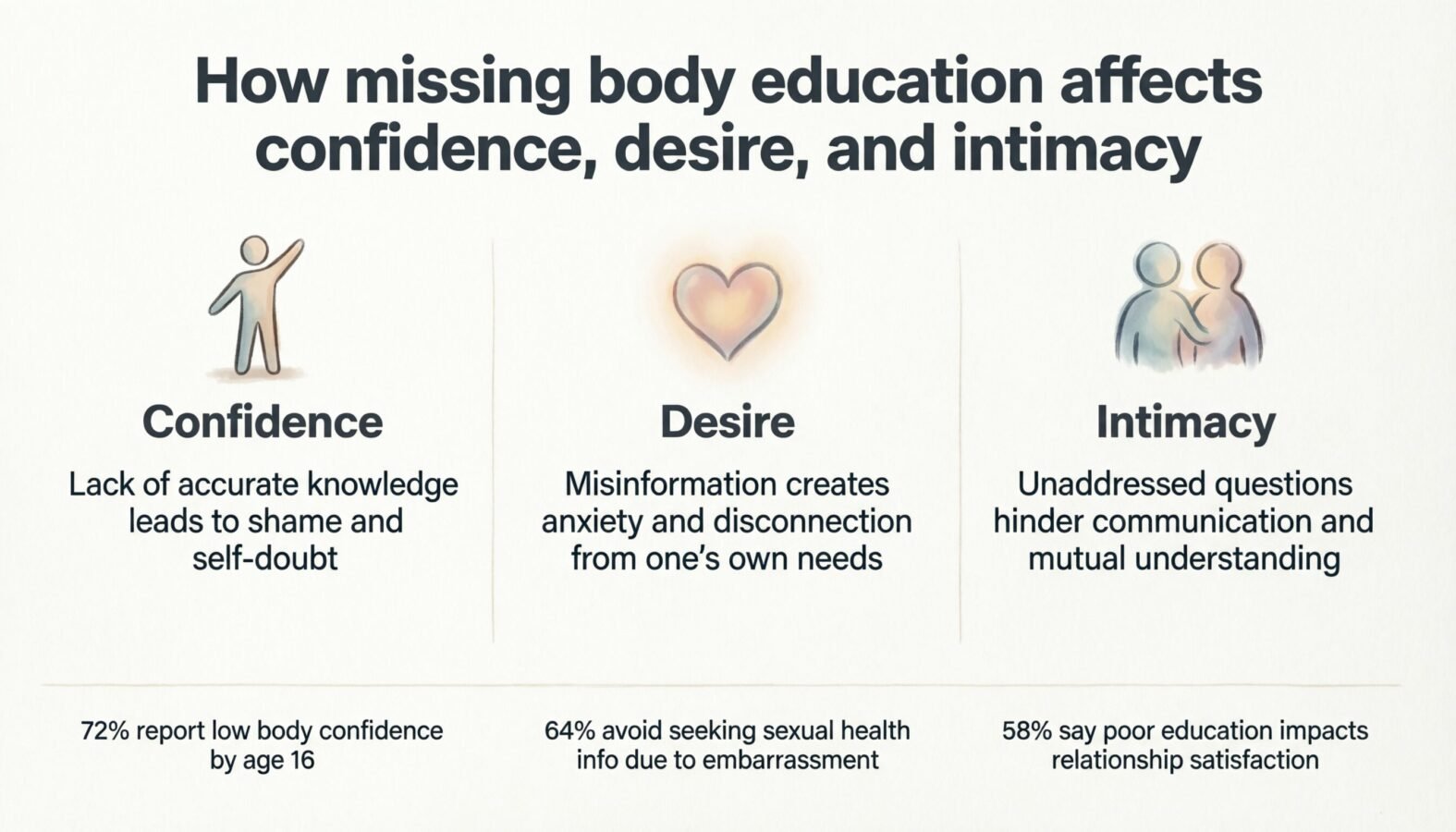
When you don’t have clear knowledge about how your body works, it is natural to blame yourself for things you were never taught to understand. This missing female body education quietly but powerfully affects your confidence, desire, communication, and intimacy.
You may feel shame about normal body responses, thinking there is something wrong with you when your body reacts in typical ways. You might interpret low desire as evidence that you are broken, rather than recognizing it as a response to stress, disconnection, or unmet safety needs. You may feel guilty for needing time, softness, rest, or emotional safety.
You might struggle to explain pain, discomfort, or pressure because you were never taught the language to describe these experiences. Perhaps most painfully, you may perform confidence while feeling disconnected inside, feeling like an observer in your own body rather than fully present.
This is where women’s body awareness becomes essential. Resources on rebuilding self-trust can help, but first, you need to understand what is happening.
3.1 Common Self-Blame Patterns
Without proper education, self-blame becomes a default response. You might find yourself thinking:
- “Why can’t I just relax and enjoy this?” when your body is responding to stress exactly as it is designed to do.
- “There must be something wrong with me” when your desire doesn’t match expectations, not realizing that desire is responsive and context-dependent.
- “I’m too sensitive” when you notice discomfort, as if sensitivity is a flaw rather than valuable information.
- “I should be over this by now” when healing takes time, forgetting that years of incomplete education can’t be undone overnight.
These thoughts feel true in the moment, but they are based on incomplete information. You are blaming yourself for not knowing what you were never taught. The truth is simpler and kinder: you weren’t broken. You were missing education, support, and language.
3.2 The Performance vs. Authenticity Conflict
Many women develop a split between who they are and who they think they should be. You may find yourself performing confidence, desire, or satisfaction while feeling disconnected, uncertain, or uncomfortable inside.
This performance isn’t dishonesty; it is survival. When you weren’t taught that your needs matter, you learn to prioritize keeping the peace over honoring your truth. But this conflict takes a toll. Performing while feeling disconnected creates exhaustion. Saying yes when your body is saying no builds resentment.
The path forward isn’t about becoming perfect at communication overnight. It is about gradually aligning your outer actions with your inner experience. Authenticity isn’t a destination you reach; it is a practice you build, one small honest moment at a time.
4. Understanding Shame and Body Disconnection
Shame is one of the most powerful forces keeping women disconnected from their bodies. It operates quietly, making you feel that something is fundamentally wrong with you, that your needs are too much, or that your body is a problem to manage rather than a source of wisdom.
Shame often makes women quiet when they want to speak, compliant when they want to set boundaries, and silent when they want to ask questions. You may want to say “I need more time” but instead say nothing. You may want emotional closeness but find your body feels tense or guarded.
This isn’t weakness. It is the natural response to being taught that your body is dangerous or that your needs are burdensome. Research on shame by experts like Brené Brown shows that shame thrives in silence and secrecy. It loses power when brought into the light, named, and met with compassion.
4.1 How Shame Silences Body Communication
Shame creates a specific pattern in how you communicate about your body:
- You use vague language because naming things directly feels too exposing. Instead of “This hurts,” you might say “I’m not sure,” hoping others will understand without you having to be direct.
- You apologize for having needs, framing boundaries as inconveniences. “I’m sorry, but…” becomes a reflexive pattern even when you have done nothing wrong.
- You stay silent to avoid conflict, prioritizing others’ comfort over your own safety.
- You feel embarrassed asking basic questions, worrying that everyone else already knows what you are supposed to understand.
This silence isn’t protection; it is isolation. When you don’t have words for your experience, you may hide what is true, creating distance in relationships.
4.2 The Nervous System Response to Shame
Understanding the nervous system’s role in shame helps explain why disconnection happens automatically. When you experience shame, your nervous system may interpret it as a threat. This triggers a stress response—your body prepares to protect itself through fight, flight, freeze, or fawn responses.
In the context of body shame and intimacy, this often shows up as:
- Freeze: Feeling numb, disconnected, or “checked out” during intimate moments.
- Flight: Wanting to leave, distract yourself, or rush through experiences.
- Fawn: Automatically saying yes, prioritizing others’ needs, suppressing your own responses.
- Physical tension: Tight shoulders, held breathing, clenched muscles, or stomach discomfort.
This isn’t brokenness. It is your nervous system doing exactly what it is designed to do: protect you from perceived threat. Somatic healing and nervous system regulation work by helping you recognize these responses without judgment, creating safety, and gradually teaching your nervous system that you are safe now.
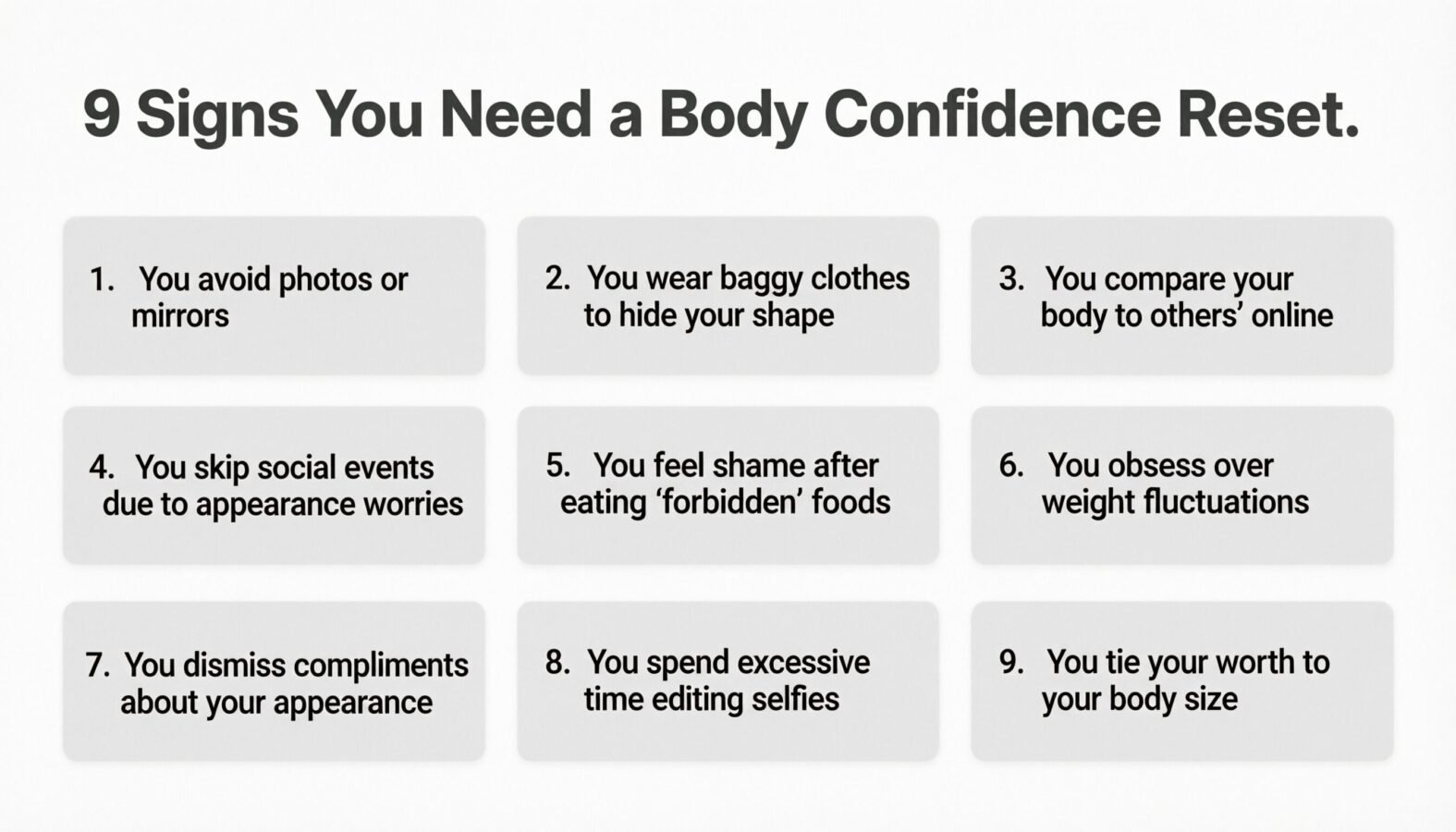
5. 9 Signs You Need a Body Confidence Reset
How do you know if incomplete body education is affecting your confidence and wellbeing? These signs may indicate you would benefit from a shame-free reset.
5.1 Emotional and Mental Signs
- You feel embarrassed learning about your body. Basic questions make you feel like you should already know the answers, even though you were never taught.
- You compare your desire or confidence to other women. You wonder why your experience doesn’t match what you see from others, not realizing that every body is unique.
- You feel pressure to be “normal.” You worry that your responses or needs don’t fit some invisible standard, creating anxiety.
- You think you should already know what your body wants. You feel frustrated that understanding your body feels confusing rather than intuitive.
- You feel guilty asking for slower pacing or emotional safety. You worry that having needs makes you difficult or demanding.
5.2 Physical and Behavioral Signs
- You avoid clear body language. You use vague words because naming things directly feels uncomfortable or exposing.
- You feel disconnected from your body during stress or intimacy. You notice yourself “checking out” or observing from a distance rather than being fully present.
- You ignore discomfort to keep peace. You notice tension or unease but stay silent to avoid conflict.
- You use vague hints instead of direct communication. Instead of saying “I need to stop,” you hope others will understand without you having to speak up.
None of these signs mean you are broken. They may simply show that your body has not been listened to with patience. They indicate not failure, but an opportunity for healing.
6. The 60-Second Body Reset: Your First Step
Healing doesn’t begin with dramatic transformations or perfect understanding. It begins with small, consistent practices of patient attention. The 60-second body reset is one such practice—simple, accessible, and powerful in its gentleness.
This practice isn’t about fixing your body or achieving a specific state. It is about noticing what is already there without judgment. It is about rebuilding the connection between your awareness and your body’s signals.
6.1 How to Practice the Daily Check-In
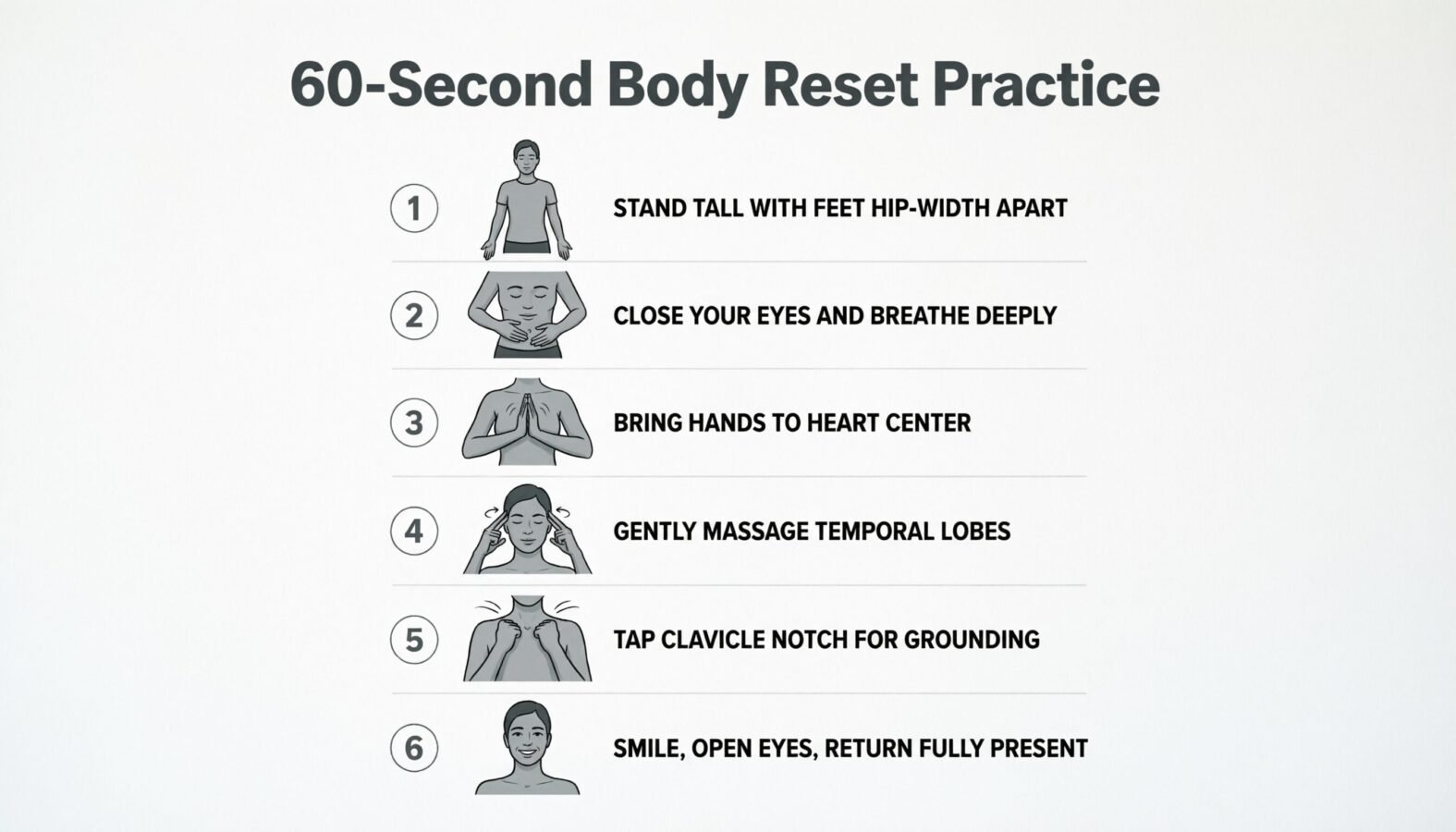
Here is exactly how to practice the 60-second body reset:
- Pause: Once a day, pause for 60 seconds. Find a quiet moment where you won’t be interrupted. This could be first thing in the morning, during a lunch break, or before bed.
- Ask: Ask yourself one simple question: “What am I feeling in my body right now?”
- Notice Without Fixing: Do not fix it. Do not judge it. Do not explain it away. Do not try to change it. Just notice.
- Identify Sensations: Your answer may be any of these or something completely different:
- My shoulders are tight.
- My stomach feels calm.
- My chest feels heavy.
- My breathing feels held.
- My body feels numb.
- My throat feels dry.
- My face feels warm.
- My body feels soft.
- Complete the Practice: Remember: you don’t have to fix the body; you only have to notice it. That is it. Sixty seconds of honest attention.
This practice builds self-trust by teaching you that your body’s signals matter and that you don’t need to earn the right to pay attention to yourself.
6.2 Common Body Signals to Notice
As you practice the reset, you may notice various sensations. Here are common signals women report:
- Tension signals: Tight shoulders or neck, clenched jaw, held breathing, stiff back, tense stomach.
- Calm signals: Relaxed shoulders, easy breathing, soft stomach, warm hands, relaxed muscles.
- Disconnection signals: Numbness, feeling “far away” from your body, difficulty noticing sensations, mental fog.
- Stress signals: Racing heart, sweaty palms, restless legs, tight chest, upset stomach.
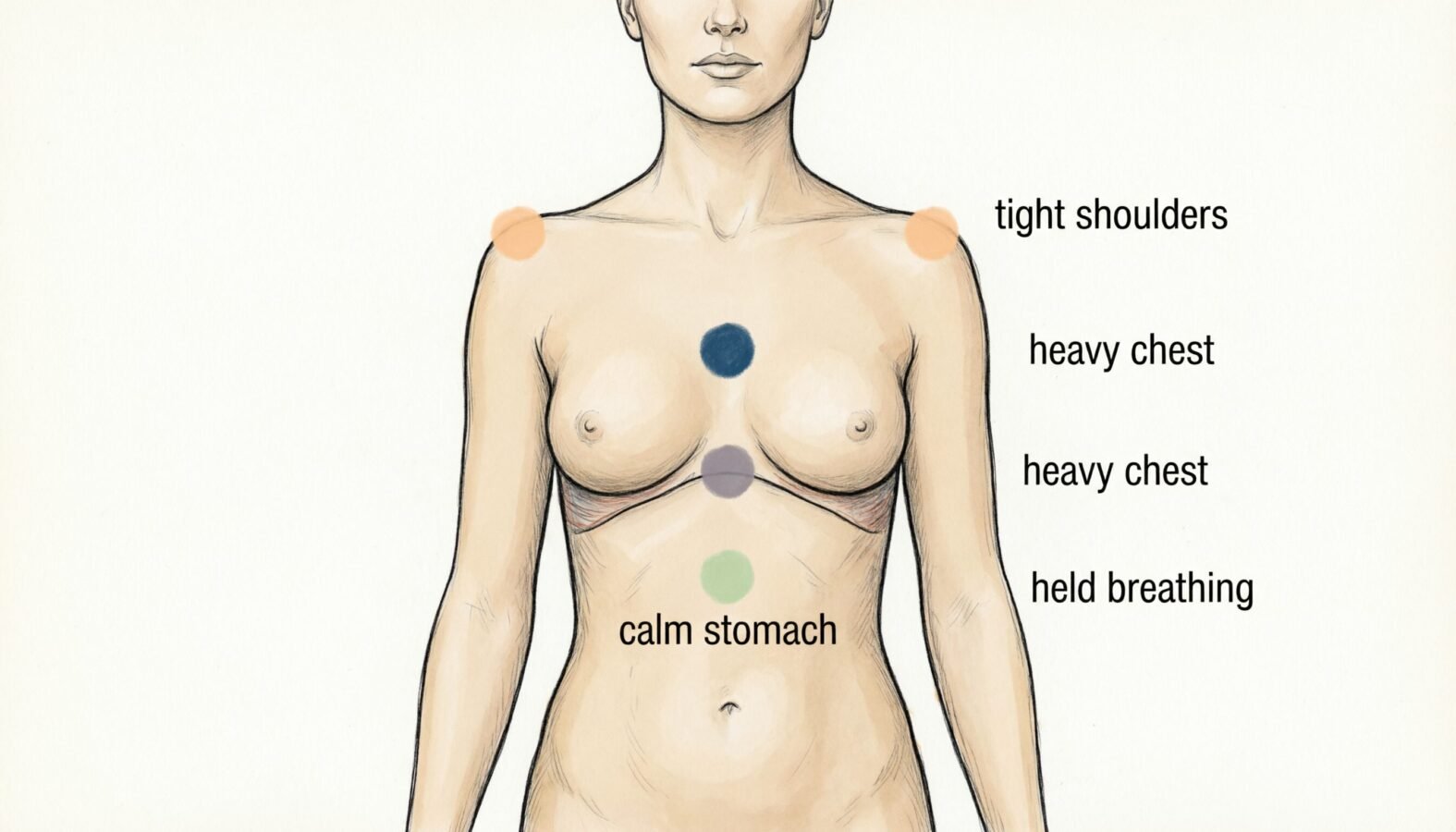
There are no right or wrong answers. Every sensation is information, not a problem to solve. The goal isn’t to feel a certain way; it is to notice what is actually there.
7. Simple Definitions: Building Your Body Literacy
Understanding the language of body awareness helps you communicate more clearly with yourself and others. Here are key terms defined for your reference:
- Female body education
- Learning about the body, desire, comfort, discomfort, boundaries, and communication in a respectful, shame-free way that goes beyond risk prevention to include understanding, self-trust, and emotional safety.
- Women body awareness
- The practice of noticing body signals without judgment—paying attention to physical sensations, emotional responses, and internal wisdom rather than ignoring or suppressing them.
- Shame-free education
- Education that does not use fear, guilt, embarrassment, or pressure to teach. Instead, it uses respect, clarity, compassion, and accurate information to help people understand their bodies.
- Intimacy education
- Learning how emotional safety, communication, body awareness, consent, desire, and trust work together to create healthy, fulfilling connections with yourself and others.
- Body confidence
- Not perfect body love or constant satisfaction, but the growing ability to live in your body with more respect, safety, and self-trust. It is the capacity to notice your needs and honor them without shame.
- Emotional safety
- The feeling that your emotions, needs, and experiences will be met with respect rather than judgment, dismissal, or punishment. It is the foundation for honest communication.
- Somatic healing
- A trauma-informed approach that reconnects your mind and body by noticing physical sensations without judgment, helping regulate your nervous system and rebuild trust in your body’s signals.
- Nervous system regulation
- The process of helping your body move from states of stress, fear, or shutdown back to states of safety, connection, and calm through awareness, breath, and supportive practices.
- Boundary setting
- The practice of identifying your limits and communicating them clearly, understanding that saying no to what doesn’t work for you is saying yes to your wellbeing.
These definitions aren’t meant to be memorized. They are meant to give you language for experiences you may already be having but couldn’t name.
8. How Shame-Free Education Transforms Intimacy
When you understand your body without shame, intimacy transforms from a source of confusion or pressure into a space for connection, pleasure, and mutual understanding. This transformation happens gradually as you build body awareness, develop clear communication, and learn to honor your needs.
Shame-free education doesn’t just benefit you individually; it strengthens your relationships. When you can communicate clearly about your body’s pace, preferences, pressure points, safety needs, and responses, you give your partners the information they need to connect with you authentically.
Comprehensive intimacy education resources can support this journey, but the foundation is your own growing understanding of your body.
8.1 From Silence to Clear Communication
Moving from silence to clear communication is a gradual process. You don’t have to become perfectly articulate overnight. Start small:
- Notice the gap: Pay attention to moments when you want to say something but stay silent. What were you going to say? What stopped you?
- Practice alone first: Before communicating with a partner, practice naming your experience to yourself. “My shoulders are tight.” “I feel rushed.” “I need more time.”
- Use simple scripts: You don’t need perfect words. Simple, honest phrases work: “I need more time,” “Can we slow down?” or “This feels uncomfortable.”
Remember: Clear communication strengthens intimacy. Your partner cannot meet needs they don’t know about. Speaking your truth isn’t selfish; it is necessary for genuine connection.
8.2 Understanding Your Body’s Pace and Preferences
Every body has its own unique pace and preferences. Understanding yours is a key part of female body education:
- Your pace is valid. Some bodies warm up quickly; others need more time. None of these are wrong; they are just different.
- Your preferences matter. What feels good to you may not feel good to someone else, and that is okay. You are not responsible for matching anyone else’s experience.
- Your body’s responses are information, not commands. If you feel tension, it is telling you something needs attention. If you feel ease, it is telling you something is working.
- Your needs can change. What works today may not work tomorrow, and that is normal. Staying connected to your body means staying curious.
Understanding your body’s pace and preferences isn’t selfish. It is the foundation for authentic intimacy.
9. Boundary Setting: Scripts for Real Conversations
Knowing you have the right to set boundaries is one thing; actually communicating them is another. Having specific scripts can make this easier, especially when you are still building confidence.
Remember: boundary setting isn’t about controlling others; it is about honoring yourself. It is not punishment or rejection; it is self-respect. Resources on setting healthy boundaries can provide additional support, but these scripts give you a starting point.
9.1 Scripts for Slowing Down
When you need more time or a slower pace:
- “I’m enjoying this, but I need to go slower.”
- “Can we pause for a moment? I need to check in with myself.”
- “I need more time to feel comfortable with this.”
- “This is moving faster than I’m ready for. Can we slow down?”
- “I’m feeling a bit overwhelmed. Can we take a break?”
These scripts are honest without being harsh. They communicate your need while acknowledging that the other person isn’t doing anything wrong.
9.2 Scripts for Expressing Discomfort
When something feels uncomfortable, painful, or wrong:
- “This doesn’t feel good to me.”
- “I need to stop.”
- “This is uncomfortable. Can we try something different?”
- “I’m feeling tense. Can we adjust?”
- “This isn’t working for me right now.”
You don’t need to justify or explain your discomfort. “This doesn’t feel good” is enough. Your body’s signals are valid information, and you have the right to honor them.
9.3 Scripts for Asking Questions
When you have questions but feel embarrassed:
- “I have a question, and I’m feeling a bit awkward asking it.”
- “Can I ask you something about this topic?”
- “I’m not sure I understand. Can you help me?”
- “Is it okay if I ask a basic question? I want to understand better.”
Questions aren’t signs of ignorance; they are signs of curiosity and care. Everyone starts somewhere, and asking questions is how we learn.
10. Somatic Healing: Reconnecting With Your Nervous System
Somatic healing is a trauma-informed approach that focuses on the connection between mind and body. The word “somatic” comes from the Greek word “soma,” meaning body. Somatic healing recognizes that trauma, stress, and shame don’t just live in your thoughts; they live in your body.
This approach helps you reconnect with your body by noticing physical sensations without judgment, regulating your nervous system, releasing stored stress, and rebuilding trust in your body’s signals through practices like body scanning and mindful awareness. According to research on somatic therapy effectiveness, this approach can be particularly helpful for women who have experienced body shame or disconnection because it works with the body’s wisdom rather than against it.
10.1 Understanding the Mind-Body Connection
Your mind and body aren’t separate entities; they are constantly communicating with each other. When you feel stressed mentally, your body responds physically. When your body is tense, your mind feels anxious. This connection is bidirectional and continuous.
The nervous system plays a central role in this connection. When you experience stress, threat, or shame, your nervous system activates protective responses. When you experience safety, connection, and ease, your nervous system supports relaxation and openness.
Understanding this connection helps you see that your body’s responses aren’t random; they are meaningful communications. You can influence your nervous system through breath, movement, awareness, and supportive practices. Healing happens in the body, not just in the mind.
11. Life-Stage Considerations: Postpartum, Perimenopause, and Trauma
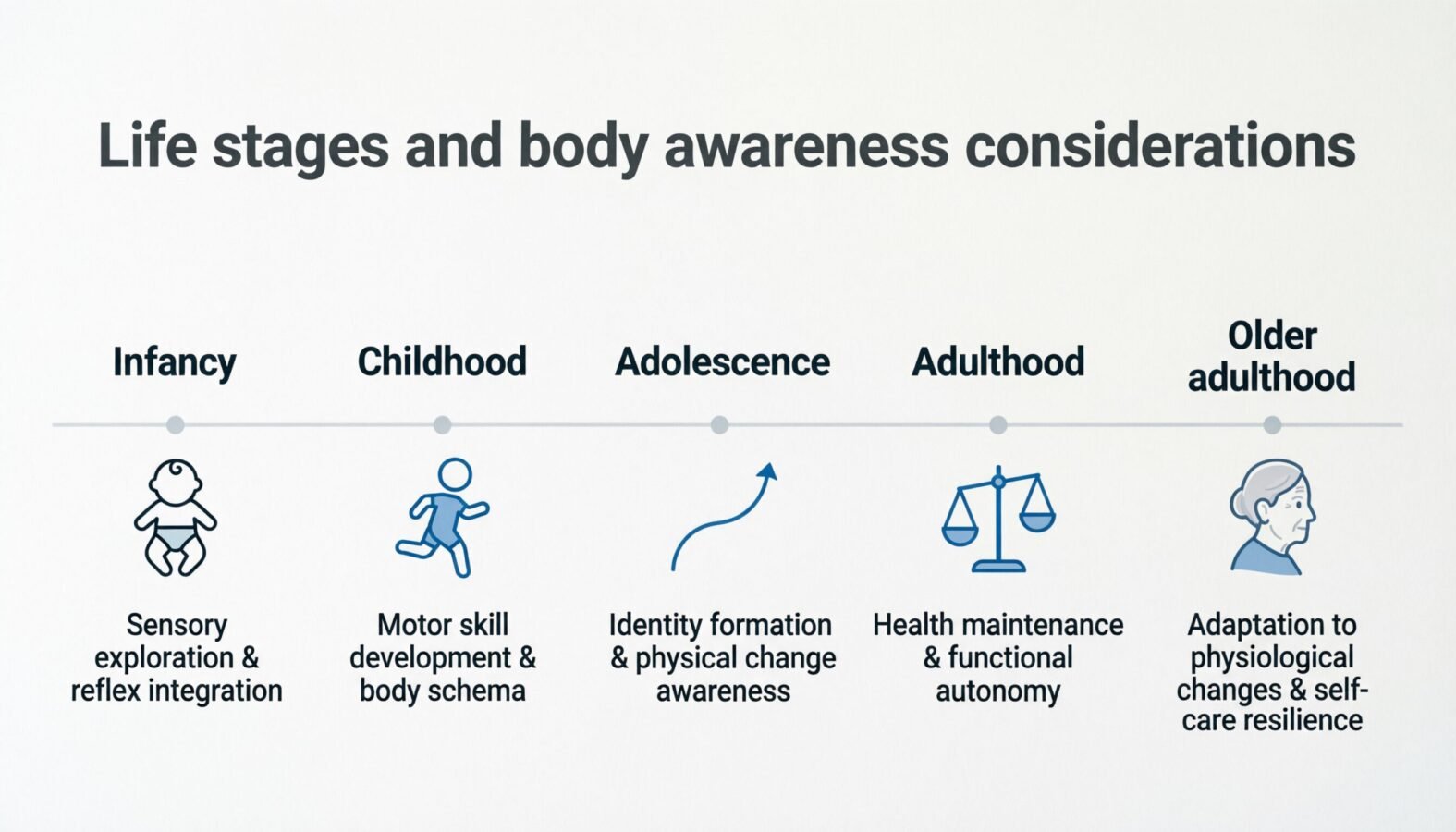
Your relationship with your body isn’t static; it evolves throughout your life. Different life stages bring different experiences, challenges, and opportunities for body awareness. Understanding these contexts can help you approach your healing with compassion and realistic expectations.
11.1 Postpartum Body Reconnection
After having a baby, your body undergoes massive physical, hormonal, and emotional changes. Reconnecting with your body during this time requires extra patience and self-compassion.
According to the American College of Obstetricians and Gynecologists (ACOG), postpartum recovery is a gradual process that can take months or even years. Your body has done something extraordinary, and it needs time to heal.
During this time:
- Be patient with physical changes. Your body may feel different, unfamiliar, or uncomfortable. This is normal.
- Honor your need for rest. Healing requires energy. Rest isn’t lazy; it is necessary.
- Communicate about intimacy. If you are in a relationship, be honest about your readiness for physical intimacy.
- Seek support. Postpartum is not the time to do everything alone. Ask for help.
11.2 Perimenopause and Body Awareness
Perimenopause brings hormonal fluctuations that can affect your body’s responses, energy levels, mood, and desire. Understanding these changes helps you adapt rather than blame yourself.
During perimenopause:
- Expect changes. Your body’s responses may shift. What used to feel easy may require more intention.
- Communicate with healthcare providers. Don’t suffer in silence. Medical support can help.
- Adjust expectations. Your body is changing, and that is okay. Flexibility and self-compassion are essential.
- Stay connected to your body. This is when body awareness practices become even more valuable.
11.3 Trauma-Informed Body Healing
If you have experienced trauma, reconnecting with your body requires special care, patience, and often professional support. Trauma-informed care emphasizes safety, choice, collaboration, and empowerment.
Important principles for trauma-informed body healing:
- Safety first: Your nervous system needs to feel safe before it can heal.
- You are in control: You get to decide what feels safe, what pace works, and what support you need.
- Professional support helps: A trauma-informed therapist or somatic experiencing practitioner can provide guidance tailored to your needs.
- Healing isn’t linear: Some days will feel easier than others. This is normal.
- Never force yourself: Pushing through discomfort can retraumatize. Gentleness and patience are essential.
12. Building a Sustainable Body Awareness Practice
Body awareness isn’t a one-time achievement; it is an ongoing practice. Like any skill, it develops through consistent, gentle attention over time. Building a sustainable practice means creating habits that fit your life, not adding more pressure to an already full schedule.
12.1 Daily Practices for Body Connection
Small, consistent practices are more effective than occasional intense efforts. Here are daily habits that support body awareness:
- The 60-second body reset: Once daily, pause and notice what you are feeling without judgment.
- Mindful breathing: Take three conscious breaths, noticing how your body responds.
- Body check-ins: Before, during, or after activities, ask, “How does my body feel right now?”
- Gentle movement: Stretch, walk, or move in ways that feel good, focusing on sensation rather than performance.
- Journaling: Write briefly about what you noticed in your body or what helped you feel safe.
- Gratitude for your body: Notice one thing your body did for you today, however small.
These practices don’t require extra time; they are integrated into what you are already doing. The goal isn’t perfection; it is gentle, consistent attention.
12.2 Overcoming Common Obstacles
Even with the best intentions, obstacles arise. Here is how to work with common challenges:
- “I don’t have time.” Start smaller. Thirty seconds counts. Consistency matters more than duration.
- “I forget to practice.” Link your practice to something you already do. Check in with your body while brushing your teeth or waiting for coffee.
- “It feels uncomfortable or I don’t notice anything.” That is information too. Disconnection is a signal. Don’t judge it; just notice it.
- “I feel guilty when I miss days.” Guilt undermines the practice. If you miss a day, simply begin again tomorrow. Gentle consistency, not perfection.
- “It’s not working fast enough.” Healing takes time. Years of incomplete education can’t be undone in days. Trust the process.
13. Key Takeaways: Your Path Forward
As you move forward on your healing journey, remember these essential points:
- Female body education helps women understand their body without shame. It is about replacing silence, fear, and confusion with clarity, respect, and self-trust.
- Many women were taught fear, risk, and silence instead of body awareness. This wasn’t your fault. You weren’t broken; you were missing education, support, and language.
- Missing education can affect confidence, desire, communication, and intimacy. But these can be rebuilt through patient, shame-free learning.
- Shame-free education replaces guilt with language, context, and self-trust. You don’t have to figure this out alone; resources and support are available.
- Women’s body awareness begins with noticing, not fixing. The 60-second body reset is a simple but powerful starting point.
- Healing takes time and patience, not pressure. Your body has been waiting to be listened to with kindness.
- Clear communication strengthens intimacy. Your needs matter, your pace is valid, and your boundaries are necessary.
- You are not broken. You were never properly taught. And now, you can begin to learn.
14. Frequently Asked Questions About Female Body Education
Q: What is female body education?
Q: How do I start healing my relationship with my body?
Q: Why do I feel guilty saying no to sex?
Q: What is somatic healing for women?
Q: How can I talk to my partner about my intimacy needs?
Q: How do I reconnect with my body after trauma?
Q: What are the signs I need a body confidence reset?
Q: How does female body education differ from traditional sex education?
Q: Why do I feel disconnected from my body during stress?
Q: Can body awareness help with low desire?
15. A Fuller Reset Path: Next Steps and Resources
This article is your starting point, but deeper transformation often needs structure. If you are ready to go further, comprehensive resources can provide the guidance, tools, and support you need.
15.1 The Confidence & Intimacy Reset For Women eBook
The Confidence & Intimacy Reset For Women by Md. Rizwanul Haque offers educational context on female body education, helping you understand:
- How your body actually works.
- Why you may have felt disconnected or confused.
- What shame-free education looks like in practice.
- How to rebuild self-trust and body confidence.
- The connection between body awareness and healthy intimacy.
The eBook provides clarity, realistic tools, and a shame-free framework for understanding your body with respect. It is designed to replace silence with knowledge and fear with understanding.
15.2 Workbook Bundle for Guided Practice
For those who want hands-on guidance, the workbook bundle offers:
- Guided reflection prompts to help you process what you are learning.
- Practical worksheets for tracking your body awareness practice.
- Communication scripts for real conversations with partners.
- Action prompts for implementing what you learn.
- Structured exercises for rebuilding self-trust.
Available in both A4 and US Letter sizes, or as a complete bundle with the eBook, these resources provide the structure many women need to move from understanding to transformation.

Begin your shame-free healing journey today. Your body deserves understanding, respect, and the space to thrive.