

Body Knowledge Without Shame: 5 Gentle Steps to Reset Intimacy #BodyPositivity #IntimacyReset
Building body knowledge without shame is the first step toward reclaiming your confidence, clarity, and intimacy.
Many women were taught to protect their bodies from risk but were never taught how to understand them. This gap leaves us feeling disconnected, unsure of our signals, and anxious in relationships. We often blame ourselves for confusion that is actually just missing education.
You are not broken. You are likely missing the language and tools to listen to your body. By shifting from self-judgment to curiosity, you can begin a gentle reset.
- Introduction: Why We Feel Disconnected From Our Bodies
- Step 1: Reframe Shame With Curiosity
- Step 2: Learn Clear, Neutral Language for Your Body
- Step 3: Notice Disconnection in Daily Life
- Step 4: Connect Body Awareness With Honest Communication
- Step 5: Build One Compassionate Daily Habit
- When to Seek Professional Support
- Frequently Asked Questions About Body Knowledge
- Conclusion: Your Journey to Shame-Free Intimacy
Introduction: Why We Feel Disconnected From Our Bodies
Body disconnection is the habit of ignoring physical signals until they become urgent problems. It is not a personal failure; it is often a learned survival strategy.
Many of us grew up in environments where our bodies were discussed primarily in terms of danger, modesty, or appearance. We were told what not to do, but rarely taught how to notice what we were feeling. This creates a gap in female body education that can persist well into adulthood.
According to the Mayo Clinic, the mind-body connection is powerful. When we ignore our body’s signals, our nervous system remains in a state of low-grade alert, making it difficult to relax or feel safe in intimacy.
The Gap Between Protection and Understanding
Traditional education often focuses on risk avoidance. While safety is important, an exclusive focus on risk teaches us to view our bodies as potential problems rather than sources of wisdom.
This risk-based education leaves many adults with high body literacy regarding medical facts but low literacy regarding their own lived experience. We may know the anatomy, but we don’t know the sensation. We know the rules, but we don’t know the rhythm.
Shame-free healing begins when we realize that this gap is not our fault. It is a systemic omission. Recognizing this allows us to approach our bodies with compassion rather than criticism.
Signs You Are Ignoring Your Body’s Signals
How do you know if you are disconnected? Body disconnection often manifests in subtle ways before it becomes a major issue.
Common signs include:
- Emotional numbness: Feeling “flat” or unable to identify emotions.
- People-pleasing: Saying yes when your body feels a strong “no.”
- Chronic tension: Holding your breath, clenching your jaw, or raising your shoulders without noticing.
- Held breath: Shallow breathing during stress or intimacy.
- Ignoring fatigue: Pushing through exhaustion until you crash.
If you struggle to name what you feel physically, you are not alone. As noted by experts in Somatic Experiencing, learning to track bodily sensations is a skill that can be developed at any age.
Step 1: Reframe Shame With Curiosity
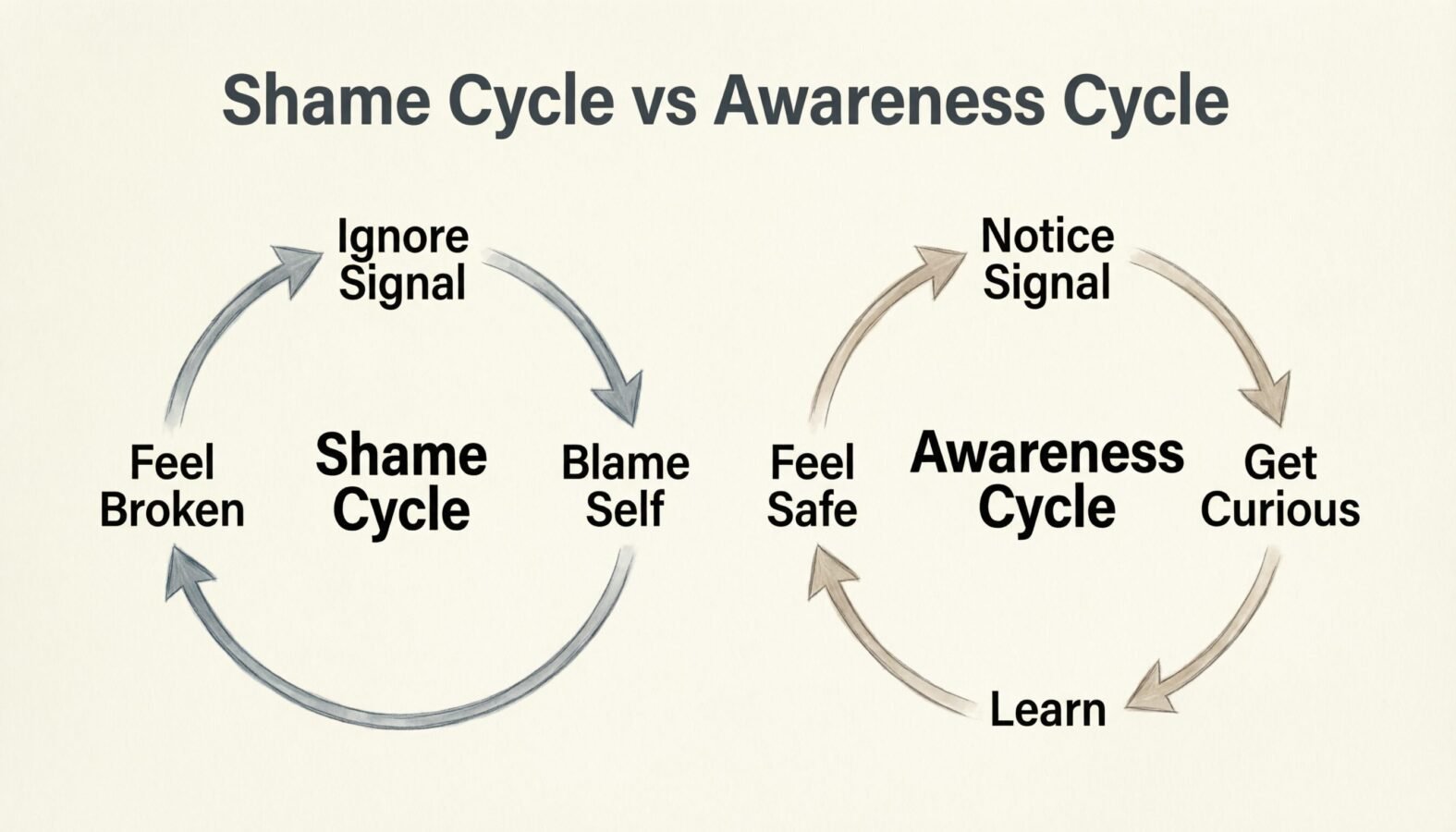
Reframing shame means replacing the question “What is wrong with me?” with “What was I never taught?” This shift lowers self-blame and opens the door to learning.
Many women blame themselves for things they were never taught to understand. They may think something is wrong with them when desire feels unclear, when intimacy feels stressful, or when they struggle to explain discomfort. But the issue may not be personal failure. It may be incomplete education.
In The Confidence & Intimacy Reset For Women, Md. Rizwanul Haque explains that many women were taught risk, danger, and reputation before they were taught how their bodies actually work. When body education focuses only on risk, the body may start to feel like a place of shame instead of a place of understanding.
The “What Was I Never Taught?” Exercise
Try this simple reframing exercise when you feel stuck or ashamed:
- Pause: Notice the feeling of shame or confusion.
- Identify the Thought: What is the critical voice saying? (e.g., “I’m too sensitive,” “I’m broken.”)
- Reframe: Ask, “What was I never taught about this sensation?”
- Curiosity: Explore the answer without judgment. (e.g., “I was never taught that tension is a normal response to stress.”)
This practice builds somatic awareness by turning inward with kindness rather than criticism. It helps you stop treating confusion as weakness.
Understanding the Role of Early Education
Our early experiences shape our nervous system regulation. If we were punished for asking questions about our bodies, we learned that curiosity was dangerous. If we were mocked for our changing bodies, we learned that visibility was shameful.
These childhood messages create a backdrop of modesty culture and risk avoidance that can make adult intimacy feel fraught with anxiety. By acknowledging these roots, we can begin to separate our current reality from past conditioning.

Step 2: Learn Clear, Neutral Language for Your Body
Clear body language is the use of specific, non-judgmental words to describe physical sensations. It supports confidence, medical care, and honest communication.
Shame grows when language is missing. Many women were taught vague words for their body. They may feel embarrassed saying proper names or describing what they feel. But clear language can support confidence, medical care, communication, and self-trust.
Knowing clear body names is not only information; it is also confidence. This does not mean you have to speak in a way that feels uncomfortable. It means you have the right to understand your body accurately.
Moving From Vague to Specific
Vague language keeps us stuck. Words like “bad,” “weird,” or “gross” carry judgment and shut down understanding. Specific language opens doors.
For example, saying “My stomach feels bad” is vague. Saying “My stomach feels tight and knotted” is specific. The latter gives you information you can work with. It tells you something about your nervous system state.
| Shame-Based / Vague | Clear / Neutral |
|---|---|
| I’m bad | I feel tense |
| It’s weird | This is new |
| I’m broken | I feel unsure |
A Toolkit of Neutral Body Words
Here is a list of neutral, descriptive words you can use to build your body literacy:
- Temperature: Warm, cool, hot, cold.
- Texture: Soft, hard, rough, smooth.
- Weight: Heavy, light, grounded, floating.
- Movement: Tight, loose, still, buzzing, trembling.
- Space: Open, closed, expansive, cramped.
- Energy: Calm, agitated, drained, vibrant.
Using these words helps you communicate clearly with yourself and others. It removes the moral weight from physical sensations. “I feel tense” is a fact. “I’m being difficult” is a story. Stick to the facts.
This toolkit is essential for shame-free healing. It allows you to observe your body as a neutral landscape rather than a courtroom.
Step 3: Notice Disconnection in Daily Life
Body disconnection shows up in daily life through ignored signals like held breath, shallow breathing, or chronic tension. Noticing these signs is the first step to reconnection.
Women’s body awareness is not only about intimacy. It begins in ordinary moments. Your body may speak during the day through tight shoulders, held breath, a heavy chest, a calm stomach, restlessness, numbness, warmth, tiredness, or softness.
Many women miss these signals because they were trained to notice everyone else first. In my practice, I often see women who can read a partner’s mood, a child’s needs, or a boss’s tone with incredible accuracy, yet remain blind to their own internal state.
This can affect relationship wellness. For example:
- You may say yes while your body feels tense.
- You may keep peace while your body feels heavy.
- You may avoid conflict while your breath becomes shallow.
- You may stay silent because speaking feels too risky.
- You may feel tired but still push yourself to be available.
Body knowledge begins when you stop ignoring these small signals. You do not have to fix them immediately. You only have to notice them.
For more insights on managing these demands, check out our resources on signs of burnout and emotional regulation.
The “Check-In” Pause
You can practice noticing disconnection with a simple “Check-In” pause:
- Stop: Pause whatever you are doing for 10 seconds.
- Scan: Quickly scan your body from head to toe.
- Name: Identify one sensation. (e.g., “My jaw is clenched.”)
- Breathe: Take one deep breath into that area.
This micro-pause helps regulate your nervous system and brings you back to the present moment. It is a small act of self-trust.

Step 4: Connect Body Awareness With Honest Communication
Honest communication starts with knowing what you feel. When you can name your body’s signals, you can share them with partners clearly and confidently.
When a woman does not understand her body, communication becomes harder. She may not know how to explain what she needs. She may not know how to describe pressure or discomfort. She may feel guilty asking for slower pacing. She may stay quiet because she does not want to disappoint anyone.
This is where intimacy education becomes important. It is not only about physical information. It is also about emotional safety, body signals, desire, consent, pace, boundaries, and honest communication.
Md. Rizwanul Haque’s framework connects self-knowledge with understanding the body’s pace, preferences, pressure points, safety needs, and responses. This kind of knowledge can help a woman gradually speak with more honesty.
Why Silence Feels Safer Than Speaking Up
Silence often feels safer because it avoids potential conflict or disappointment. We may fear that setting a boundary will hurt our partner’s feelings or end the connection.
However, silence often leads to resentment and communication breakdown. When we ignore our own needs, we cannot be fully present. True emotional intimacy requires honesty, even when it is uncomfortable.
Scripts for Setting Gentle Boundaries
Here are some scripts to help you communicate your body’s needs:
These sentences are not selfish. They are part of shame-free education. Healthy communication becomes easier when a woman knows what is happening inside her.
Practicing these scripts can help you build consent practices that feel safe and respectful for both you and your partner.
Step 5: Build One Compassionate Daily Habit
A compassionate habit is a small, consistent action that rebuilds trust with your body. The 60-second body check-in is a powerful tool for this.
A small habit can begin a larger reset. Once a day, pause for 60 seconds and ask: What am I feeling in my body right now?
Do not judge the answer. Do not fix the answer. Do not turn it into a performance. Just notice.
Your answer may be:
- My shoulders are tight.
- My chest feels heavy.
- My stomach feels calm.
- My throat feels dry.
- My breathing is held.
- My body feels numb.
- My body feels soft.
The eBook recommends this kind of body check-in and reminds readers that the goal is not to fix the body, but to notice it.
The 60-Second Body Scan Guide
Here is how to perform a 60-second body scan:
- Find a Quiet Spot: Sit or lie down comfortably.
- Close Your Eyes: Reduce visual distractions.
- Breathe: Take three deep breaths.
- Scan: Move your attention from your toes to your head.
- Notice: Observe any sensations without trying to change them.
- Thank: Thank your body for carrying you through the day.
This habit is simple, but it matters. A body that is ignored all day may struggle to feel safe during closeness. A body that is listened to gently can slowly rebuild trust.
Turning Observation Into Trust
Consistency is key. Over time, this daily practice builds self-trust. You learn that you can rely on yourself to notice and honor your needs. This foundation makes it easier to navigate complex emotions and relationships.

When to Seek Professional Support
While self-help strategies are powerful, they are not a substitute for professional care. If you have a history of trauma, severe anxiety, or persistent pain, seeking support is a wise and brave step.
Trauma-informed care emphasizes safety and choice. A therapist specializing in somatic therapy can help you process stored trauma and develop deeper body awareness in a safe environment.
Remember, asking for help is not a sign of weakness. It is a sign of strength and self-respect. You can find qualified professionals through directories like Psychology Today.
Disclaimer: This article is educational and should not replace medical, legal, or therapeutic advice. The eBook also states that it is for informational and educational purposes only and is not a substitute for qualified professional advice.
Frequently Asked Questions About Body Knowledge
Common signs include frequent tension headaches, holding your breath without noticing, feeling numb during intimacy, or prioritizing others’ needs while ignoring your own fatigue. If you struggle to name what you feel physically, you may be experiencing body disconnection.
Shame often stems from early education that focused on risk, modesty, or protection rather than understanding and pleasure. This creates a narrative that the body is a problem to be managed, not a home to be inhabited.
Try words like tight, heavy, warm, cool, soft, sharp, dull, buzzing, or calm. These descriptive terms remove judgment and help you communicate clearly with yourself and others.
Start by replacing self-blame with curiosity. Ask, “What was I never taught?” instead of “What is wrong with me?” Begin with a 60-second daily check-in to simply notice sensations without trying to fix them.
It’s okay to start with “I don’t know yet.” Use simple observations like “My chest feels tight” or “My stomach is quiet.” Over time, as you practice noticing, your vocabulary will expand naturally.
When you understand your own signals, you can communicate needs clearly (e.g., “I need to slow down”). This reduces resentment, improves consent, and fosters deeper emotional intimacy because you are present and honest.
Somatic experiencing is a therapeutic approach that uses body awareness to process trauma. Building body knowledge is a broader educational practice that includes language, habits, and self-trust, which can complement somatic therapy.
Yes, but it often requires gentle, consistent practice and sometimes professional support. Trauma-informed care emphasizes safety and choice, allowing you to reconnect at your own pace without pressure.
Conclusion: Your Journey to Shame-Free Intimacy
Reconnecting with your body is not a destination but a daily practice of gentle noticing. It requires replacing shame with curiosity and silence with clear, honest language.
We explored how to reframe self-blame, learn neutral body language, recognize disconnection signals, communicate needs to partners, and build a 60-second daily habit. These small steps create a foundation of self-trust.
Ready for Deeper Guidance?
If you are ready for structured worksheets, more scripts, and comprehensive tools, explore The Confidence & Intimacy Reset For Women bundle.
It offers everything needed to turn these concepts into lasting change.
Start your journey to body knowledge without shame today, one gentle breath at a time.