

How to Understand Low Desire and Stress Without Shame: A Compassionate Guide for Women
Introduction: You Are Not Broken
Understanding the link between stress and desire is the first step toward reclaiming your intimacy without shame.
You may love your partner deeply and still not feel ready for closeness. This doesn’t mean you’re broken, cold, or failing. It means your nervous system is carrying too much.
When stress fills your mind—bills, children, work, aging parents, body shame—your body prioritizes survival over pleasure. This is normal. This is protective. And this is reversible.
In this guide, you’ll discover why stress affects desire, how to create nervous system safety, and gentle practices to help your body soften without pressure. You are not alone. And you are not broken.
Why Stress and Desire Are Deeply Connected
Stress and desire are connected through the nervous system. When stress activates your fight-or-flight response, your body prioritizes survival over pleasure, naturally suppressing libido until safety signals return.
This isn’t a malfunction. It’s your body working exactly as designed.
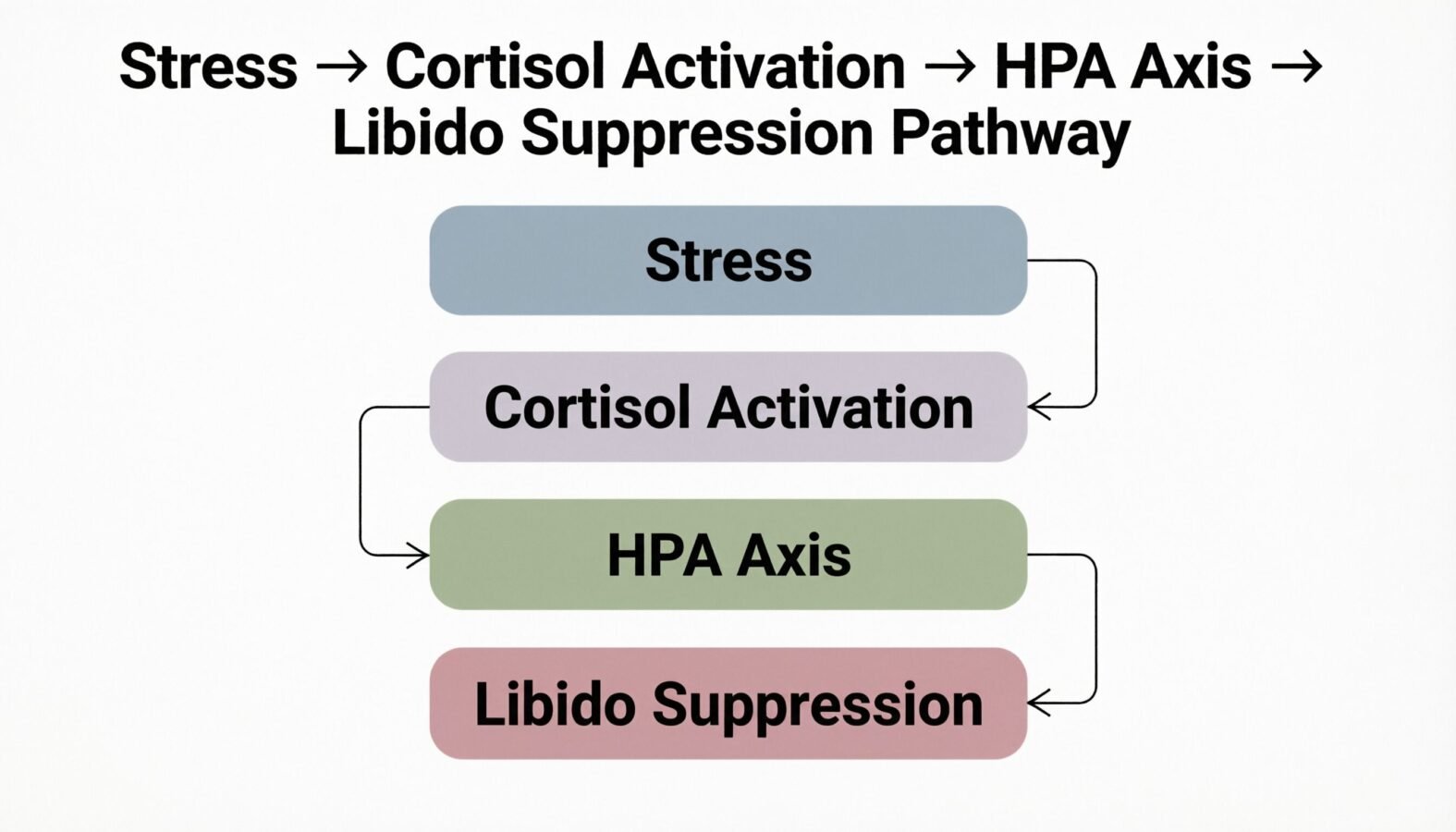
When you’re managing deadlines, family responsibilities, financial pressures, and relationship dynamics, your nervous system receives constant signals that demand attention. These signals activate what researchers call the hypothalamic-pituitary-adrenal (HPA) axis, triggering a cascade of physiological responses designed to keep you safe.
According to the American Psychological Association, stress affects every system in your body, including your reproductive and sexual systems. When your brain perceives stress—whether from an actual threat or a packed to-do list—it shifts resources away from non-essential functions. Unfortunately, pleasure and desire fall into that “non-essential” category from your body’s survival perspective.
This explains why stress kills female libido so effectively. It’s not personal. It’s physiological. Low desire in women under stress doesn’t mean something is wrong with you, your relationship, or your capacity for intimacy. It means your nervous system is overwhelmed and needs support before it can access pleasure. Understanding this connection between stress and desire is the foundation of shame-free intimacy work.
The Physiology of Stress: What Happens in Your Body
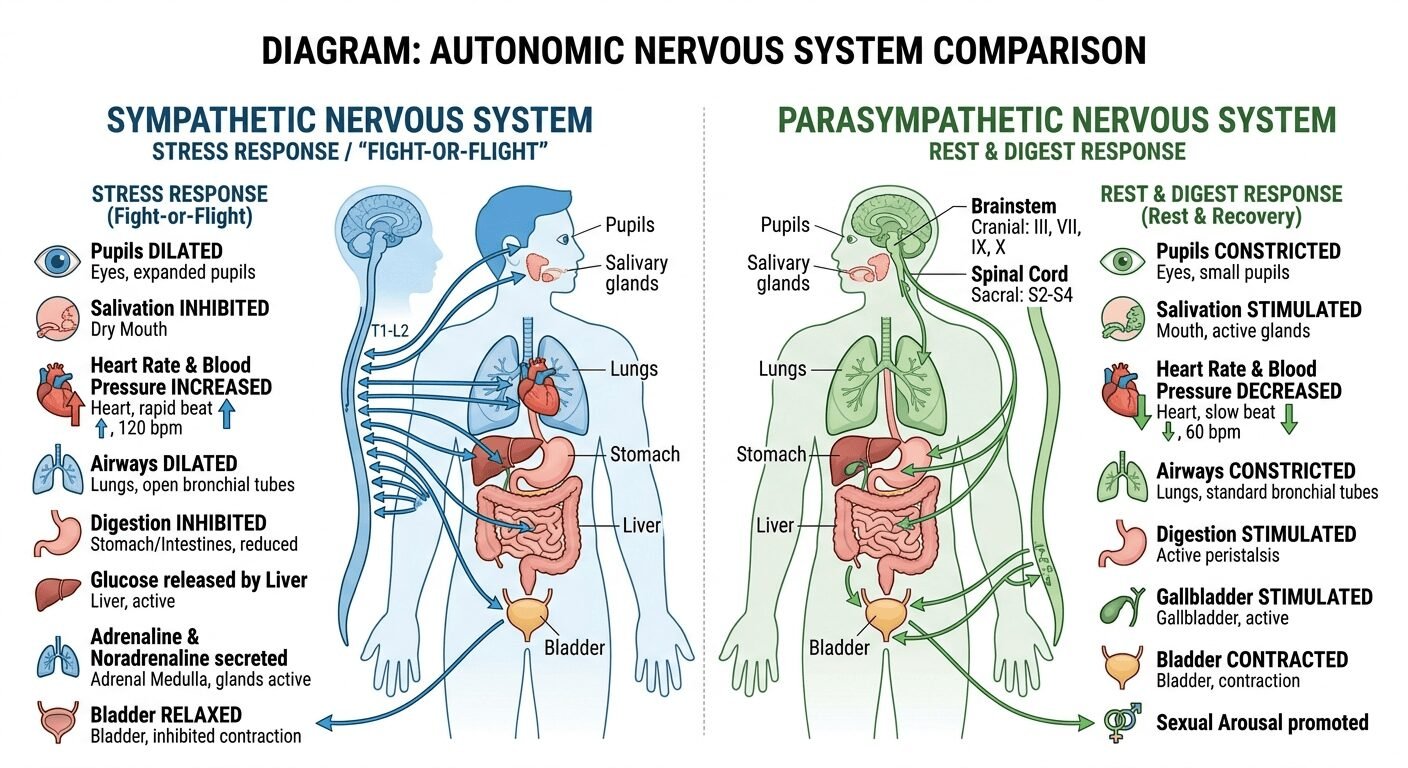
How does stress physically affect female libido? Stress triggers your sympathetic nervous system, activating the fight-or-flight response that suppresses reproductive hormones and redirects blood flow away from sexual organs toward muscles and vital organs needed for survival.
When your brain senses stress, it doesn’t distinguish between running from danger and managing a difficult work project. Your body responds the same way:
- Heart rate increases
- Breathing becomes shallow and rapid
- Muscles tighten, especially in your jaw, neck, and shoulders
- Your stomach pulls inward or feels knotted
- Attention narrows to perceived threats
- Blood flow shifts from digestive and reproductive systems to limbs
Physical signs of stress: increased heart rate, shallow breathing, muscle tension, jaw clenching, narrowed attention, digestive changes, and reduced genital blood flow.
These responses served our ancestors well when facing immediate physical threats. But when the same system stays active throughout your day—during commutes, work meetings, household management, and bedtime worries—there’s simply less physiological capacity for pleasure. Your body operates from a limited pool of resources. When stress consumes most of those resources, desire has nowhere to live.
The Fight-or-Flight Response and Intimacy
The sympathetic nervous system (fight-or-flight) and the parasympathetic nervous system (rest-and-digest) work like a seesaw. When one is active, the other is suppressed.
Intimacy and sexual response require parasympathetic activation. This is the state where your body feels safe enough to turn attention inward, where breathing deepens naturally, where muscles soften, and where blood can flow to sexual organs. You can’t access this state while your sympathetic nervous system is dominant. This is why you might feel physically present with your partner but emotionally and physiologically absent. Your body is still scanning for threats, still managing stress signals, still in survival mode. It’s not a choice or a reflection of your feelings for your partner. It’s neurobiology.
Why “Just Relax” Doesn’t Work
Telling a stressed woman to “just relax” is like telling someone with a broken leg to “just walk.”
The body does not soften on command. Nervous system regulation requires specific conditions and practices, not willpower. When someone suggests you relax, they’re asking you to override your body’s protective mechanisms through sheer effort—which creates more stress.
What your body actually needs is safety. Not the absence of stress, but the presence of enough safety signals to shift from sympathetic to parasympathetic dominance. This happens through nervous system regulation practices, boundary setting, somatic check-ins, and building body trust over time.
What Is Nervous System Safety?
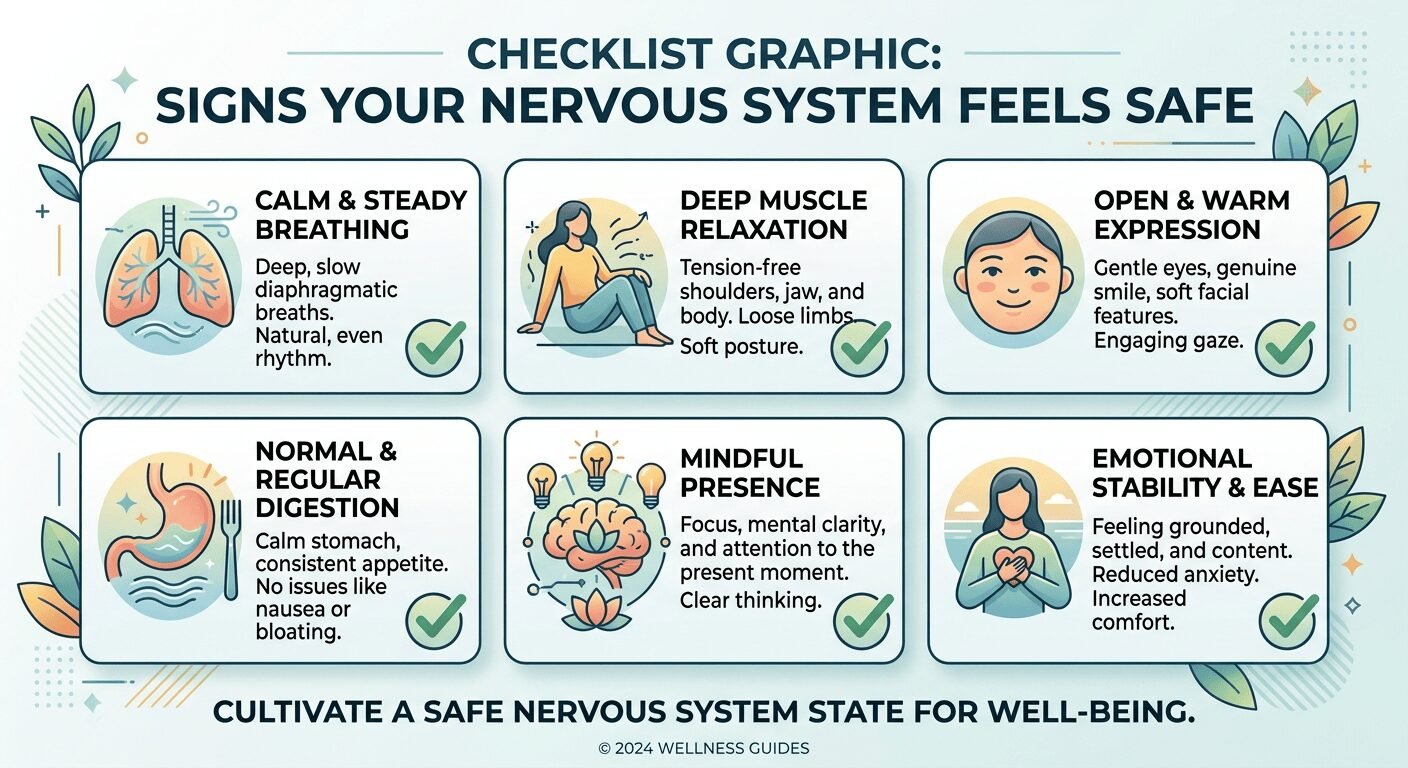
Nervous system safety means your body receives enough signals that it is not in danger, not being rushed, not being judged, and not being forced to perform. It is the foundation for pleasure and desire to emerge naturally.
This isn’t about eliminating all stress from your life—that’s impossible. It’s about creating enough moments of safety throughout your day that your nervous system can reset and access different states.
Nervous system safety may come through:
- Rest that feels truly restorative, not just exhaustion
- Emotional warmth from yourself and others
- Less pressure around performance or outcomes
- A clear no that’s respected without negotiation
- Help with responsibilities that lightens your load
- Touch without expectations of where it must lead
- A calmer transition from work to rest
- A feeling that honesty is allowed without punishment
When you practice setting clear boundaries, you create external conditions that support internal safety. Boundaries aren’t walls—they’re gates you control, allowing you to regulate what enters your nervous system.
How Safety Signals Activate Desire
Safety signals tell your parasympathetic nervous system it’s okay to come online. When this happens, several things shift:
Your breathing deepens automatically. Your heart rate slows. Muscles release tension. Blood flow redistributes to include sexual organs. Your attention can turn inward toward sensation rather than outward toward threat detection.
This is the state where responsive desire can emerge. Not because you’ve forced it, but because you’ve created conditions where it’s physiologically possible.
Creating Safety in Your Daily Environment
You don’t need hours of meditation or a complete life overhaul to create nervous system safety. Small, consistent signals add up:
- Morning: Five minutes of stillness before checking your phone
- Midday: A brief walk outside to reset your nervous system
- Evening: A transition ritual between work and home
- Bedtime: Permission to rest without productivity guilt
- Throughout the day: Checking in with your body’s needs
These practices support nervous system regulation and build body trust over time. They tell your nervous system: “You’re safe. You can rest. You don’t have to be on alert constantly.”
Understanding Responsive Desire vs. Spontaneous Desire
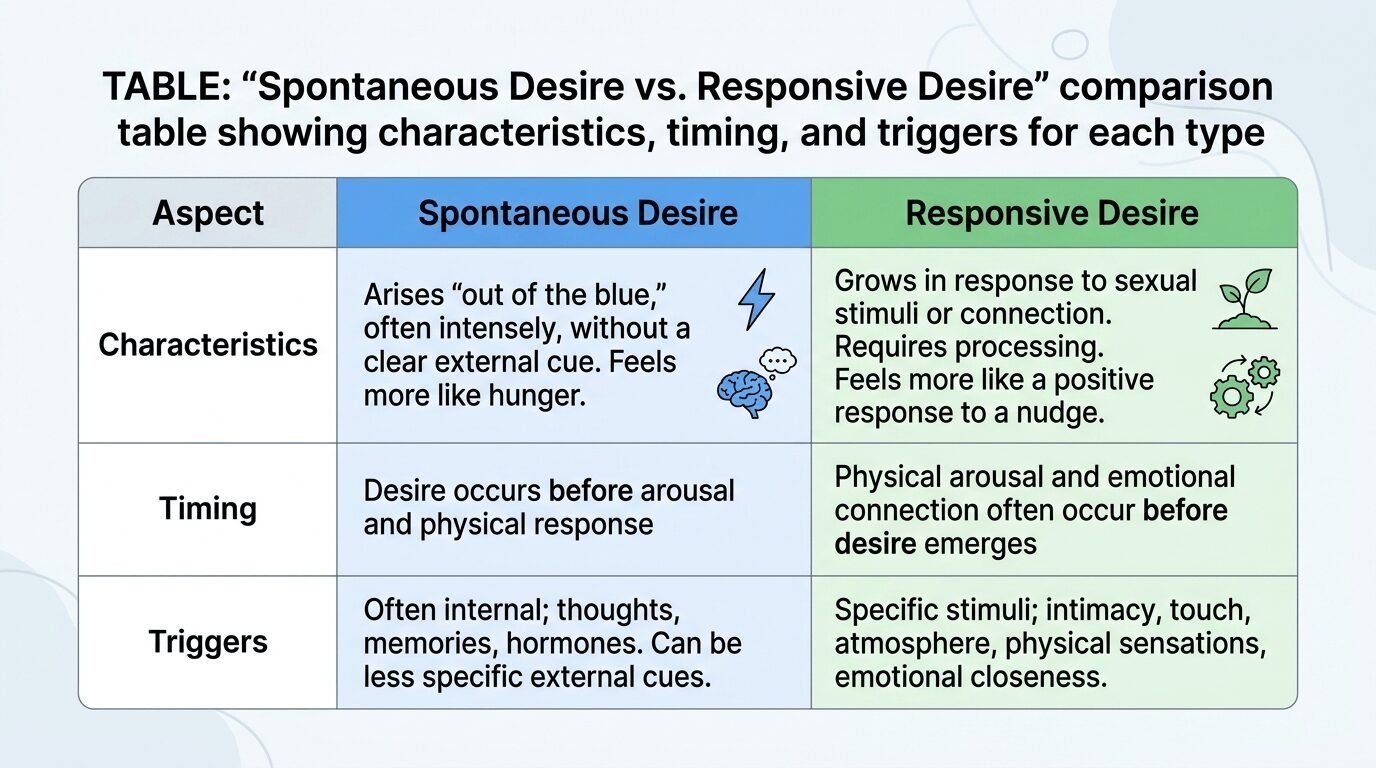
Responsive desire is desire that appears after warmth, safety, and connection have been created. Unlike spontaneous desire, which arises unexpectedly, responsive desire emerges in response to pleasurable stimuli and emotional safety.
Many women experience responsive desire, especially when stressed. This is normal. This is healthy. And this is often misunderstood.
| Spontaneous Desire | Responsive Desire |
|---|---|
| Appears unexpectedly, like a sudden thought | Emerges after safety and connection are established |
| Often described as “out of the blue” | Builds gradually in response to stimuli |
| Common in early relationship stages | Common in long-term relationships and during stress |
| Feels like hunger appearing randomly | Feels like hunger appearing when you smell food |
| Neither better nor worse—just different timing | Neither better nor worse—just different timing |
| May decrease during high-stress periods | Often more accessible during stress with proper support |
According to research on the Dual Control Model of sexual response, both types of desire are normal variations of human sexuality. Neither indicates a problem. Neither is superior.
When you reconnect with their bodies through gentle practices, you may find that responsive desire becomes more accessible. It’s not about creating spontaneous desire—it’s about honoring how your desire actually works.
Why Many Women Experience Responsive Desire
Responsive desire is particularly common among women managing multiple responsibilities. When your mind is occupied with tasks, worries, and other people’s needs, spontaneous desire has little room to surface.
This doesn’t mean you’re broken or that your relationship is failing. It means your desire has a different rhythm—one that requires a bridge from your current state to a state where pleasure is accessible.
Many women blame themselves for not feeling spontaneous desire. But desire can have a rhythm. It may need a bridge. Understanding this removes shame and opens the door to working with your body instead of against it.
The Bridge from Stress to Pleasure
The eBook explains that many women expect desire to arrive suddenly after a noisy day, a busy mind, and a hard body. But that is a large jump. The body needs a bridge from stress to pleasure.
That bridge is not seduction pressure. It’s nervous system care.
This bridge might look like:
- Twenty minutes of quiet after work before engaging with family
- A warm shower to shift from work mode to home mode
- Gentle touch that doesn’t demand a sexual response
- A conversation that acknowledges your stress without trying to fix it
- Permission to say no without guilt
These aren’t obstacles to intimacy. They’re pathways to it.
The Dual Control Model: Your Body’s Brakes and Accelerators
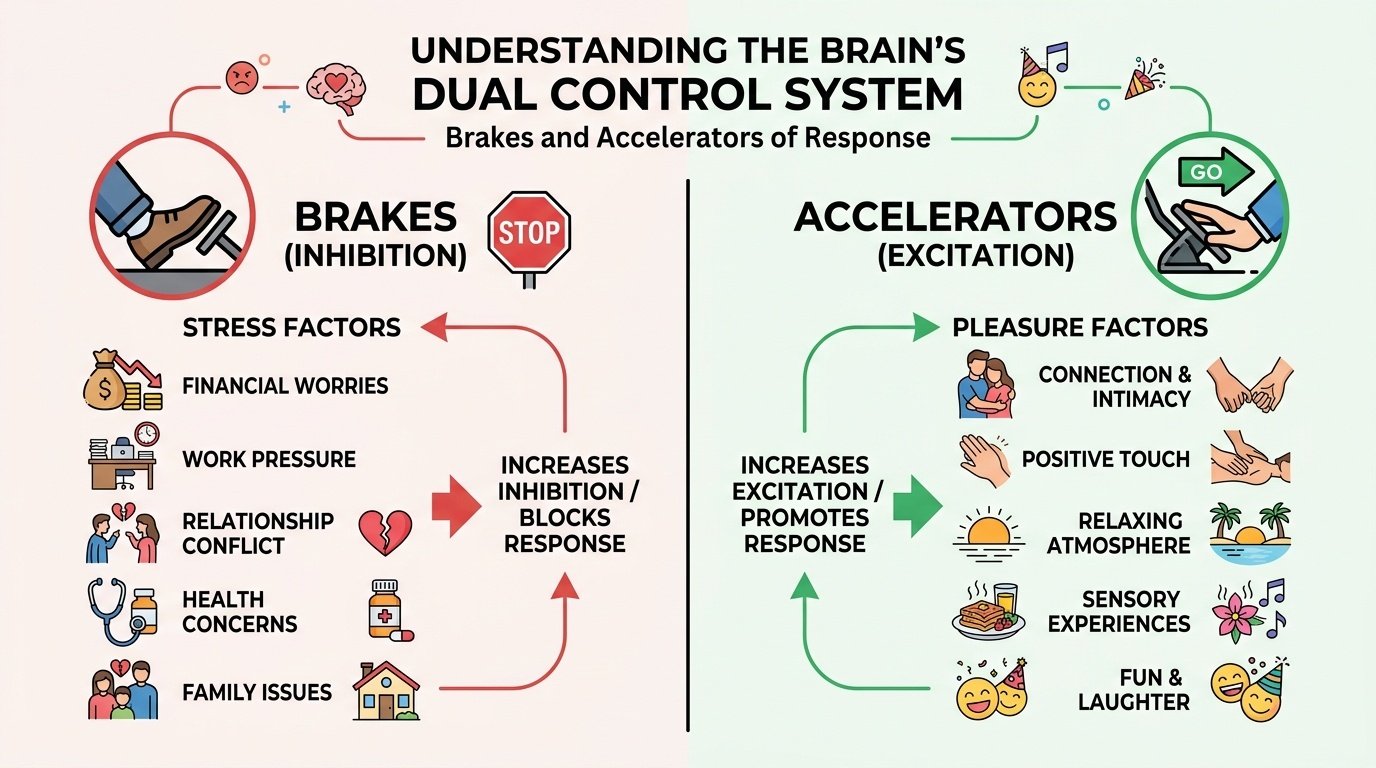
The Dual Control Model, developed by researchers and popularized by sex educator Emily Nagoski, explains sexual response through two systems: inhibition (brakes) and excitation (accelerators).
The Dual Control Model describes how sexual response depends on both excitation factors (accelerators) that turn desire on and inhibition factors (brakes) that turn it off. Stress activates your brakes, making it harder for accelerators to work effectively.
Think of it like driving a car. You need both the accelerator and the brakes to function properly. But if someone is constantly riding the brakes, pressing the accelerator harder won’t help—you’ll just create friction and heat without movement.
For many women experiencing low desire, the issue isn’t that the accelerator is broken. It’s that the brakes are being pressed too hard by stress, worry, exhaustion, and lack of safety.
Identifying Your Brakes
Common inhibition factors (brakes) include:
- Stress and overwhelm from daily responsibilities
- Performance pressure to desire or respond a certain way
- Body shame or negative self-talk
- Unresolved conflict in your relationship
- Fear of consequences (pregnancy, judgment, disappointment)
- Exhaustion and sleep deprivation
- Feeling touched out from constant caregiving
- Lack of privacy or time alone
- Emotional flooding from unresolved feelings
When these brakes are active, no amount of seduction or willpower can override them. The solution isn’t pressing the accelerator harder—it’s releasing the brakes.
Pressing the Accelerator Safely
Excitation factors (accelerators) vary widely between individuals, but common ones include:
- Emotional connection and feeling seen
- Physical attraction to your partner
- Erotic thoughts or fantasies
- Pleasant physical sensations
- Feeling desired by your partner
- Novelty or new experiences
- Positive body image in the moment
- Anticipation built over time
The key is pressing the accelerator after you’ve released the brakes. Trying to create desire while your nervous system is in survival mode creates frustration, shame, and more stress—activating the brakes even harder.
Common Signs Stress Is Blocking Your Desire
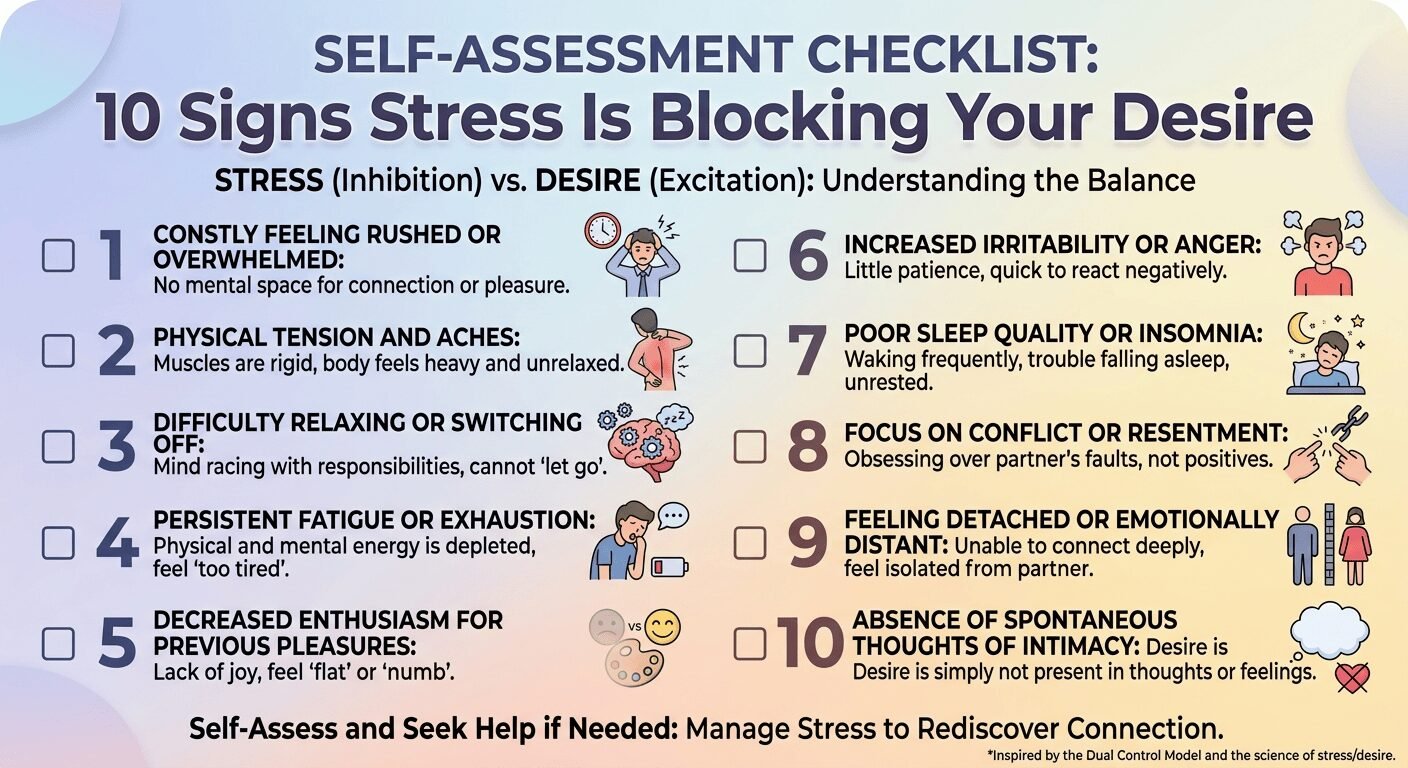
You may need a shame-free stress and desire reset if you notice these signs:
- You feel love, but your body feels closed. Your emotions say yes, but your physiology says no. You might want to want intimacy, but your body remains tense, distant, or numb.
- You feel tired more than available. Exhaustion isn’t just physical—it’s nervous system depletion. You collapse into bed each night with nothing left to give, even when you care deeply about your partner.
- You feel tense when intimacy is expected. Your body anticipates pressure, creating a stress response before anything even happens. You might notice your muscles tightening or your breathing changing when your partner initiates.
- You want connection, but your mind keeps listing tasks. Even in intimate moments, your brain is managing your to-do list, worrying about tomorrow, or replaying today’s conflicts. You’re physically present but mentally elsewhere.
- You feel guilty for low desire. Shame compounds the problem. You blame yourself for not feeling what you “should” feel, creating more stress that further suppresses desire.
- You feel pressure to respond before your body is ready. You might say yes when your body wants to say no, creating a pattern of disconnection between your mind and your physiology.
- You need rest, privacy, or emotional warmth before closeness. This isn’t a problem—it’s information. Your body is telling you what it needs to access desire.
- You feel like you’re always in work mode. Even at home, even in bed, your nervous system stays in task-management mode, unable to shift into receptivity.
- You feel touched out, overwhelmed, or emotionally full. After a day of physical and emotional demands, the idea of more touch feels like too much, not like comfort.
- You wonder, “Do I not love my partner anymore, or am I just exhausted?” This question itself is a sign. If you’re asking it, the issue is likely stress, not love.
These signs do not automatically mean the relationship is failing. They may mean your nervous system has not had enough safety, rest, or space.
If you’re struggling with overcoming body shame alongside these symptoms, know that both are common responses to stress and both can heal with compassionate support.
Physical Signs of Stress-Related Low Desire
Beyond the emotional and mental signs, your body gives you physical information:
- Persistent muscle tension, especially in your jaw, shoulders, and pelvis
- Shallow breathing that never fully deepens
- Digestive issues or stomach discomfort
- Difficulty falling or staying asleep
- Headaches or migraines
- Reduced genital sensation or numbness
- Chronic fatigue that rest doesn’t resolve
These aren’t separate from your low desire—they’re part of the same stress response pattern.
Emotional and Mental Signs
Emotional flooding, guilt, and performance pressure create a mental environment where desire cannot thrive. When you’re constantly monitoring your responses, worrying about your partner’s feelings, or judging yourself for not feeling enough, you create additional stress that further suppresses desire.
This is why addressing intimacy burnout requires more than just “trying harder.” It requires creating safety, releasing pressure, and allowing your nervous system to reset.
How Cortisol and Libido Are Connected
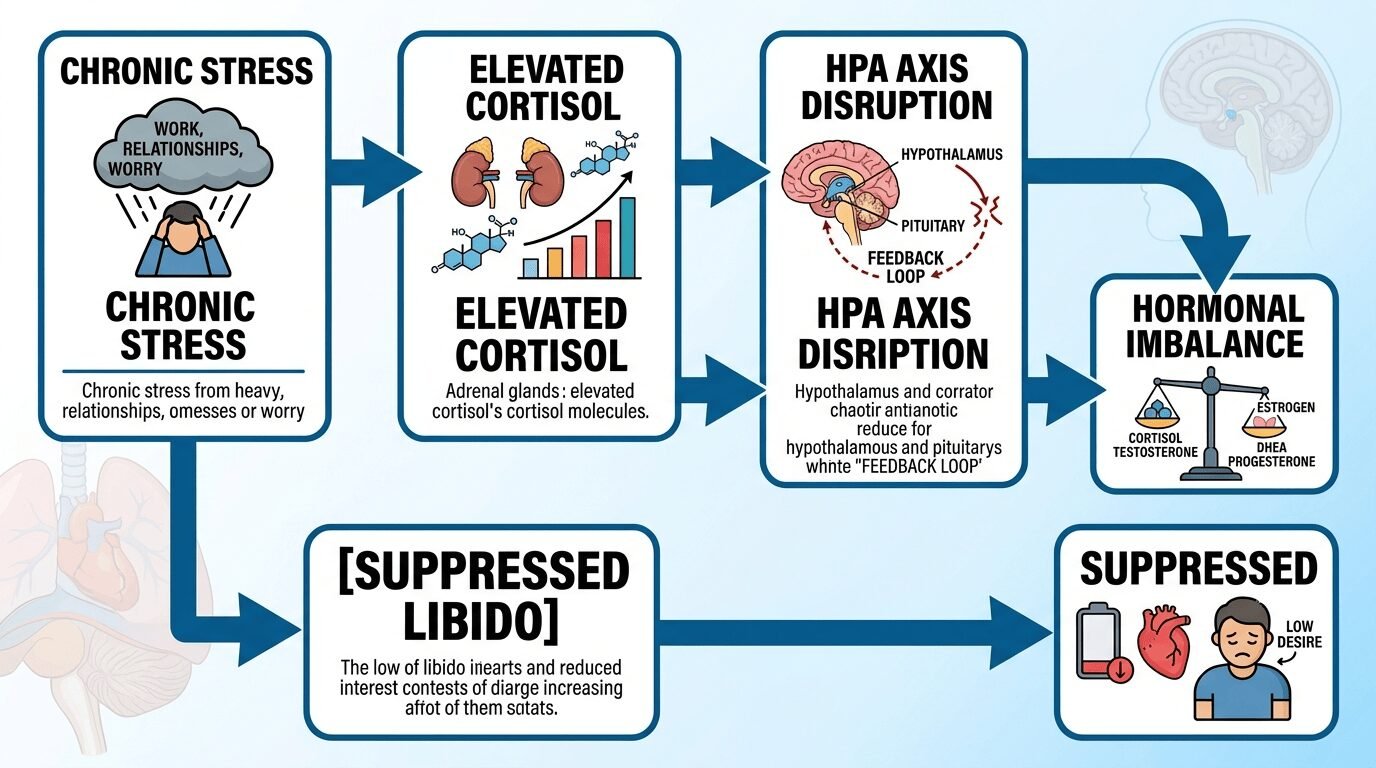
How does cortisol affect female libido? Elevated cortisol from chronic stress suppresses sex hormones like estrogen and testosterone, disrupts the HPA axis, and signals your body to deprioritize reproduction and pleasure in favor of survival.
Cortisol is your primary stress hormone. When released occasionally in response to acute stress, it helps you respond to challenges. But when cortisol stays elevated due to chronic stress, it creates hormonal imbalances that directly impact desire.
The Stress Hormone Cascade
Here’s what happens in your body:
- Stress activates your HPA axis (hypothalamic-pituitary-adrenal axis)
- Cortisol and adrenaline flood your system
- Blood sugar rises to provide quick energy
- Reproductive hormones are suppressed because they’re “non-essential” for immediate survival
- Estrogen and testosterone levels drop
- Libido decreases as your body redirects resources
This isn’t a defect. It’s your body’s intelligent prioritization system. When resources are limited, survival comes before reproduction. Pleasure comes after safety.
Long-Term Effects of Chronic Stress
Acute stress (a single difficult day) creates temporary changes. Chronic stress (weeks, months, or years of ongoing pressure) creates lasting hormonal imbalances that contribute to intimacy burnout and persistent low desire.
Long-term elevated cortisol can lead to:
- Disrupted menstrual cycles
- Reduced vaginal lubrication
- Decreased sexual arousal
- Difficulty reaching orgasm
- Persistent fatigue
- Mood changes that further impact desire
- Weakened immune function
The good news: these changes are typically reversible when you address the underlying stress and support your nervous system in returning to balance.
Creating Nervous System Safety: Practical Daily Strategies
You don’t need to eliminate all stress to create nervous system safety. You need consistent, small practices that signal safety to your body throughout the day.
Here are gentle practices for nervous system safety:
Morning Practices for Safety
How you start your day sets the tone for your nervous system:
- Wait before reaching for your phone. Give yourself 5-10 minutes of stillness before flooding your brain with information and demands.
- Breathe deeply before getting up. Three slow breaths signal safety to your nervous system before the day begins.
- Set an intention, not a to-do list. Instead of immediately cataloging tasks, ask: “How do I want to feel today?”
- Move your body gently. Stretch, walk, or do yoga—not to optimize productivity, but to reconnect with sensation.
- Eat something nourishing. Blood sugar stability supports nervous system regulation.
These practices take minutes, not hours. But they tell your body: “We have time. We’re not in emergency mode.”
Evening Transition Rituals
The bridge from work to rest is critical for accessing desire. Without it, you carry the day’s stress into intimate moments.
Consider these transition rituals:
- Create a buffer zone. Twenty minutes between work and family time to decompress.
- Change your clothes. Physical shifts support nervous system shifts.
- Take a warm shower or bath. Warm water activates the parasympathetic nervous system.
- Write down tomorrow’s tasks. Get them out of your head and onto paper so your brain can release them.
- Set a “no serious conversations” time. Like Renata’s story, where no serious conversations after 9 p.m. lowered her nervous system’s starting point.
These rituals aren’t luxuries. They’re necessities for nervous system regulation.
Micro-Moments of Safety Throughout the Day
You don’t need hours of meditation. Brief somatic check-ins throughout your day add up:
- Pause and breathe before transitioning between activities
- Notice tension and consciously soften one muscle group
- Step outside for fresh air and natural light
- Drink water slowly, noticing the sensation
- Place a hand on your heart and breathe into it for 30 seconds
- Name what you’re feeling without judgment
These micro-moments build body trust and support nervous system regulation throughout your day.
Partner Communication: Talking About Low Desire Without Shame
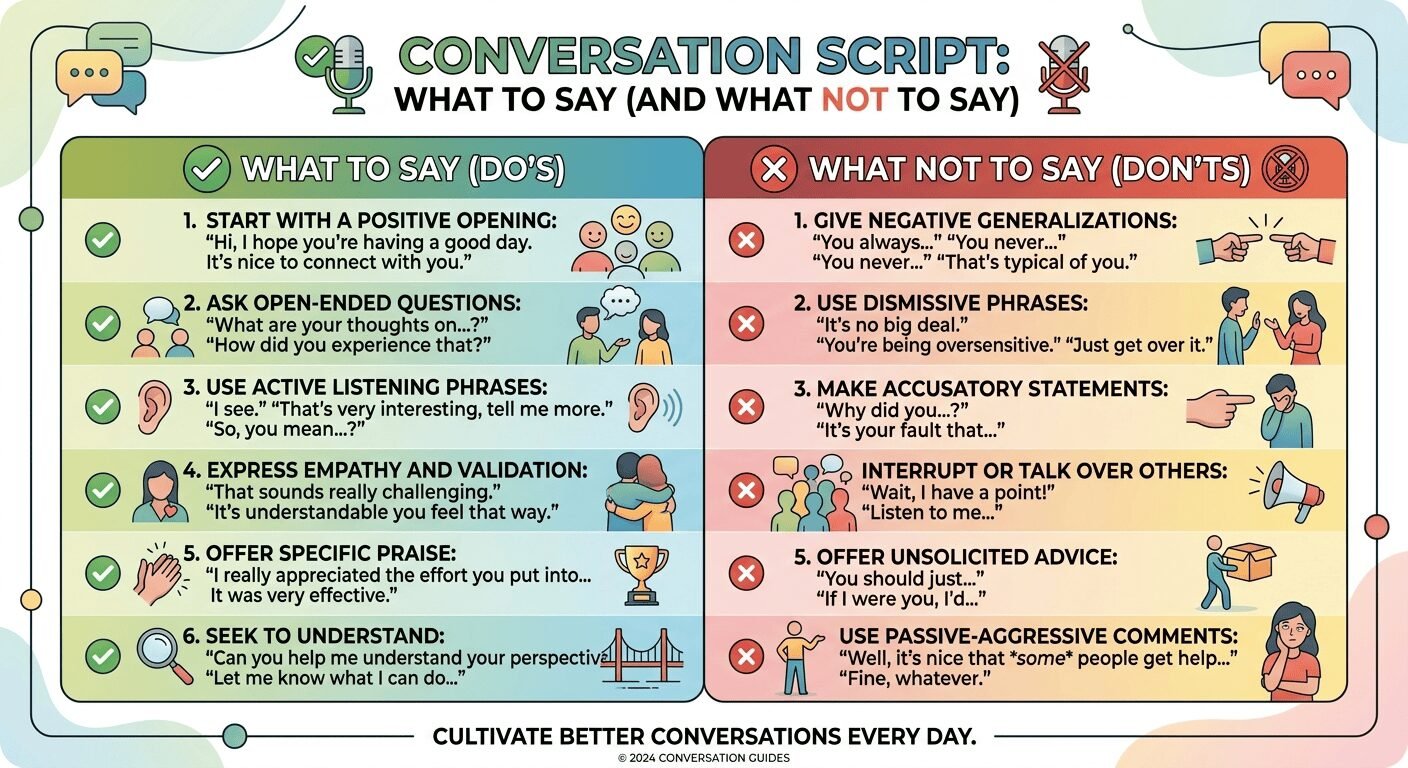
How do I talk to my partner about low desire due to stress? Start with “I” statements about your experience, not blame. Example: “I’ve been feeling overwhelmed, and my body needs more time to transition from work to rest. Can we talk about how to create more safety together?”
This conversation is vulnerable. It requires honesty about your experience without making your partner the problem. The goal isn’t to justify your low desire—it’s to invite collaboration in creating conditions where desire can return.
Scripts for Starting the Conversation
Try these conversation starters:
- “I want to talk about something that’s hard for me. I’ve been experiencing low desire, and it’s not because I don’t love you or find you attractive. My body has been carrying a lot of stress, and I’m learning how to create more safety so I can feel more available.”
- “I notice that when I’m stressed, my body closes down. This isn’t about you—it’s about my nervous system needing support. Can we talk about what might help me feel safer and more connected?”
- “I’m feeling pressure around intimacy, and that pressure is making it harder for me to access desire. I need us to slow down and create more space for connection without expectation. Can we try that together?”
These scripts focus on your experience, not your partner’s failures. They invite collaboration instead of creating defensiveness.
How Partners Can Support Nervous System Safety
Partners can actively support nervous system safety through:
- Reducing pressure around sexual performance or frequency
- Offering emotional warmth without expecting it to lead to sex
- Helping with responsibilities to lighten your load
- Providing touch without expectations of where it must lead
- Respecting boundaries when you say no
- Creating space for transition between work and intimacy
- Listening without trying to fix your experience
- Expressing appreciation for who you are, not just what you do
The key is creating safety, not trying to “fix” or seduce you into desire. Open communication about needs is essential.
What to Avoid Saying
Certain phrases activate stress responses and press the brakes harder:
- “You never want sex anymore” (creates shame and pressure)
- “What’s wrong with you?” (implies brokenness)
- “Everyone else’s partner wants sex” (creates comparison and inadequacy)
- “Just relax” (invalidates your experience)
- “If you loved me, you’d want me” (creates guilt and obligation)
- “You’re always too tired” (implies laziness or lack of care)
These phrases, even when said from hurt or frustration, activate your nervous system’s threat response, making desire even less accessible.
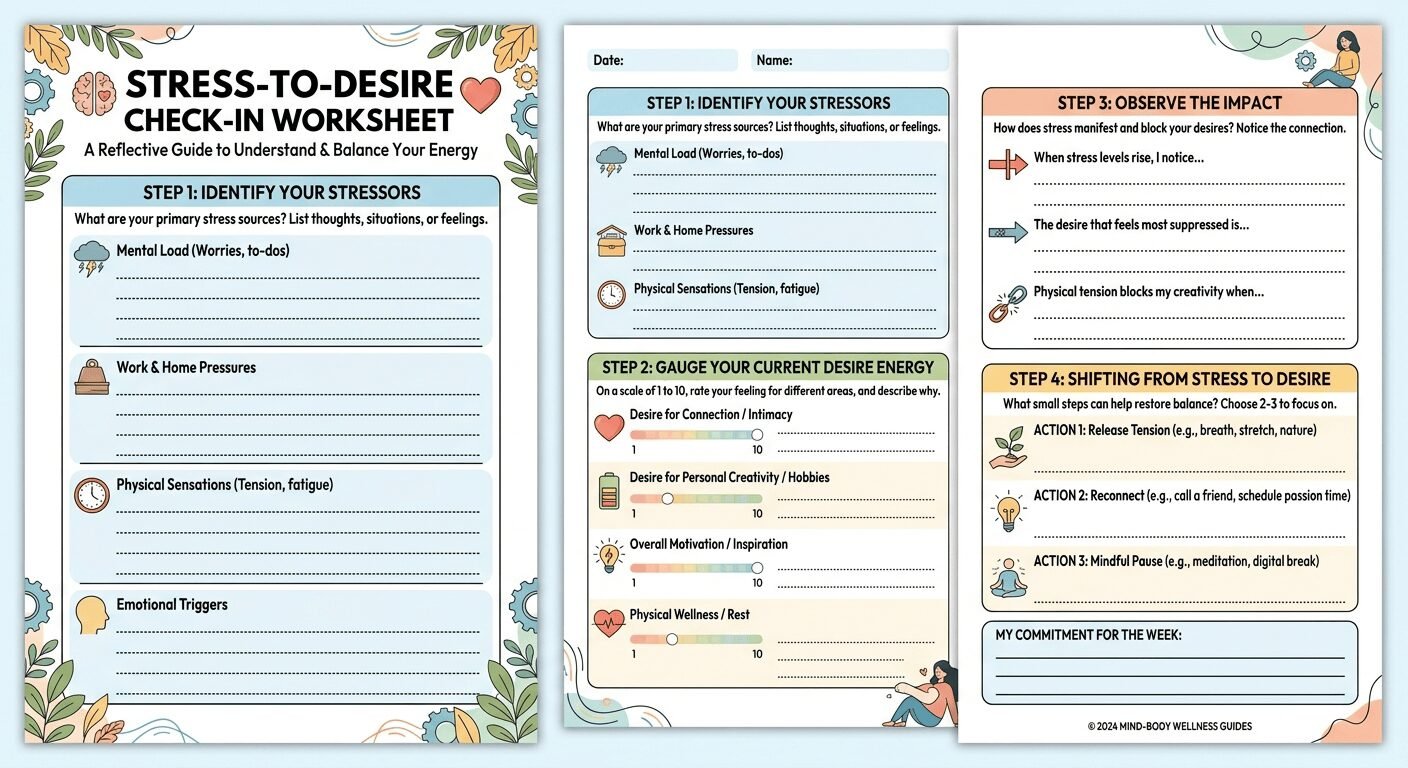
The Stress-to-Desire Check-In: A Gentle Daily Practice
This practice helps you reconnect with your body’s needs and create conditions where desire can emerge naturally.
Step-by-Step Instructions
- Step 1: Pause and arrive. Stop what you’re doing. Place both feet on the floor. Take three slow breaths, noticing the sensation of air entering and leaving your body.
- Step 2: Scan your body. Without judgment, notice what you’re feeling. Tension? Exhaustion? Numbness? Warmth? Simply observe.
- Step 3: Ask the core question. “What condition does my body need before desire can wake up?” Let the answer come from your body, not your mind.
- Step 4: Listen for the answer. It might be:
- Ten minutes alone
- A slower evening
- No serious conversations after a certain time
- A shower, quiet, or sleep
- Emotional reassurance
- Touch without expectations
- Permission to say no
- Step 5: Choose one small action. Not a complete life overhaul. One small thing you can do today to move toward that condition.
- Step 6: Honor your answer. If your body needs rest, rest. If it needs connection, reach out. If it needs space, create it. This builds body trust.
- Step 7: Notice without judgment. There’s no “right” answer. Your body’s needs are valid information, not problems to solve.
Practice this once daily, or before intimate conversations. Over time, you’ll build a deeper relationship with your body’s rhythms and needs.
Renata’s Story: A Composite Case Study
Note: This is a composite case study based on common client experiences to illustrate how these principles work in real life.
Renata thought her desire had broken. She loved her partner, but after long days managing work, children, and household responsibilities, the idea of intimacy felt impossible. She blamed herself, wondering if she’d fallen out of love.
Through the Stress-to-Desire Check-In, Renata began to see the bigger picture. Her daily check-ins revealed patterns: there was no tenderness in her days, no bridge from work to rest, no privacy, and no time when no one asked anything from her.
She started small. She implemented a regular bedtime. She set a boundary: no serious conversations after 9 p.m. She asked her partner to handle bedtime routines three nights a week so she could have quiet time. She gave herself permission to say no without guilt.
These small changes lowered her nervous system’s starting point. Gradually, desire stopped feeling impossible. It didn’t return as spontaneous fireworks, but as responsive warmth that emerged after safety and connection.
That is how healing often begins. Not with a magical solution. Not with pressure. But by removing enough weight for the body to speak again.
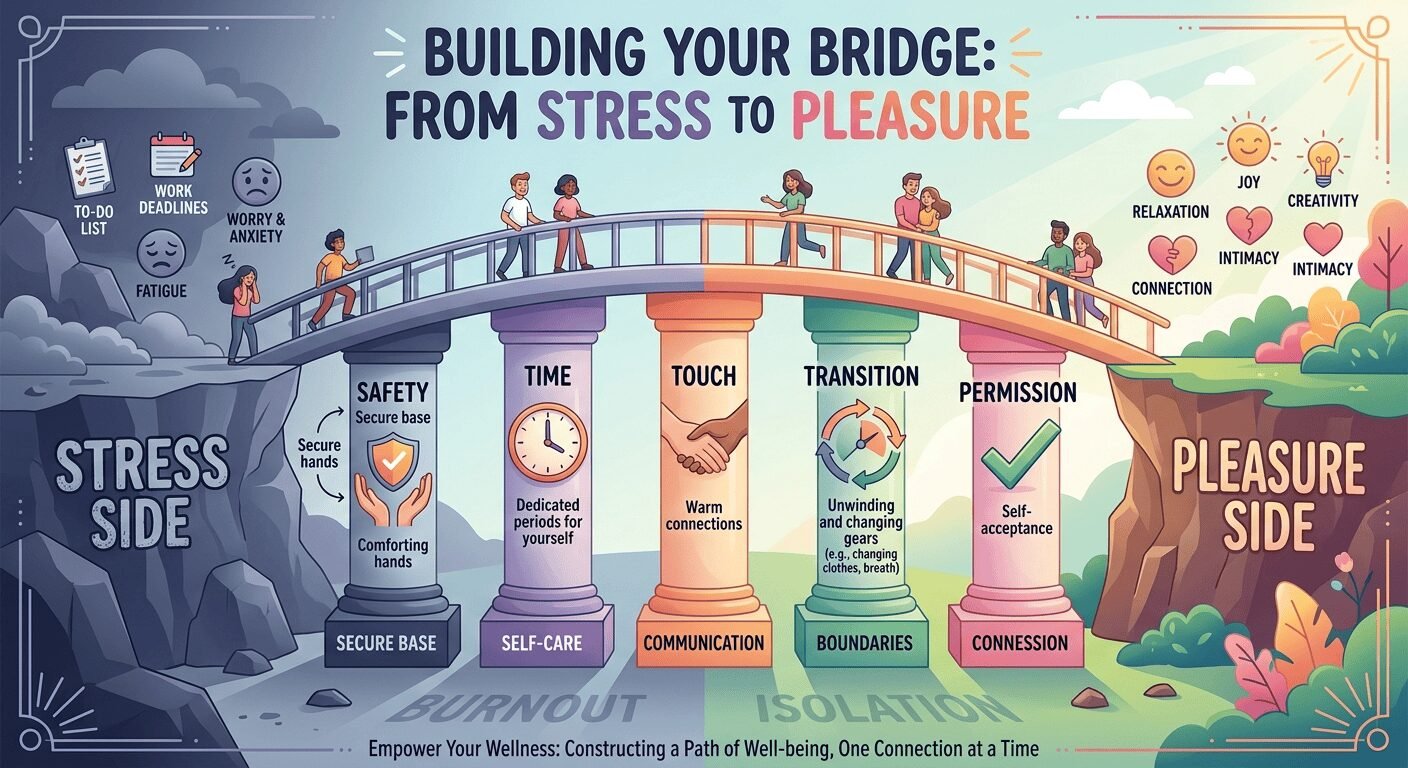
Building a Bridge from Stress to Pleasure
The bridge from stress to pleasure isn’t built in a single moment. It’s constructed through daily practices, small transitions, and consistent nervous system care.
This bridge requires:
- Time to shift states
- Safety to soften
- Permission to move at your own pace
- Support from yourself and your partner
- Patience with your body’s rhythm
Non-Sexual Touch and Connection
Before sexual intimacy becomes accessible, non-sexual touch rebuilds the foundation:
- Holding hands without expectation
- Hugging for 20 seconds or longer (this releases oxytocin)
- Sitting close while watching TV or talking
- Gentle massage that doesn’t demand reciprocation
- Cuddling with no agenda
- Kissing that’s playful, not goal-oriented
This touch without expectations tells your nervous system: “Connection is safe. You don’t have to perform. You can just be.”
Creating Time and Space for Transition
You can’t jump from stress to pleasure. You need transition time:
- Schedule buffer time between work and intimacy
- Create a slower evening routine that allows decompression
- Protect privacy so you’re not managing others’ needs constantly
- Set boundaries around serious conversations before bed
- Build in alone time to reset your nervous system
Practical scheduling advice: If you know you need 30 minutes to transition from work mode to connection mode, protect that time. It’s not selfish—it’s necessary for accessing desire.
When to Seek Professional Support
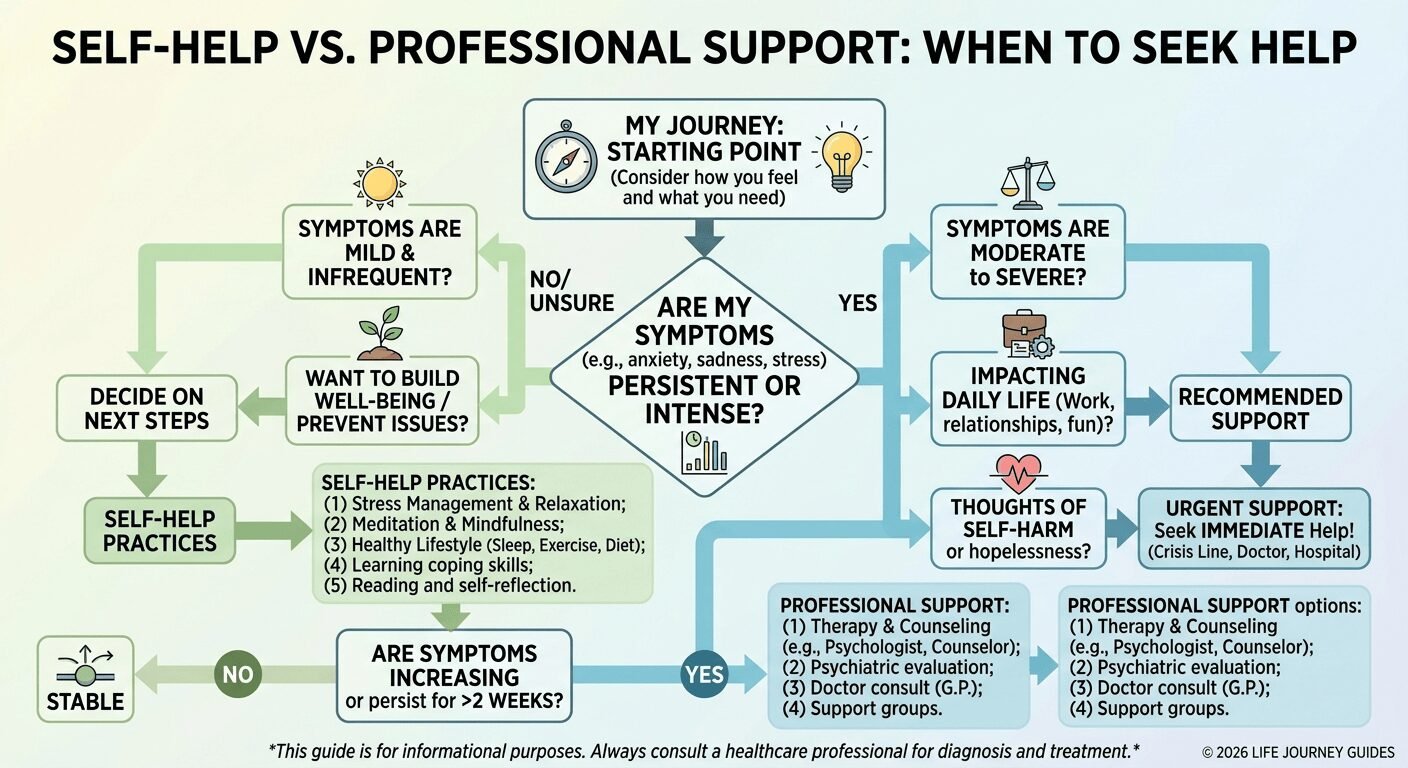
While stress-related low desire is common and often resolvable through nervous system care, there are times when professional support is helpful or necessary.
When should I see a doctor or therapist for low desire? Consider professional support if self-help strategies aren’t creating change after several months, if low desire causes significant distress, if you suspect hormonal issues, or if relationship conflicts are contributing to the problem.
It’s important to note that hypoactive sexual desire disorder (HSDD) is a medical diagnosis that requires persistent, distressing low desire not explained by other factors. However, most stress-related low desire doesn’t meet HSDD criteria—it’s a normal response to overwhelming circumstances.
Red Flags That Need Medical Attention
Seek medical evaluation if you experience:
- Sudden, complete loss of desire with no clear stressor
- Pain during intercourse that wasn’t present before
- Other hormonal symptoms like irregular periods, hot flashes, or extreme fatigue
- Depression or anxiety that interferes with daily functioning
- Medication side effects that may be impacting desire
- Relationship violence or coercion
These require professional assessment to rule out medical causes or address safety concerns.
Types of Professional Support Available
Different professionals offer different types of support:
- Somatic therapy helps you reconnect with body sensations and release stored stress
- Sex therapy addresses sexual concerns with specialized training in sexual health
- Couples counseling works with both partners to improve communication and connection
- Medical evaluation rules out hormonal or physiological causes
- Individual therapy addresses underlying anxiety, depression, or trauma
According to the American Association of Sexuality Educators, Counselors and Therapists (AASECT), seeking professional support is a sign of self-care, not failure.
Key Takeaways: Your Path Forward
As you continue your journey with stress and desire, remember these essential truths:
- Low desire under stress is normal, not a personal failure. Your body is responding intelligently to overwhelming circumstances.
- Your body needs safety signals before pleasure can emerge. This isn’t a flaw—it’s physiology.
- Responsive desire is valid and common. It’s not inferior to spontaneous desire; it’s just different.
- Small, consistent acts of nervous system care create the bridge back to intimacy. You don’t need dramatic changes.
- You deserve patience, understanding, and support. From yourself and from your partner.
- Healing is not linear. Some days will be easier than others. This is normal.
- Compassion over perfection. Be kind to yourself as you navigate this.
- You are not broken. Your desire is buried, not gone. It can return with the right support.
Continue Your Journey: Resources for Deeper Healing
This guide gives you a starting point. But rebuilding desire awareness often needs structure, language, and repeated reflection.
If you’re ready for deeper support, The Confidence & Intimacy Reset for Women offers structured worksheets, reflection prompts, and a shame-free path to rebuild desire awareness at your own pace.
The Confidence & Intimacy Reset for Women
Written by Md. Rizwanul Haque and co-authored by Md. Kawsharul Islam, this comprehensive resource helps you explore:
- How stress, self-talk, physiology, and desire are intertwined
- Shame-free approaches to understanding your body
- Practical strategies for building confidence and connection
- Step-by-step guidance for reclaiming intimacy without pressure
The eBook describes its path as one that helps readers understand how stress, self-talk, physiology, and desire are intertwined, while moving through confidence, pleasure without shame, and lasting connection.
→ Get The Confidence & Intimacy Reset for WomenWorkbook Options and Bundle
For deeper work, consider the workbook options:
- Workbook A4 Size – Printable format for European/international users
- Workbook US Letter Size – Printable format for North American users
- Main Book & Workbook Bundle – Complete package for comprehensive support
The bundle includes worksheets, action prompts, and reflection exercises that guide you through implementing the concepts at your own pace.
→ Get the Complete Bundle → Get the Workbook Only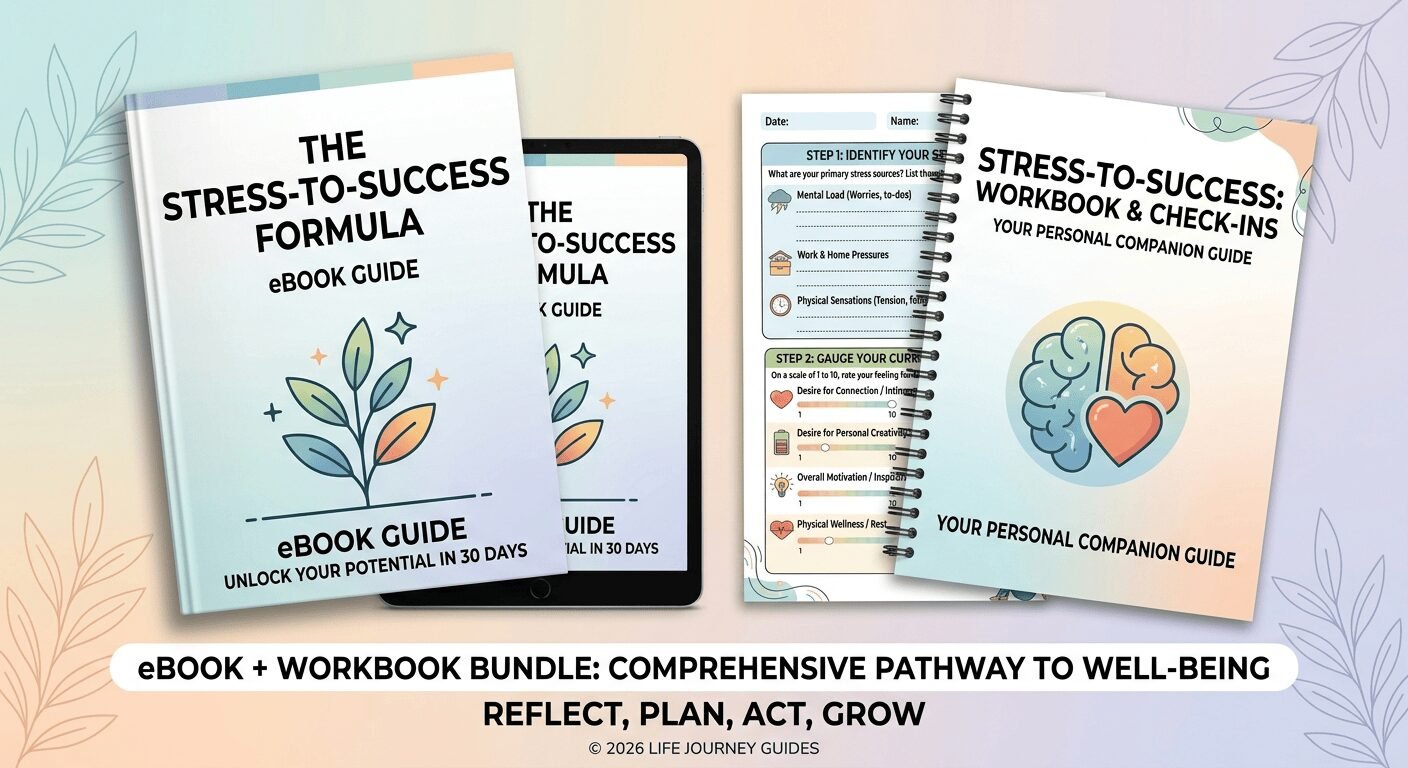
Frequently Asked Questions About Stress and Desire
Can stress cause low libido in women?
Yes, stress is one of the most common causes of low libido in women. When your body is in fight-or-flight mode, it prioritizes survival over pleasure. Chronic stress keeps your nervous system activated, making it difficult to access desire. This is normal and reversible with nervous system care.
What is the difference between spontaneous and responsive desire?
Spontaneous desire appears unexpectedly, while responsive desire emerges after warmth, safety, and connection are created. Many women experience responsive desire, especially when stressed. Neither is “better”—both are normal. Responsive desire simply needs a bridge from stress to pleasure.
How does cortisol affect female libido?
Elevated cortisol from chronic stress suppresses sex hormones like estrogen and testosterone. This hormonal shift naturally reduces desire. Your body is protecting you by deprioritizing reproduction during perceived danger. Lowering stress allows hormones to rebalance and desire to return.
Why don’t I feel desire even though I love my partner?
Love and desire operate through different systems. Your nervous system may be overwhelmed by stress, responsibilities, or lack of safety—even in a loving relationship. This doesn’t mean your love is gone. It means your body needs safety signals before desire can emerge.
How long does it take to rebuild desire after stress?
There’s no universal timeline. Some women notice shifts within days of implementing nervous system safety practices. For others with chronic stress, it may take weeks or months of consistent care. Be patient and compassionate with your body’s pace. Healing is not linear.
Can partners help with stress-related low desire?
Yes. Partners can support by reducing pressure, offering emotional warmth, helping with responsibilities, providing touch without expectations, and respecting boundaries. The key is creating safety, not trying to “fix” or seduce. Open communication about needs is essential.
Is low desire permanent or can it be reversed?
Stress-related low desire is typically reversible. When you address the underlying stress and create nervous system safety, desire often returns naturally. It’s not broken—it’s buried. With compassionate care and the right support, most women reconnect with desire.
What if I’ve tried everything and still feel disconnected?
If self-help strategies aren’t enough, professional support can help. Consider working with a somatic therapist, sex therapist, or couples counselor. Medical evaluation can rule out hormonal issues. You’re not failing—you may just need additional support and tools.
What is nervous system safety?
Nervous system safety means your body receives enough signals that it is not in danger, not being rushed, not being judged, and not being forced to perform. It is the foundation for pleasure and desire to emerge naturally.
How can I talk to my partner about low desire without starting a fight?
Start with “I” statements about your experience, not blame. Example: “I’ve been feeling overwhelmed, and my body needs more time to transition from work to rest. Can we talk about how to create more safety together?” Focus on needs, not deficits.
Final Thoughts: Compassion Over Perfection
Remember, navigating stress and desire is a journey of compassion, not perfection.
Your body is speaking. Listen with kindness. Healing begins when you remove enough weight for desire to speak again.
You are not broken. You are not failing. You are learning to work with your body instead of against it. And that is a profound act of self-love.