

Understanding Your Body: A Gentle Guide to Women’s Body Awareness and Intimacy
Female body education is the missing lesson many women never received—the gentle, shame-free understanding of how their bodies speak, feel, and connect. You may look confident from the outside but feel uncertain inside your own body. You care deeply about connection, yet struggle to explain what feels safe, uncomfortable, or what you truly need. This isn’t because you’re broken. Many women were taught risk and silence before they were taught body awareness. The good news? You can learn this language now. In this guide, you’ll discover what female body education really means and five gentle steps to reclaim intimate confidence.
The Missing Lesson: Why So Many Women Feel Disconnected from Their Bodies
Many women were taught how to protect their bodies before they were taught how to understand them. You were told to be careful. To stay quiet. To avoid shame. To manage how others saw you. But you were never gently taught how your body speaks, how stress affects desire, how comfort and discomfort show up, or how to build intimate confidence without pressure.
That missing lesson can follow you into adulthood. You may look confident from the outside but feel uncertain inside your own body. You may care deeply about connection, yet still struggle to explain what feels safe, what feels uncomfortable, or what you need. If you’ve ever felt this way, you’re not alone. Many women struggle to explain what feels safe in their relationships because they were never given the language to understand their own bodies.
This disconnect isn’t your fault. It’s the result of an incomplete education. When you weren’t taught to listen to your body’s signals, when you weren’t shown how emotional safety connects to physical comfort, when you weren’t given permission to explore your own needs without judgment—of course it feels confusing. Of course intimacy can feel complicated.
The body shame that many women carry isn’t a personal failing. It’s a predictable outcome of risk-based sex education that focused on pregnancy prevention, disease avoidance, and reputation management while completely skipping over the parts that matter most: understanding your body as a source of wisdom, learning to recognize what feels good and what doesn’t, and developing the confidence to honor your own experience.
This is why female body education matters. It’s not about fixing something that’s broken. It’s about filling in the gaps. It’s about giving yourself permission to learn what you were never taught—to return to your body with curiosity instead of criticism, with kindness instead of judgment.
What Is Female Body Education? A Clear Definition
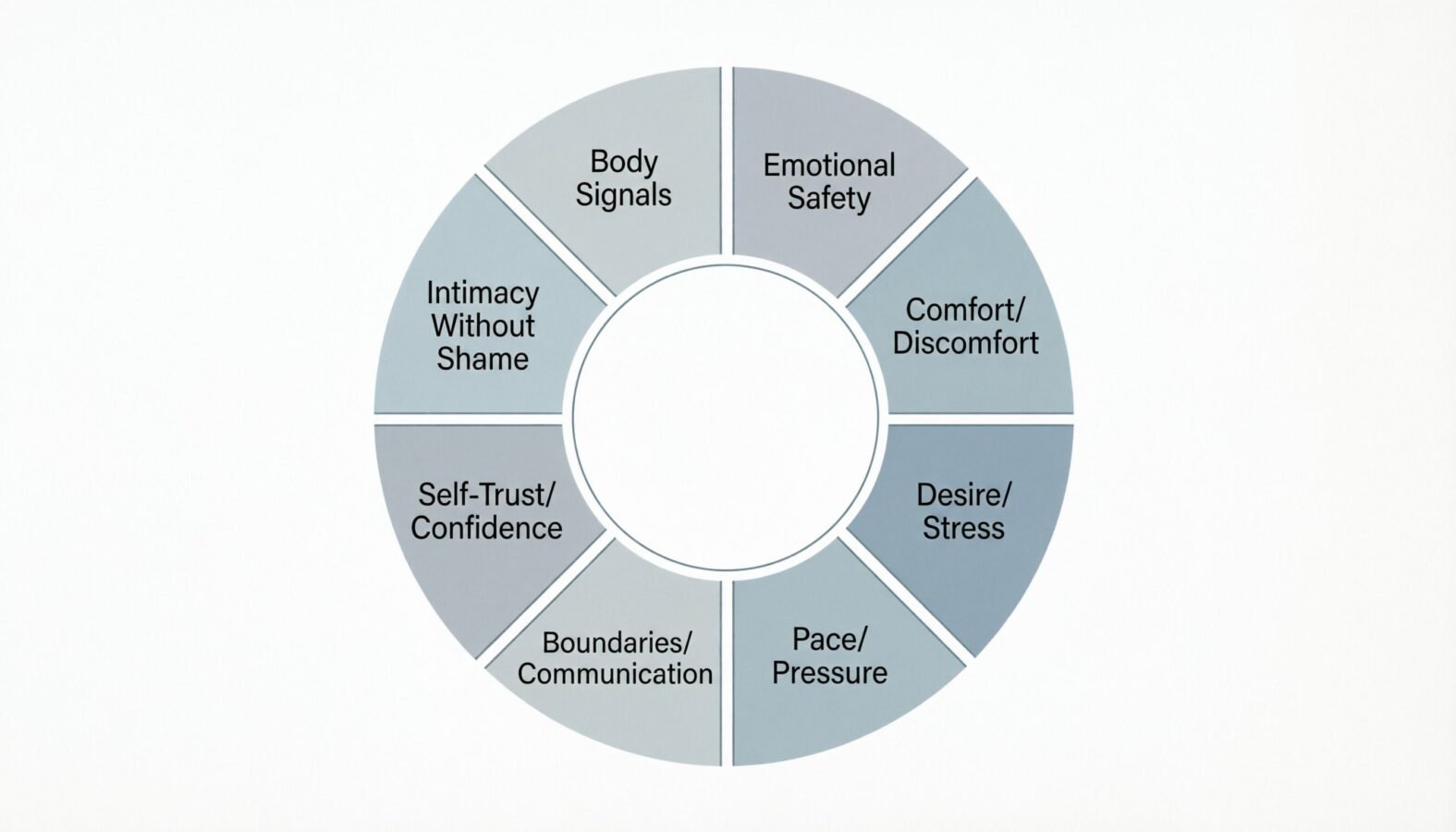
Female body education is the process of learning your body with respect, beyond just anatomy or sexual health facts. It includes understanding body signals, emotional safety, comfort and discomfort, desire and stress, pace and pressure, boundaries and communication, self-trust, and intimacy without shame. Unlike traditional risk-based sex education, it focuses on helping you understand your body as a home rather than a warning sign.
Female body education is not only anatomy. It is not only sexual health. It is not only learning names or facts. It is the process of learning your body with respect, aiming for shame-free understanding of your unique physical and emotional landscape.
It includes:
- Body signals: Recognizing what your body is telling you through physical sensations.
- Emotional safety: Understanding how emotions and physical feelings connect.
- Comfort and discomfort: Learning to identify what feels right and what doesn’t.
- Desire and stress: Recognizing how stress affects your body’s responses.
- Pace and pressure: Understanding your body’s natural rhythms and needs.
- Boundaries and communication: Developing the language to express your needs.
- Self-trust and confidence: Building faith in your own experience.
- Intimacy without shame: Creating space for connection free from judgment.
This matters because many women were trained to understand everyone else first. You may notice a partner’s mood, a child’s needs, a boss’s tone, or a heavy family environment, but still struggle to notice your own body signals. This isn’t failure; it’s the result of training, and learning the language within takes time.
So female body education is not about becoming someone new. It’s about returning to yourself with better language. It’s about developing somatic awareness—the ability to feel and interpret what’s happening in your body—so you can make choices that honor your whole self.
The Hidden Impact of Risk-Based Sex Education
Many women received risk-based education. You learned about pregnancy, disease, reputation, danger, and mistakes. These topics matter. Safety and health matter. Consent matters. Protection matters. But when the whole lesson is only about risk, the body can begin to feel like a warning sign instead of a home.
Much sex education was not designed to explain women’s real bodies. When education is only about risk, the body can become a place of shame, danger, control, and fear. According to organizations like the American College of Obstetricians and Gynecologists (ACOG) and the International Society for the Study of Women’s Sexual Health (ISSWSH), comprehensive sex education should include far more than risk prevention—it should address pleasure, communication, body autonomy, and emotional well-being.
This risk-only approach creates a hidden pattern that plays out in adult relationships:
What Was Taught:
- Pregnancy prevention
- Disease transmission
- Reputation management
- Danger avoidance
- Mistake prevention
- Saying “no” to protect yourself
What Was Missing:
- How to recognize body signals
- Understanding emotional safety
- Identifying comfort and discomfort
- How stress affects desire
- Communicating needs clearly
- Building intimate confidence
- Experiencing pleasure without shame
- Enthusiastic consent (not just absence of “no”)
This can create a hidden pattern:
- You feel confused, then blame yourself.
- You feel disconnected, then assume you’re broken.
- You feel discomfort, then stay silent.
- You feel desire change, then think something is wrong with you.
- You need time, but feel guilty asking for it.
But here’s a kinder reframe: maybe it was not your body that failed; maybe your education was incomplete. That one idea can begin a reset. When you understand that your confusion isn’t a personal flaw but a predictable result of incomplete information, shame loses its grip. You can stop blaming yourself for not knowing what you were never taught.
How Body Knowledge Reduces Shame and Builds Self-Trust
Shame grows in silence. When women do not have clear language for the body, everything becomes harder to understand. Vague words can create distance. Silence can make normal questions feel wrong. Lack of language can make discomfort, pain, pleasure, pressure, sensitivity, or confusion harder to explain.
Shame grows where language is not allowed, and knowing clear body names is not only about information; it is also about confidence. Understanding nervous system regulation—how your body responds to stress, safety, and connection—gives you a framework for making sense of your experiences. It’s not that something is wrong with you; it’s that your nervous system is doing exactly what it was designed to do.
This is why shame-free education is powerful. It helps you move from silence to understanding, from confusion to clarity. It transforms your relationship with your body through simple but profound shifts:
- From: “I should not talk about this.” To: “I am allowed to understand this.”
- From: “My body is confusing.” To: “My body has signals I can learn.”
- From: “I should already know.” To: “I can begin gently.”
- From: “Something is wrong with me.” To: “I wasn’t taught what I needed to know.”
- From: “I have to figure this out alone.” To: “I can seek support and guidance.”
This is not a quick confidence trick. It is a deeper repair. When you understand trauma-informed intimacy—how past experiences shape present responses—you can approach your body with compassion instead of criticism. You can recognize that healing isn’t linear, that progress isn’t perfect, and that every small step toward self-awareness matters.
Building self-trust through body knowledge means learning to believe your own experience. It means honoring what feels right for you, even when it doesn’t match expectations. It means developing the confidence to say what you need, to set boundaries, to ask for what brings you pleasure and connection.
Recognizing Your Body Signals: A Practical Guide
Women body awareness begins before intimate moments. It begins during daily life. Learning to recognize your body signals is the foundation of female body education, and it’s a skill you can develop with practice.
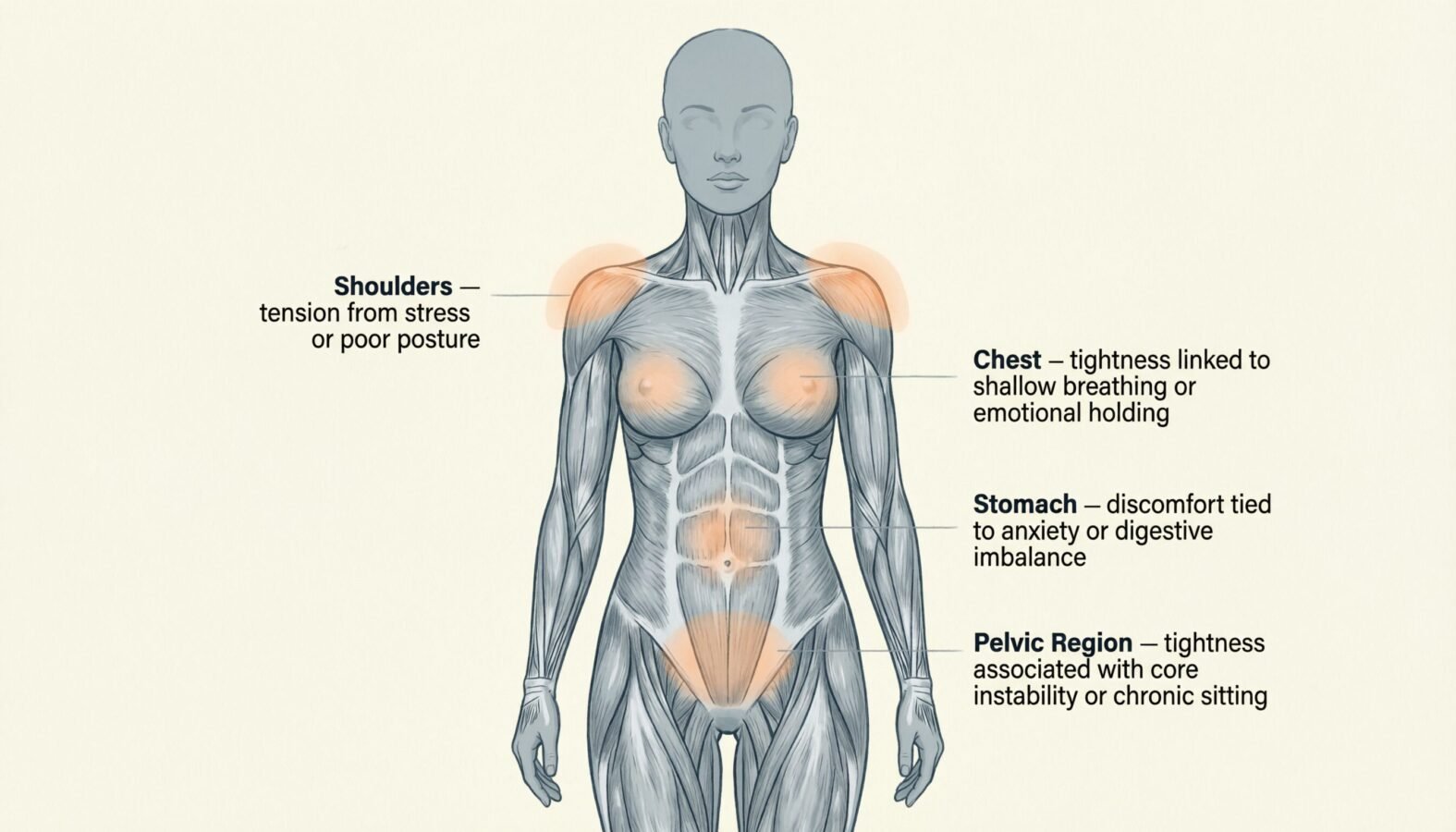
Your body is constantly communicating with you through physical sensations. The key is learning to notice these signals without judgment and to understand what they’re telling you. Here are the most common body signals to pay attention to:
- Shoulders tightening: This often indicates pressure or tension. When you feel your shoulders creeping up toward your ears, pause and ask: What’s creating this pressure? Is it external demands, internal expectations, or something else?
- Breathing becoming shallow: Shallow breathing is your body’s fear response. When you notice your breath becoming short or held, it’s a signal that you may feel unsafe or anxious. This is your nervous system regulation in action—your body preparing for perceived threat.
- Stomach feeling heavy: That heavy, sinking feeling in your stomach often appears when you’re saying yes too quickly or agreeing to something that doesn’t feel right. It’s your body’s way of saying “wait” or “this doesn’t align with my needs.”
- Body feeling numb: Numbness or disconnection can signal overwhelm. When experiences feel too intense or too much, your body may shut down sensation as a protective mechanism. This is common in trauma-informed intimacy contexts.
- Chest softening: This is a positive signal! When your chest feels open, relaxed, or warm, it often indicates emotional safety. Notice what conditions create this feeling so you can recreate them.
- Pelvic floor tension: Tightness or tension in your pelvic area can indicate discomfort, fear, or lack of readiness. Conversely, relaxation in this area often signals safety and openness.
- Changes in desire: Desire naturally fluctuates based on stress, emotional connection, physical comfort, and many other factors. Notice patterns without judgment.
These signals matter because a body that is ignored during the day may struggle to feel safe during intimacy. The goal isn’t to fix or change these sensations immediately. The goal is to notice them, name them, and begin to understand what they’re telling you.
The Connection Between Daily Body Awareness and Intimate Confidence
Body awareness supports intimacy because it helps you speak from truth instead of pressure. When you practice noticing your body signals during ordinary moments—while working, eating, walking, talking—you build the neural pathways that make it easier to access that awareness during intimate moments.
Think of it like this: if you only try to notice your body when you’re already in an intimate situation, you’re asking yourself to learn a new skill under pressure. But if you’ve been practicing body awareness daily, it becomes second nature. You can tune in quickly and accurately, even in vulnerable moments.
This awareness transforms intimacy in practical ways. You may begin to say:
- “I need more time.”
- “This feels too fast.”
- “I feel tense right now.”
- “I want to feel emotionally close first.”
- “I am still learning what my body needs.”
These are not selfish sentences. They are honest sentences. And honesty is the foundation of enthusiastic consent—freely given, reversible, informed, enthusiastic, and specific agreement.
When you understand your body’s pace, preferences, pressure points, safety needs, and responses, you can communicate with more honesty and less shame. You stop guessing what you should want and start discovering what you actually want. You move from performing intimacy to experiencing it.
This kind of intimate confidence doesn’t come from external validation. It comes from internal trust—the trust that you can feel your body’s signals, interpret them accurately, and honor them in your choices. It’s the confidence that comes from knowing yourself, not from meeting someone else’s expectations.
Step 1: Practice Daily Body Check-Ins (7-Day Exercise)
How to reconnect with your body after years of ignoring it? Start with this simple, structured practice. This body scan exercise is designed to build somatic awareness without overwhelming you.
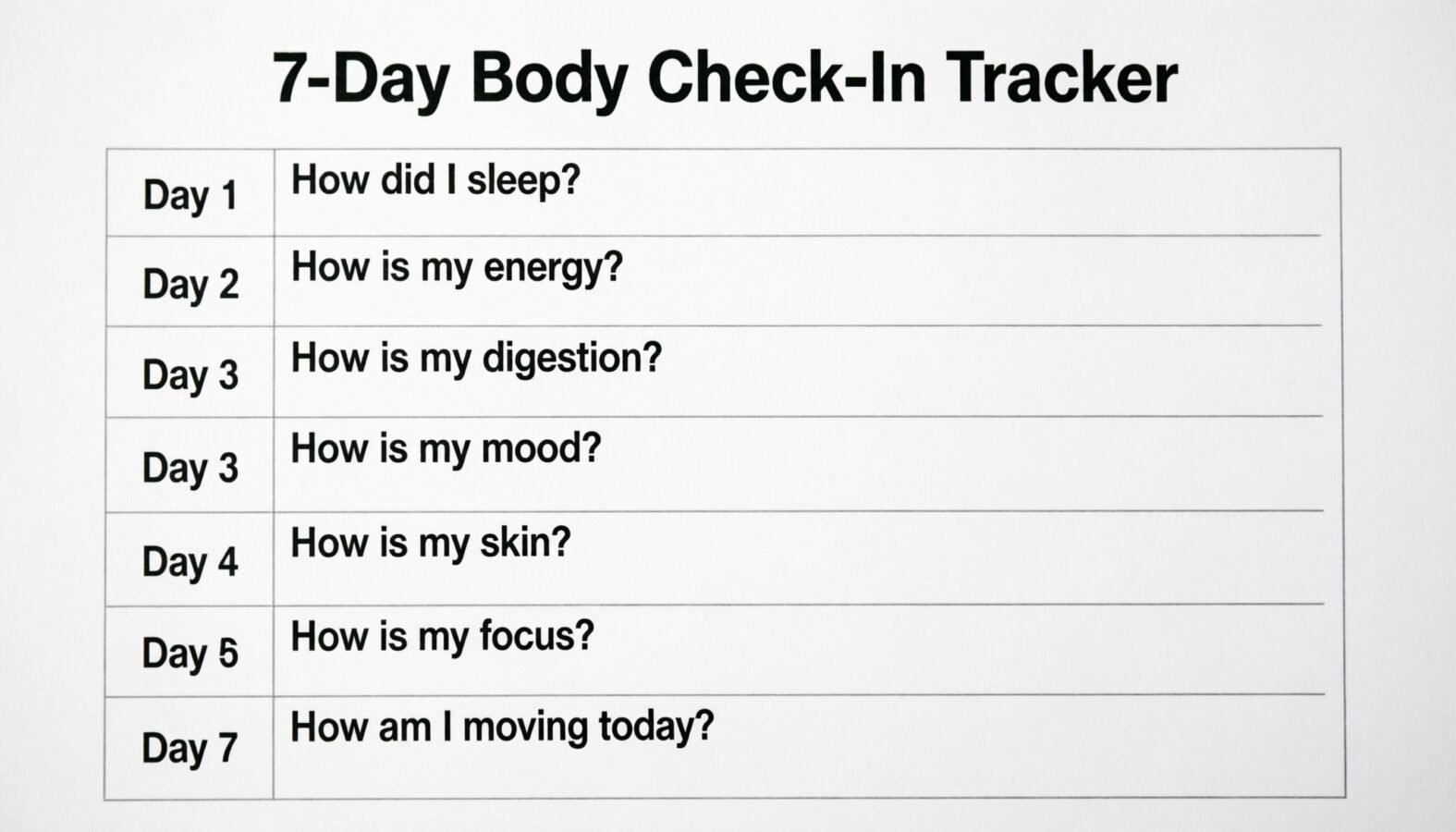
The 7-Day Body Check-In Practice:
Day 1-2: Setting the Foundation
- Choose a consistent time each day (morning, lunch break, or evening).
- Set a gentle reminder on your phone.
- Find a quiet space where you won’t be interrupted for 5 minutes.
- Sit or lie comfortably.
Day 3-4: Asking the Question
- Close your eyes or soften your gaze.
- Take three deep breaths.
- Ask yourself: “What am I feeling in my body right now?”
- Notice whatever arises without trying to change it.
- Common experiences: tension in shoulders, tightness in jaw, heaviness in chest, restlessness in legs, or maybe nothing noticeable at all.
Day 5-6: Naming Without Judgment
- When you notice a sensation, give it a simple name: “tightness,” “warmth,” “heaviness,” “lightness.”
- Avoid labeling sensations as “good” or “bad.”
- Simply observe: “My shoulders feel tight” rather than “My shoulders are too tight and that’s wrong.”
- If your mind wanders, gently return to the question.
Day 7: Journaling Your Experience
- After your body check-in, write 2-3 sentences about what you noticed.
- Use the prompt: “What was I taught to hide about my body, and what do I want to understand with more kindness now?”
- Don’t edit yourself. Write whatever comes up, even if it feels messy or incomplete.
Important reminders:
- The goal is not to fix your body.
- The goal is not to achieve a specific feeling.
- The goal is simply to notice, with kindness and curiosity.
- All experiences are valid—feeling nothing, feeling confused, feeling emotional, feeling uncertain.
This guided reset through structured prompts creates the foundation for deeper body awareness. If you’d like more support continuing this practice, resources like The Confidence & Intimacy Reset For Women offer extended exercises and worksheets.
Step 2: Learn Your Body’s Language of Comfort and Discomfort
How do you know what your body needs? By learning to distinguish between comfort and discomfort with increasing precision. This isn’t about achieving constant comfort—that’s impossible. It’s about developing the awareness to recognize what feels aligned and what doesn’t.
Signs of Comfort:
- Breath flows easily and naturally.
- Muscles feel relaxed, not tense.
- You feel present and engaged.
- There’s a sense of ease or openness.
- You feel curious rather than anxious.
- Time feels spacious, not rushed.
Signs of Discomfort:
- Breath becomes shallow or held.
- Muscles tighten, especially in shoulders, jaw, or stomach.
- You feel the urge to escape or shut down.
- There’s a sense of constriction or pressure.
- You feel distracted or disconnected.
- Time feels urgent or overwhelming.
Practice this exercise:
Throughout your day, pause three times and ask:
- “Does this feel comfortable or uncomfortable in my body?”
- “Where do I feel this sensation?”
- “What might my body be trying to tell me?”
Start with low-stakes situations—choosing what to eat, deciding whether to accept an invitation, selecting what to wear. Build your comfort/discomfort vocabulary in safe contexts so it’s accessible when you need it most.
Remember: discomfort isn’t always bad (growth can be uncomfortable), and comfort isn’t always good (avoidance can feel comfortable). The goal is awareness, not perfection. You’re learning shame-free language for your experience so you can make choices that honor your whole self.
Step 3: Set Boundaries Without Guilt
How to communicate body boundaries to a partner without guilt? This is one of the most important skills in female body education, and it requires practice, patience, and self-compassion.
Boundaries aren’t walls. They’re not about keeping people out or rejecting connection. Boundaries are about creating the conditions where genuine intimacy can flourish—where you can show up fully because you know your needs will be respected.
Understanding Enthusiastic Consent:
Enthusiastic consent means freely given, reversible, informed, enthusiastic, and specific agreement. It’s not just the absence of “no”—it’s the presence of an eager, informed “yes.” And enthusiastic consent requires the freedom to say no, to slow down, to change your mind, or to need more information.
Boundary-Setting Scripts:
Use these honest, direct sentences as starting points. Adapt them to your voice and situation:
- “I need more time before I’m ready for that.”
- “This feels too fast for me right now.”
- “I feel tense right now, and I need to pause.”
- “I want to feel emotionally close first.”
- “I am still learning what my body needs.”
- “I’m not sure how I feel about that yet.”
- “Can we talk about this before we do it?”
- “I’d like to try something different.”
- “That doesn’t feel good for me.”
- “I need to stop now.”
These aren’t selfish sentences. They’re honest sentences. Setting boundaries is an act of self-respect, not rejection of your partner. When you honor your boundaries, you teach others how to treat you. You create space for authentic connection based on mutual respect and understanding.
Remember:
- You don’t owe anyone an explanation for your boundaries.
- Boundaries can change from moment to moment.
- Saying no to one thing is saying yes to your well-being.
- A partner who respects your boundaries is a partner worth keeping.
Step 4: Communicate Your Needs to Partners with Clarity
How do you talk to your partner about your body’s needs? Clear communication is essential for intimate confidence and emotional safety. It’s also a skill that improves with practice.
Many women struggle with this because they were taught to prioritize others’ needs, to avoid “making waves,” or to assume that a loving partner should just “know” what they need. But mind-reading isn’t love. Clear communication is.
Conversation Starters:
Try these approaches to open dialogue about your needs:
For ongoing conversations:
- “I’ve been learning about my body and what helps me feel safe. Can I share some things I’ve discovered?”
- “I want our intimacy to feel good for both of us. Can we talk about what that means for each of us?”
- “I’m working on understanding my body better. It would help me if we could check in with each other more.”
For in-the-moment communication:
- “I’m noticing I feel [tense/excited/uncertain]. Can we [slow down/talk about this/try this instead]?”
- “What I need right now is [reassurance/space/something different].”
- “I’m not sure what I need yet. Can we pause while I check in with myself?”
For after intimate moments:
- “I really liked when we [specific thing]. That felt good for me.”
- “Next time, I’d like to try [specific request].”
- “When [specific thing] happened, I felt [emotion]. Can we talk about that?”
Tips for effective communication:
- Use “I” statements: “I feel” rather than “You make me feel.”
- Be specific: “I need slower touch” rather than “I need you to be better.”
- Choose calm moments for bigger conversations, not just in-the-moment requests.
- Acknowledge that this might feel awkward at first—that’s normal.
- Remember: your partner can’t meet needs they don’t know about.
This kind of communication builds intimate confidence for both partners. It creates emotional safety. It transforms intimacy from performance into collaboration.
Step 5: Build Intimate Confidence Through Gentle Practice
How can you build confidence in your body? Through consistent, gentle practice that honors where you are right now while supporting your growth.
Intimate confidence isn’t something you either have or don’t have. It’s a skill you develop through repeated experiences of listening to your body, honoring your needs, and discovering that you can trust yourself.
Practice Suggestions:
Start small:
- Notice one body signal per day without trying to change it.
- Practice one boundary in a low-stakes situation.
- Have one honest conversation about your needs.
Build gradually:
- Extend your body check-in practice from 5 minutes to 10 minutes.
- Practice boundary-setting in increasingly important situations.
- Share more of your experience with trusted people.
Be consistent:
- Daily practice matters more than perfect practice.
- Missing a day isn’t failure; it’s being human.
- Return to practice with kindness, not criticism.
Celebrate progress:
- Notice what’s different, even in small ways.
- Acknowledge your courage in trying something new.
- Recognize that healing isn’t linear.
The workbook bundle that accompanies The Confidence & Intimacy Reset For Women provides structured prompts, scripts, and worksheets to support this practice. But you can also create your own system—journaling, voice memos, check-ins with a trusted friend, or working with a therapist.
Remember: this isn’t about instant perfection. It’s about gradual, sustainable reconnection. Every time you notice a body signal, honor a boundary, or communicate a need, you’re building intimate confidence. You’re teaching yourself that you can trust your experience. You’re creating the conditions for deeper, more authentic connection.
Common Barriers to Body Reconnection (And How to Overcome Them)
Why is it hard to reconnect with my body? Understanding common barriers can help you navigate them with compassion instead of self-criticism.
Barrier 1: “I don’t feel anything”
What’s happening: Numbness or disconnection is often a protective response, especially if you have a history of trauma or chronic stress.
How to work with it: Start with external sensations—temperature of the room, texture of your clothes, sounds around you. Gradually work inward. Be patient; sensation often returns slowly.
Barrier 2: “It feels selfish to focus on my body”
What’s happening: You’ve been trained to prioritize others’ needs and may feel guilty attending to your own experience.
How to work with it: Remind yourself that understanding your body makes you more present and authentic in relationships. Self-awareness isn’t selfish; it’s foundational to healthy connection.
Barrier 3: “I’m afraid of what I might discover”
What’s happening: Unprocessed emotions or experiences may feel overwhelming to face.
How to work with it: Go slowly. You don’t have to process everything at once. Consider working with a trauma-informed therapist if you’re dealing with significant trauma. Practice grounding techniques when emotions feel intense.
Barrier 4: “I don’t have time”
What’s happening: Life is busy, and body awareness practice can feel like one more thing on your list.
How to work with it: Start with 2-3 minutes per day. Integrate check-ins into existing routines (brushing teeth, waiting for coffee, lying in bed). Remember: consistency matters more than duration.
Barrier 5: “This feels awkward or uncomfortable”
What’s happening: Any new skill feels awkward at first, especially one as personal as body awareness.
How to work with it: Acknowledge the discomfort without letting it stop you. Remind yourself that awkwardness is temporary. Focus on curiosity rather than performance.
Barrier 6: “I’ve tried before and it didn’t work”
What’s happening: Past attempts may have felt forced, rushed, or unsupported.
How to work with it: Approach this differently—more gently, with more support, with realistic expectations. Consider what didn’t work before and adjust. This isn’t starting over; it’s learning from experience.
The key to overcoming barriers is nervous system regulation—working with your body’s natural responses rather than against them. When you meet resistance with kindness instead of force, reconnection becomes possible.
When Female Body Education Isn’t Enough: Knowing When to Seek Support
When should you seek professional help for body disconnection? While female body education provides valuable tools and understanding, it’s not a substitute for professional care when deeper issues are present.
Consider seeking professional support if you experience:
- Persistent intimacy anxiety that doesn’t improve with self-practice.
- Trauma symptoms (flashbacks, severe dissociation, panic attacks).
- Severe body shame that significantly impacts your daily life.
- Pain during intimacy that hasn’t been medically evaluated.
- Relationship patterns that feel impossible to change on your own.
- Depression or anxiety that interferes with your ability to engage in self-care.
- History of trauma that feels overwhelming to process alone.
Types of professional support:
- Somatic therapy: Focuses on the connection between mind and body, helping you process experiences stored in physical sensation.
- Sex therapy: Addresses sexual concerns, intimacy issues, and relationship dynamics with specialized training.
- Trauma-informed therapy: Uses approaches designed to avoid re-traumatization while supporting healing.
- Pelvic floor physical therapy: Addresses physical pain or dysfunction in the pelvic region.
- Medical care: Rules out or treats physiological conditions that may affect intimacy.
Organizations like ACOG and ISSWSH can help you find qualified providers. Your primary care physician can also provide referrals.
Important: Female body education complements professional care; it doesn’t replace it. If you’re working with a therapist, share what you’re learning through body awareness practice. If you’re using resources like The Confidence & Intimacy Reset For Women, consider it part of a broader support system that may include professional care.
This article is educational and should not replace medical, legal, or therapeutic advice. If you’re in crisis or experiencing severe symptoms, please reach out to a qualified professional immediately.
Key Takeaways: Your Path Forward
Let’s summarize the most important points about female body education:
- Female body education helps women understand their body without shame. It goes beyond anatomy to include body signals, emotional safety, boundaries, and intimate confidence.
- Many women were taught risk and silence before they were taught body awareness. This incomplete education isn’t your fault, and it can be corrected through gentle, consistent practice.
- Missing education can affect confidence, communication, desire, and intimacy. But these aren’t permanent conditions—they’re skills that can be learned.
- Shame-free education gives women language, context, and self-trust. When you can name your experience, you can begin to honor it.
- Women body awareness begins with noticing daily body signals. Practice in low-stakes moments so it’s accessible when you need it most.
- One reflection prompt can open the door to deeper healing. “What was I taught to hide about my body, and what do I want to understand with more kindness now?”
- The eBook and workbook bundle offer structured guidance, worksheets, scripts, and action prompts for those ready to go deeper with supported practice.
Your path forward isn’t about perfection. It’s about progress. It’s about returning to yourself with curiosity instead of criticism, with kindness instead of judgment. Every small step matters.
Frequently Asked Questions About Female Body Education
What is female body education?
Female body education is the process of learning your body with respect, beyond just anatomy or sexual health facts. It includes understanding body signals, emotional safety, comfort and discomfort, desire and stress, pace and pressure, boundaries and communication, self-trust, and intimacy without shame. Unlike traditional risk-based sex education, it focuses on helping you understand your body as a home rather than a warning sign.
How do I know if I am disconnected from my body?
Common signs include: shoulders tightening when pressured, shallow breathing when afraid to speak, stomach heaviness when saying yes too quickly, numbness when overwhelmed, difficulty identifying what feels safe or uncomfortable, blaming yourself for confusion, staying silent about discomfort, and feeling guilty for needing time. If you notice others’ needs easily but struggle to notice your own body signals, you may be disconnected.
Why does traditional sex education cause shame?
Traditional sex education often focuses only on risk—pregnancy, disease, reputation, danger, and mistakes. While these topics matter, when education is ONLY about risk, the body can feel like a warning sign instead of a home. This risk-only approach can create shame, fear, and control around the body, making it harder to develop healthy body awareness and intimate confidence.
How can I reconnect with my body after years of ignoring it?
Start with a simple 7-day practice: once daily, ask “What am I feeling in my body right now?” Notice without judgment—shoulder tension, breathing patterns, stomach sensations. The goal isn’t to fix anything, just to notice. Journal using the prompt: “What was I taught to hide about my body, and what do I want to understand with more kindness now?” Practice speaking honest sentences like “I need more time” or “This feels too fast.”
What is the difference between standard sex education and female body education?
Standard sex education typically focuses on risk prevention (pregnancy, disease, consent, protection) and anatomical facts. Female body education goes deeper—it teaches you to understand your body’s signals, emotional safety, comfort/discomfort, desire patterns, boundaries, and communication. It’s not about becoming someone new; it’s about returning to yourself with better, shame-free language and self-trust.
How do I communicate body boundaries to a partner without guilt?
Use honest, direct sentences: “I need more time,” “This feels too fast,” “I feel tense right now,” “I want to feel emotionally close first,” or “I am still learning what my body needs.” These aren’t selfish—they’re honest. Remember: enthusiastic consent requires freedom to say no or slow down. Setting boundaries is an act of self-respect, not rejection of your partner.
Can female body education help with intimacy anxiety?
Yes. By learning to recognize body signals, understand your nervous system responses, and communicate needs clearly, you build intimate confidence. Body awareness before intimate moments helps you speak from truth instead of pressure. However, if you have trauma-related anxiety, female body education should complement—not replace—professional trauma-informed therapy or somatic therapy.
What are body signals I should learn to recognize?
Key signals include: shoulders tightening (pressure), shallow breathing (fear), stomach heaviness (saying yes too quickly), body numbness (overwhelm), chest softening (emotional safety), pelvic floor tension (discomfort), and changes in desire. These physical sensations are your body’s language. Learning to notice them during daily life—not just intimate moments—builds the awareness needed for healthy intimacy.
Is female body education a substitute for therapy?
No. Female body education is for informational and educational purposes only and is not a substitute for qualified professional advice. If you have experienced trauma, have persistent intimacy anxiety, or struggle with severe body shame, please seek support from a licensed therapist, somatic therapist, or sex therapist. Body education complements professional care; it doesn’t replace it.
How long does it take to reconnect with your body?
There’s no fixed timeline—it’s a personal journey. Some notice changes within days of daily check-ins; others need weeks or months of practice. The eBook and workbook bundle offer structured guidance through phases of rebuilding self-esteem, understanding pleasure without shame, and turning self-knowledge into trust. Be patient and gentle with yourself. This isn’t about instant perfection; it’s about gradual, sustainable reconnection.
Who created The Confidence & Intimacy Reset for Women?
The Confidence & Intimacy Reset For Women was written by Md. Rizwanul Haque, with co-author Md. Kawsharul Islam. The book and workbook bundle offer structured prompts, scripts, worksheets, and action steps to help women rebuild self-esteem, understand their bodies without shame, and develop lasting intimate confidence through guided practice.
What topics does female body education cover?
Female body education covers: body signals and sensations, emotional safety, recognizing comfort and discomfort, understanding desire and stress responses, pace and pressure awareness, boundaries and communication skills, building self-trust and confidence, and developing intimacy without shame. It’s a holistic approach that goes beyond anatomy to help you understand your whole embodied experience.
Continue Your Journey: Structured Support for Lasting Change
This guide is a starting point. For deeper reflection and practical action, explore the complete resources by Md. Rizwanul Haque, co-authored by Md. Kawsharul Islam.
A blog post can help you understand the problem. But deeper change usually needs repeated practice. That’s why The Confidence & Intimacy Reset For Women and the workbook bundle are positioned as a fuller path. The main book gives you context and language. The workbook gives you space to reflect, write, practice, and return to yourself.
The eBook’s promise is not instant perfection. It offers clarity and guides readers through phases of rebuilding self-esteem, understanding pleasure and desire without shame, and turning self-knowledge into trust and lasting connection.
Available resources:
- Main Book: The Confidence & Intimacy Reset For Women
- Workbook A4 Size
- Workbook US Letter Size
- Main Book & Workbook Bundle
These resources provide structured prompts, scripts, worksheets, and action steps to support your journey. They’re designed to work alongside your own practice, offering guidance when you need it while respecting your pace and process.
That’s the real conversion point:
- Not pressure.
- Not fear.
- Not “fix yourself.”
A guided reset.
Your Body Is Worth Understanding
Your body is not a problem to hide or fix. It is a self to understand with kindness, patience, and respect. You’ve learned that female body education goes beyond anatomy—it’s about understanding body signals, emotional safety, and intimacy without shame. You now have practical tools: daily body check-ins, honest boundary-setting language, and the awareness to notice your body’s signals before and during intimate moments. You understand that shame grows in silence, but confidence grows through gentle, consistent practice.
If this guide resonated with you and you’re ready for deeper support, The Confidence & Intimacy Reset For Women and its workbook bundle offer structured prompts, scripts, and action steps to continue your journey. Remember: this isn’t about instant perfection. It’s about a guided reset—returning to yourself with better language, more self-trust, and lasting intimate confidence.
Your path to female body education begins with one gentle question: “What am I feeling in my body right now?” Start there. Be patient. You deserve this understanding.
This article is for informational and educational purposes only and is not a substitute for qualified professional advice. If you are experiencing severe distress, trauma symptoms, or mental health concerns, please seek support from a licensed healthcare provider.