

How Nervous System Regulation Rewires Stress and Awakens Female Desire #IntimacyReset #WomensHealth
Nervous system safety is the missing piece that explains why you can love your partner deeply yet still feel closed off to intimacy. Simply put, nervous system safety means your body receives enough physiological signals that it is safe to soften, rest, connect, and become present.
You’re not broken. Your body isn’t failing you. When stress, responsibilities, and overwhelm accumulate, your nervous system enters survival mode—prioritizing tasks and safety over pleasure and connection. This isn’t a personal failure; it’s physiology.
The path back to desire isn’t about trying harder or forcing yourself. It’s about creating the conditions where your body feels safe enough to naturally awaken to connection.
In this guide, you’ll discover the science behind stress and desire, recognize the signs your nervous system needs support, and learn 5 gentle, science-backed steps to restore safety and reclaim intimacy—without shame or pressure.
Understanding Why Your Body Says “Not Now” to Intimacy
A woman can love her partner completely and still not feel ready for intimacy. That sentence matters more than you might realize.
Low desire doesn’t always mean love has disappeared. It doesn’t mean attraction is gone. It doesn’t mean something is fundamentally wrong with your body. Sometimes, the body is simply carrying too much.
In The Confidence & Intimacy Reset For Women, Md. Rizwanul Haque explains that a woman may deeply love her partner while her body is still not ready for intimacy. Bills, children, work messages, housework, unresolved anger, body shame, and relationship loneliness can all gather inside the body like an overwhelming storm. From the outside, someone may only see a woman lying quietly in bed, but inside, “a whole city may be making noise.”
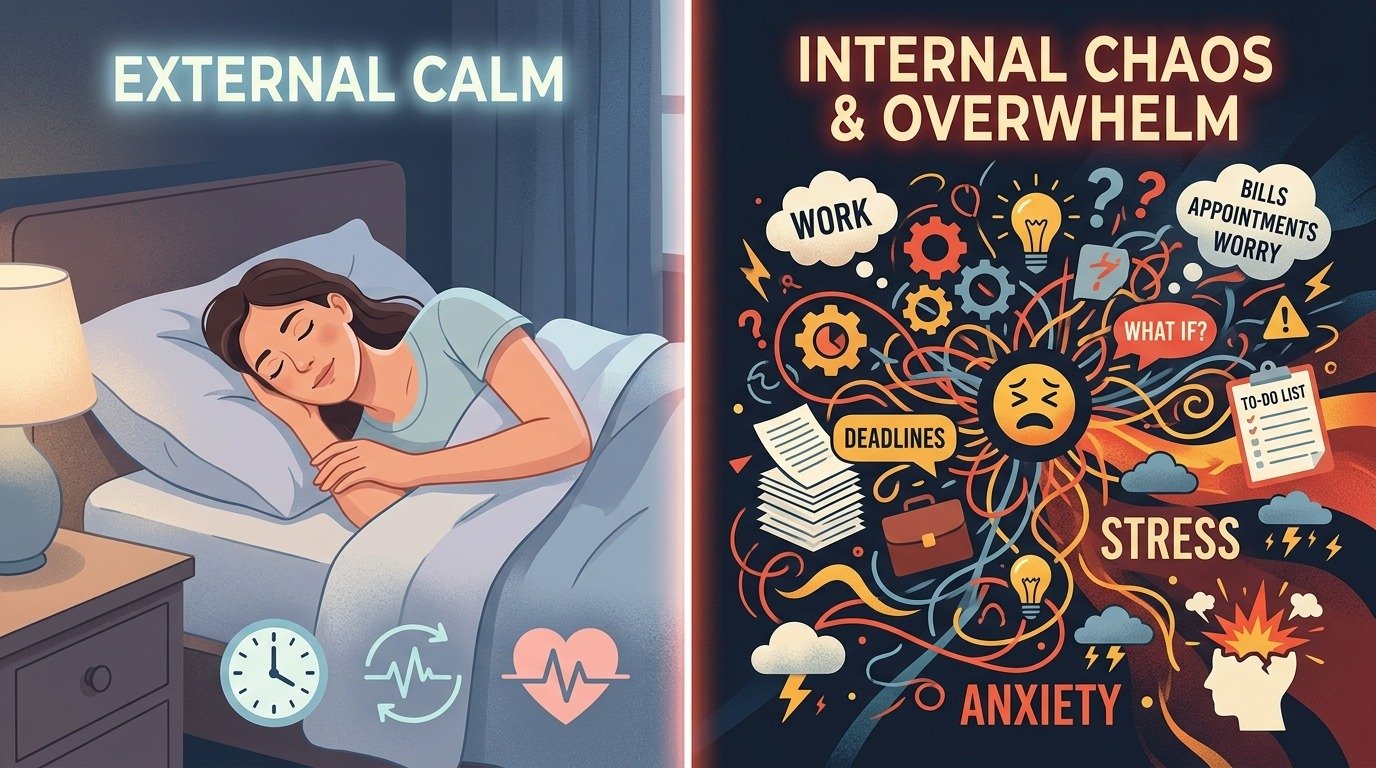
This is why stress and desire must be understood together. When stress blocks desire, the answer isn’t always “try harder.” Often, the better answer is to create more emotional safety.
If you’re struggling with shame-based self-talk around intimacy, know that you’re not alone. Your body’s response is information, not failure.
What Is Nervous System Safety and Why Does It Matter for Desire?
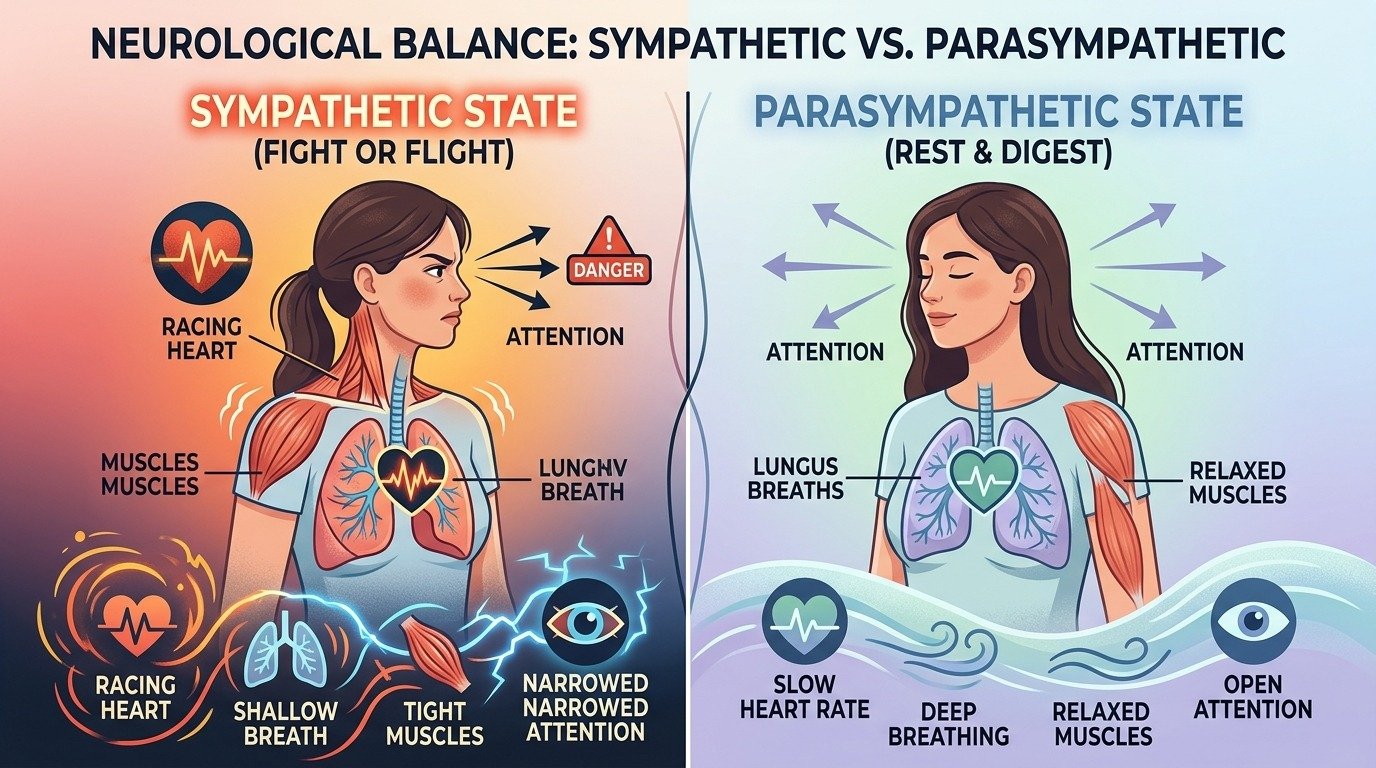
Nervous system safety means the body receives enough signals that it is safe to soften, rest, connect, and become present. It’s not just a psychological concept. It’s a physiological state where your parasympathetic nervous system can activate, allowing blood flow, sensation, and oxytocin release that are essential for desire.
When your nervous system feels safe, it shifts from asking “What problem needs to be handled first?” to “What would feel good?” This creates the physiological conditions where responsive desire can emerge naturally, without force or pressure.
For some women, safety may come through sleep. For others, it may come through emotional warmth, privacy, help with responsibilities, a clear “no,” or touch without expectations. The key is understanding that nervous system safety is highly individual. What regulates one person’s system may not work for another.
You can learn more about building this foundation on the Reset Intimacy blog, where we explore how stress, self-talk, and physiology interconnect.
The Difference Between Feeling Safe and Being Safe
Here’s something crucial: your logical mind can know you’re physically safe while your body still doesn’t feel safe. This isn’t a contradiction. It’s how the nervous system works.
Your body’s threat-detection system operates below conscious awareness, scanning for danger 24/7. When it perceives stress—whether from a looming deadline, an argument, or financial worry—it activates the same physiological response it would use if you were facing physical danger. Your heart rate rises, breathing becomes shallow, muscles tighten, and attention narrows.
This response is incredibly useful during actual danger. But when your body stays in this activated state all day, there’s little room left for softness, pleasure, and connection.
Understanding this distinction removes blame. You’re not “overreacting.” Your body is doing exactly what it evolved to do: prioritize survival over pleasure when it perceives ongoing stress.
How Your Nervous System Communicates “Yes” or “No” to Intimacy
Your nervous system is constantly sending signals about your readiness for intimacy. Learning to recognize these signals is essential for rebuilding nervous system safety.
When your body is saying “no” or “not yet,” you might notice:
- Shallow, rapid breathing
- Muscle tension, especially in the jaw, shoulders, or pelvis
- A racing mind that can’t settle
- Feeling “touched out” or irritable when approached
- A sense of pressure or dread rather than curiosity
When your body is moving toward “yes,” you might experience:
- Deeper, slower breathing
- Softer muscles and relaxed posture
- Mental quiet or present-moment awareness
- Warmth or openness in the chest and belly
- Curiosity rather than obligation
These signals aren’t moral judgments. They’re physiological information about your current state. Honoring them builds trust between you and your body, which is foundational for nervous system safety.
The Science: How Chronic Stress Hijacks Your Body’s Capacity for Pleasure
To understand why stress blocking desire happens, we need to look at what’s occurring physiologically. This isn’t just “in your head.” It’s in your entire nervous system.
When you experience chronic stress, your body maintains elevated cortisol levels and stays in sympathetic activation (fight-or-flight mode). This state is designed for survival, not connection. In survival mode, your body diverts resources away from “non-essential” functions like digestion, immune response, and sexual desire.
Research on arousal non-concordance shows that what’s happening in your body doesn’t always match what you’re thinking or feeling emotionally. You can love your partner, want to feel desire, and still have a body that’s physiologically unable to access pleasure because it’s stuck in stress response.
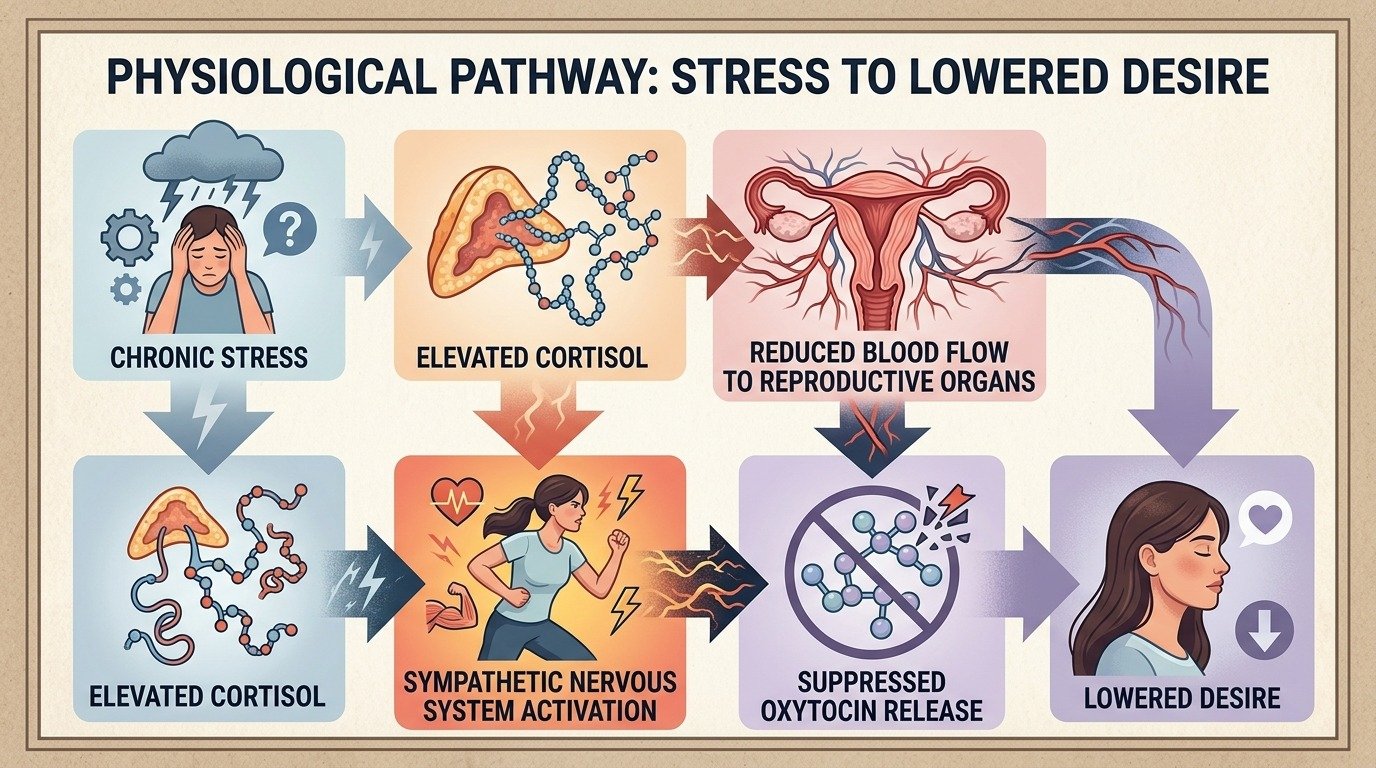
The Polyvagal Theory, developed by Dr. Stephen Porges, helps explain this further. Your vagus nerve—the primary nerve of the parasympathetic nervous system—acts as a communication highway between your brain and body. When stress dominates, this communication gets disrupted, making it difficult to access the calm, connected state where desire can flourish.
Understanding this science removes shame. Your body isn’t broken; it’s responding exactly as designed to the stress signals it’s receiving.
The Sympathetic Nervous System: Your Body’s “Emergency Mode”
Your sympathetic nervous system is your body’s emergency response system. When activated, it triggers:
- Increased heart rate and blood pressure
- Rapid, shallow breathing
- Muscle tension and readiness for action
- Redirected blood flow away from digestion and reproduction toward major muscle groups
- Heightened alertness and narrowed focus
This response is brilliant when you need to swerve to avoid an accident. The problem arises when this system stays activated for hours, days, or weeks due to ongoing life stress.
When your body is in sympathetic activation, it’s essentially asking: “What needs to be handled right now to keep me safe?” This question crowds out the possibility of asking: “What would feel good?”
Why “Just Relax” Doesn’t Work: The Physiology of Stress Recovery
If you’ve ever been told to “just relax” before intimacy, you know how unhelpful—and even frustrating—that advice can be. Here’s why it doesn’t work:
Stress is physiological, not just mental. Your body has been in sympathetic activation all day, with elevated cortisol, shallow breathing, and muscle tension. You can’t simply “decide” to switch off this response any more than you could decide to stop digesting food.
Shifting to a parasympathetic state requires active regulation—like breathing exercises, movement, touch, or other somatic exercises—not just mental commands. Your body needs concrete nervous system safety signals, not abstract instructions.
A body that has been planning, managing, and carrying responsibilities all day cannot always become soft on command. It needs a bridge. This is why understanding nervous system safety is so crucial. It gives you a framework for creating that bridge.
Recognizing the Signs: Is Stress Blocking Your Desire?
How do you know if your low libido is from stress? The signs are often clearer than you might think. Recognizing them is the first step toward creating nervous system safety.
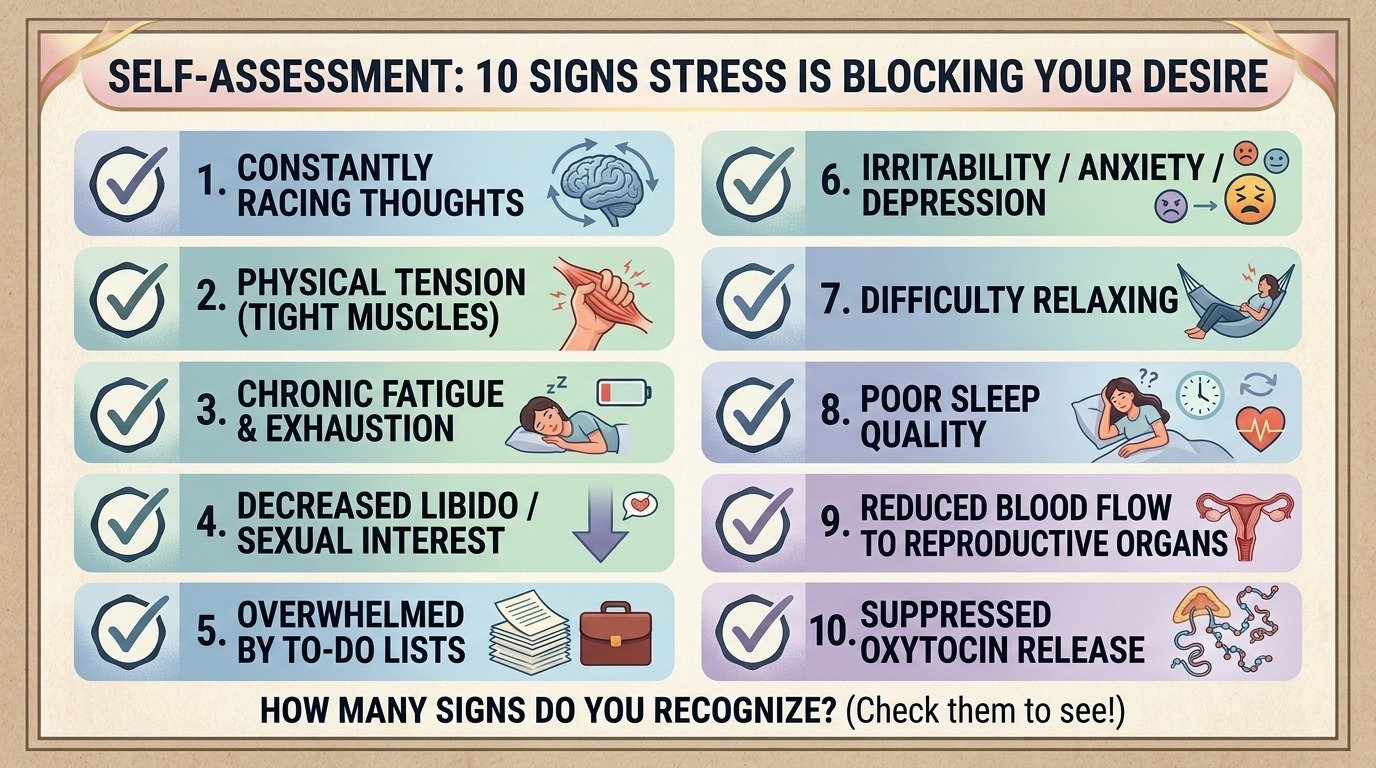
Stress may be affecting your desire if you notice:
- You love your partner, but your body feels closed or shut down.
- You feel tired, tense, or emotionally full most of the time.
- You feel pressure or anxiety when intimacy is expected or suggested.
- Your mind keeps listing unfinished tasks during intimate moments.
- You need sleep more than you need closeness.
- You feel guilty or ashamed about your low desire.
- You feel “touched out” or overwhelmed by physical contact.
- You need emotional warmth and connection before physical closeness feels possible.
- You feel like your body is still in “work mode” even at night.
- You wonder whether desire is gone forever, but you’re also completely exhausted.
These signs don’t automatically mean your relationship is broken. They may simply mean your body needs nervous system safety before desire can return.
Physical Signs Your Body Is in Survival Mode
Your body sends clear signals when it’s stuck in survival mode. These physical signs include:
- Chronic muscle tension, especially in shoulders, jaw, and pelvis
- Shallow breathing that barely moves your ribs
- Digestive issues or stomach tightness
- Difficulty falling or staying asleep
- Frequent headaches or body aches
- Feeling “wired but tired”—exhausted but unable to rest
- Reduced sensitivity to pleasure or numbness
When these signs are present, your sympathetic nervous system is dominating. Your body is prioritizing vigilance and readiness over relaxation and receptivity.
Emotional and Mental Patterns That Signal Overwhelm
Beyond physical signs, emotional and mental patterns reveal when stress is blocking desire:
- Persistent guilt about not wanting intimacy
- Irritability or resentment when your partner initiates
- Feeling like intimacy is “another task” on your to-do list
- Difficulty being present—your mind wanders to responsibilities
- Anxiety about disappointing your partner
- Feeling emotionally “full” with no space for more
These patterns reflect emotional safety deficits. When your nervous system is overwhelmed, it protects itself by shutting down non-essential functions, including the vulnerability that intimacy requires.
Understanding Responsive Desire: Why Some Women Need a Bridge to Intimacy
Many women expect desire to arrive suddenly, spontaneously, like a lightning bolt. But desire doesn’t always work that way—and that’s completely normal.
Responsive desire is desire that appears after warmth, safety, trust, and connection have already been created. It’s not broken or inferior. It’s simply a different pathway to arousal. The Dual Control Model of sexual response, developed by researchers like Emily Nagoski, confirms that many women experience responsive desire, especially when stressed.
This understanding is crucial for low desire women because it reduces shame. Not every woman feels spontaneous desire quickly. Some bodies need a bridge from stress to softness before desire can wake up.
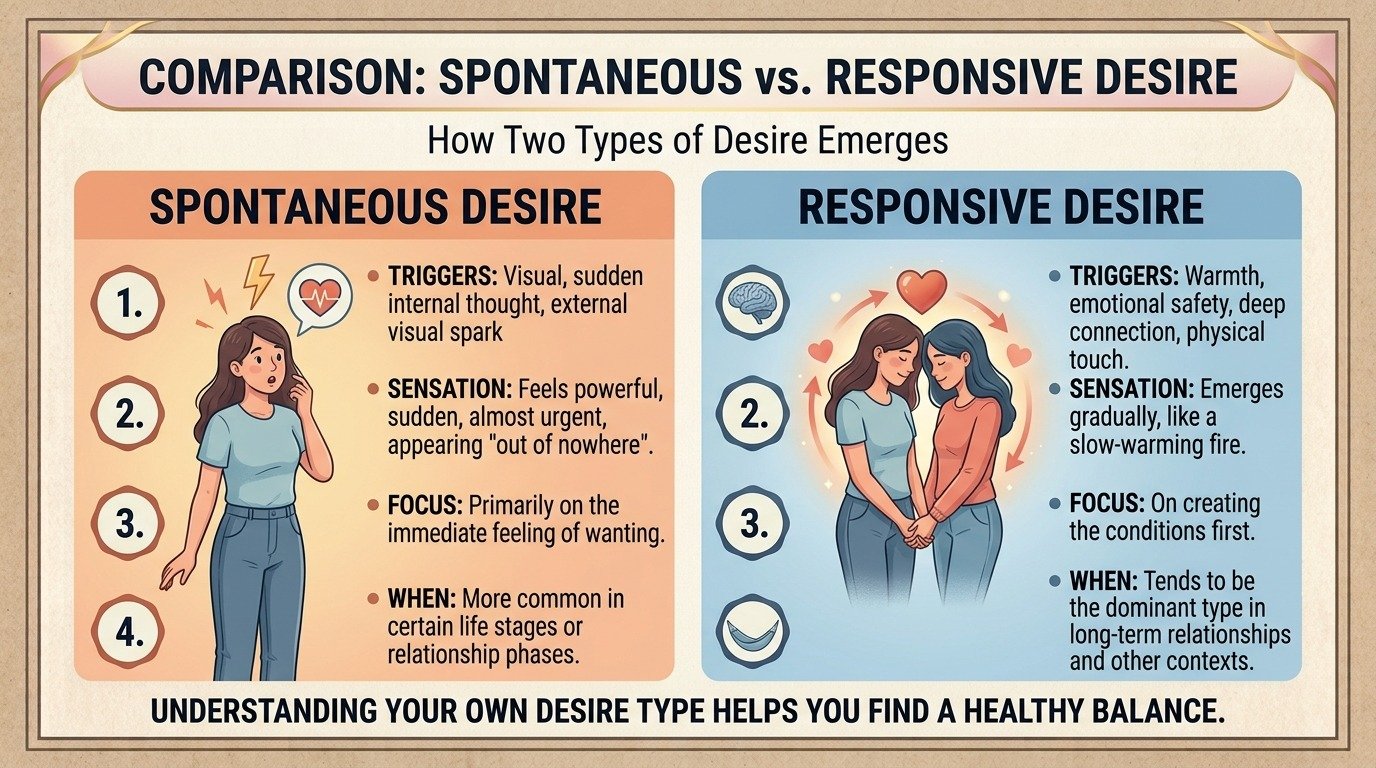
The problem arises when women expect spontaneous desire after a noisy day, a busy mind, and a hard body. That’s a massive jump for the nervous system. The body needs a bridge. It may be quiet, rest, emotional repair, a slower evening, conversation, or no expectations.
You can explore more about this concept in our responsive desire guide.
Spontaneous vs. Responsive Desire: What’s Normal?
Both spontaneous and responsive desire are normal. Neither is better. Understanding the difference helps you work with your body instead of against it.
Spontaneous Desire:
- Appears suddenly, often without obvious triggers
- May come “out of the blue”
- Often more common in early relationship stages
- Can feel like hunger or craving
Responsive Desire:
- Emerges after warmth, safety, connection, or physical touch are already present
- Builds gradually as conditions become right
- Often more common when stressed or in long-term relationships
- Feels like a gradual opening or warming
Many women experience responsive desire, especially when stressed. Understanding this reduces shame and helps you create the conditions—the “bridge”—your body needs for desire to wake up. It’s not broken; it’s biology.
Building Your Personal Bridge from Stress to Softness
Your bridge from stress to softness is uniquely yours. It’s built from small, intentional practices that signal nervous system safety to your body.
Start by asking: “What condition does my body need before desire can wake up?”
Possible answers include:
- Ten minutes of quiet alone
- A slower transition after work
- An honest conversation
- Help with household tasks
- Touch with no expectation
- Permission to say no without guilt
- One night of uninterrupted sleep
Your bridge isn’t pressure. It’s not “trying harder.” It’s creating the physiological and emotional conditions where your body can naturally shift from survival mode to connection mode.
Polyvagal Theory: How Your Vagus Nerve Governs Intimacy Readiness
Polyvagal Theory, developed by Dr. Stephen Porges, offers a powerful framework for understanding how your vagus nerve governs your capacity for intimacy. This theory explains why nervous system safety is foundational for desire.
Your vagus nerve is the primary nerve of your parasympathetic nervous system. It runs from your brainstem through your face, throat, heart, lungs, and digestive organs, creating a communication network that constantly monitors safety and threat.
When your vagus nerve detects safety, it activates your “social engagement system”—the state where connection, trust, and intimacy are possible. When it detects threat, it shifts you into survival modes that make intimacy inaccessible.
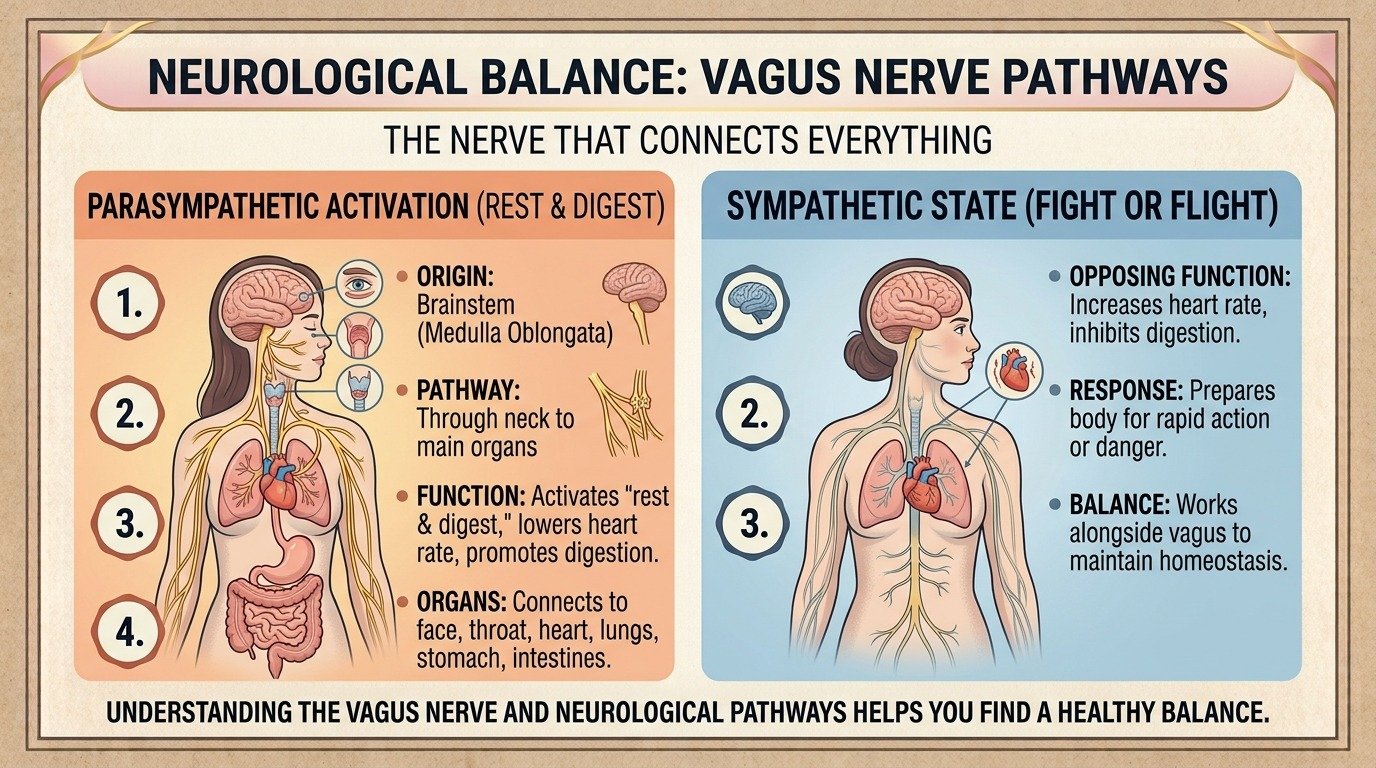
Understanding polyvagal theory helps you see that low desire isn’t a relationship problem or a personal failing. It’s a nervous system state. By learning to activate your vagus nerve through specific practices, you can create the parasympathetic state where desire naturally emerges.
The Three States of the Nervous System
According to polyvagal theory, your nervous system moves through three primary states:
- Ventral Vagal (Safe and Social): You feel calm, connected, and curious. Your voice is warm and expressive. You can make eye contact comfortably. You’re open to connection and intimacy. This is the state where responsive desire can emerge.
- Sympathetic (Activated/Fight-or-Flight): You feel anxious, restless, or irritable. Your heart races and breathing quickens. You’re focused on solving problems or escaping threats. Intimacy feels like pressure or another demand. Desire is inaccessible.
- Dorsal Vagal (Shutdown/Freeze): You feel numb, disconnected, or collapsed. You have low energy and motivation. You may feel depressed or hopeless. Your body is in conservation mode. Desire is completely offline.
Most women struggling with stress-related low desire are cycling between sympathetic activation during the day and dorsal vagal shutdown at night—never accessing the ventral vagal state where intimacy is possible.
How to Activate Your Vagus Nerve for Better Intimacy
You can activate your vagus nerve and shift toward nervous system safety through specific practices:
- Slow, deep breathing: Aim for 4-6 breaths per minute, with longer exhales than inhales
- Humming, singing, or chanting: These vibrate the vagus nerve, stimulating activation
- Cold exposure: Splashing cold water on your face or holding something cold
- Gentle movement: Yoga, stretching, or walking
- Social connection: Warm, safe conversation with trusted people
- Touch: Gentle, non-demanding physical contact
These practices aren’t just relaxation techniques. They’re physiological interventions that directly signal safety to your nervous system, creating the conditions where intimacy can feel accessible.
The 5-Step Framework to Restore Nervous System Safety and Desire
Now that you understand the science, let’s move into action. This 5-step framework provides a clear pathway to restore nervous system safety and reclaim desire—without pressure, shame, or force.
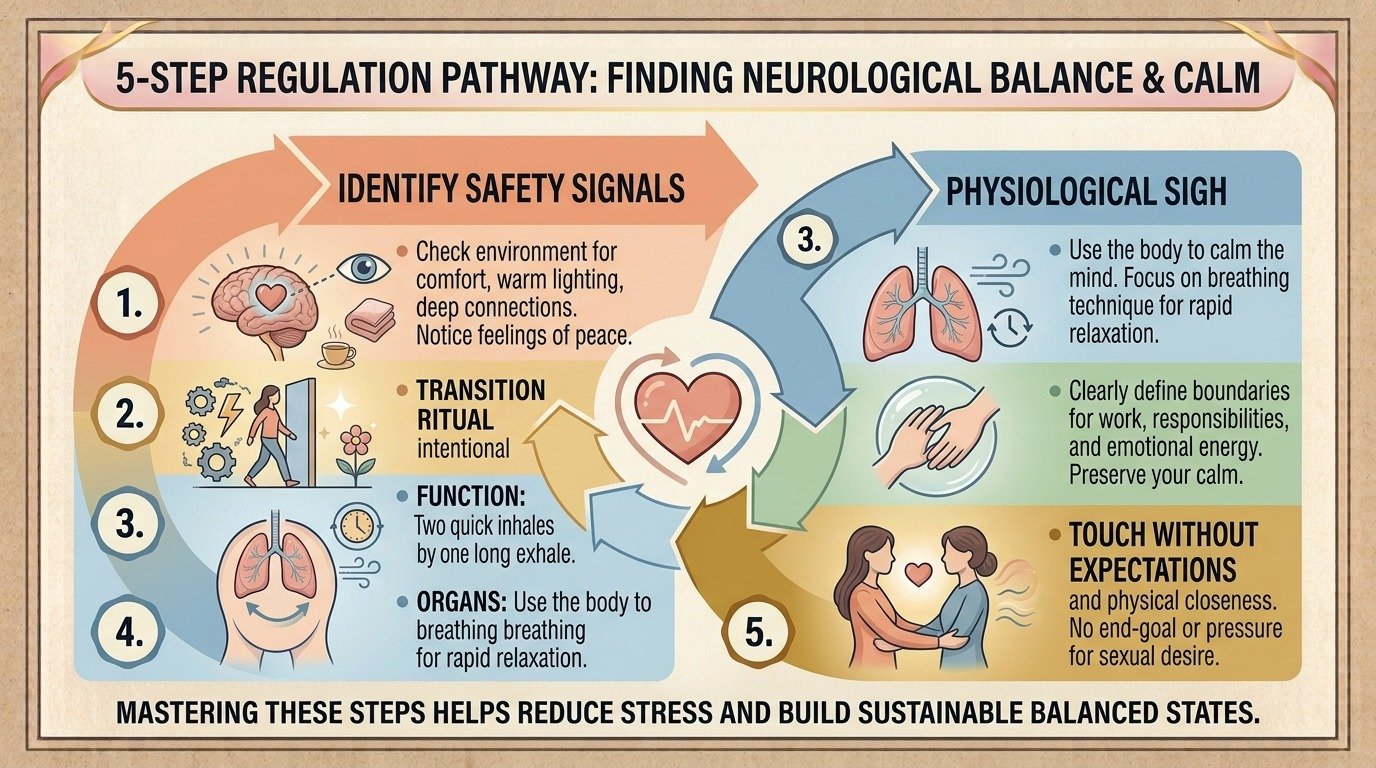
Each step builds on the previous one, creating a cumulative effect. You don’t need to do all five perfectly. Start where you are. Even one small safety signal can begin to shift your nervous system’s default setting.
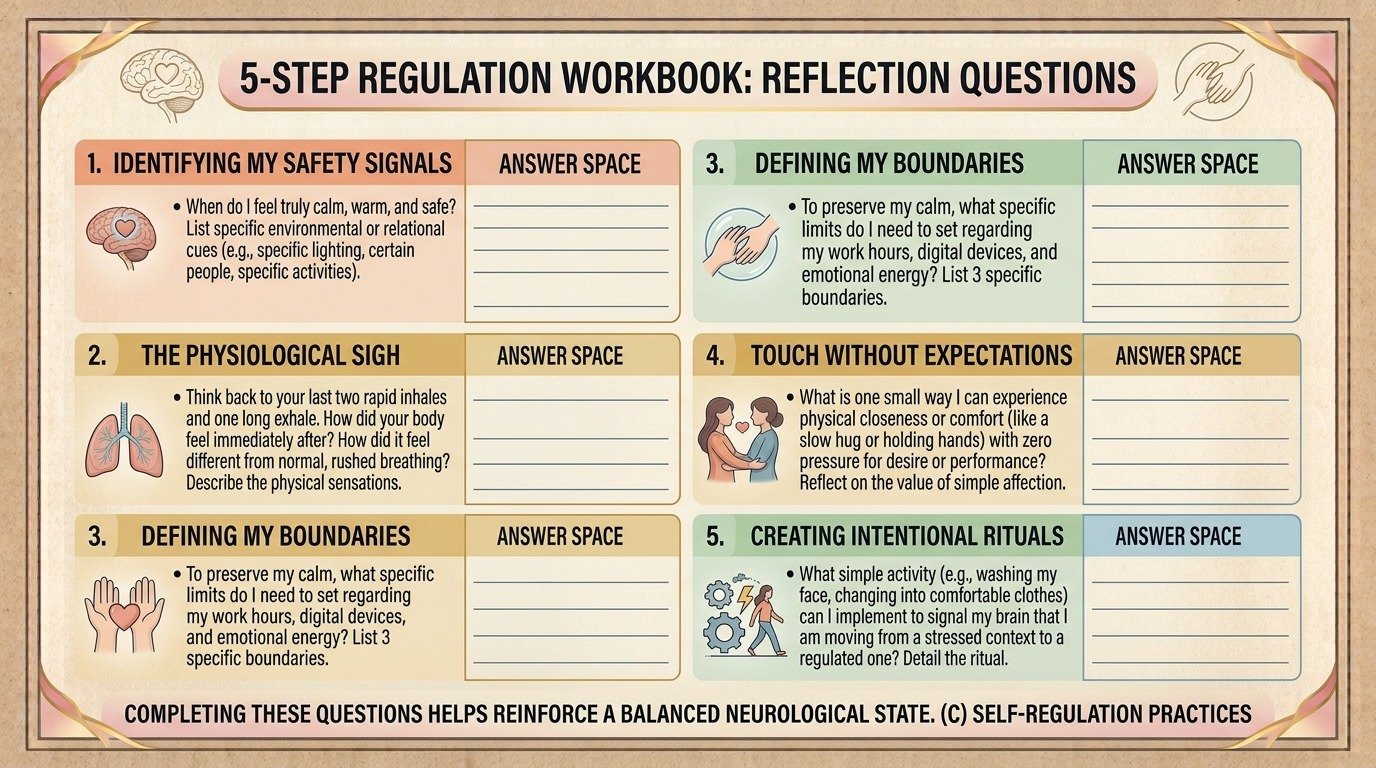
Step 1: Identify Your Body’s Safety Signals
Before you can create nervous system safety, you need to know what safety feels like for your body. Safety signals are highly individual.
Guided Exercise:
Take 10 minutes to reflect on these questions:
- When have you felt most relaxed and at ease in the past month? What was present?
- What helps you feel calm when you’re stressed? (Examples: warm bath, quiet walk, certain music)
- What kind of touch feels good when you’re overwhelmed? (Examples: hand on shoulder, back rub, holding hands)
- What conditions help you sleep deeply?
- What makes you feel emotionally safe with another person?
Write down your answers. These are your personal safety signals. Keep this list visible. Refer to it when you’re trying to create nervous system safety before intimacy.
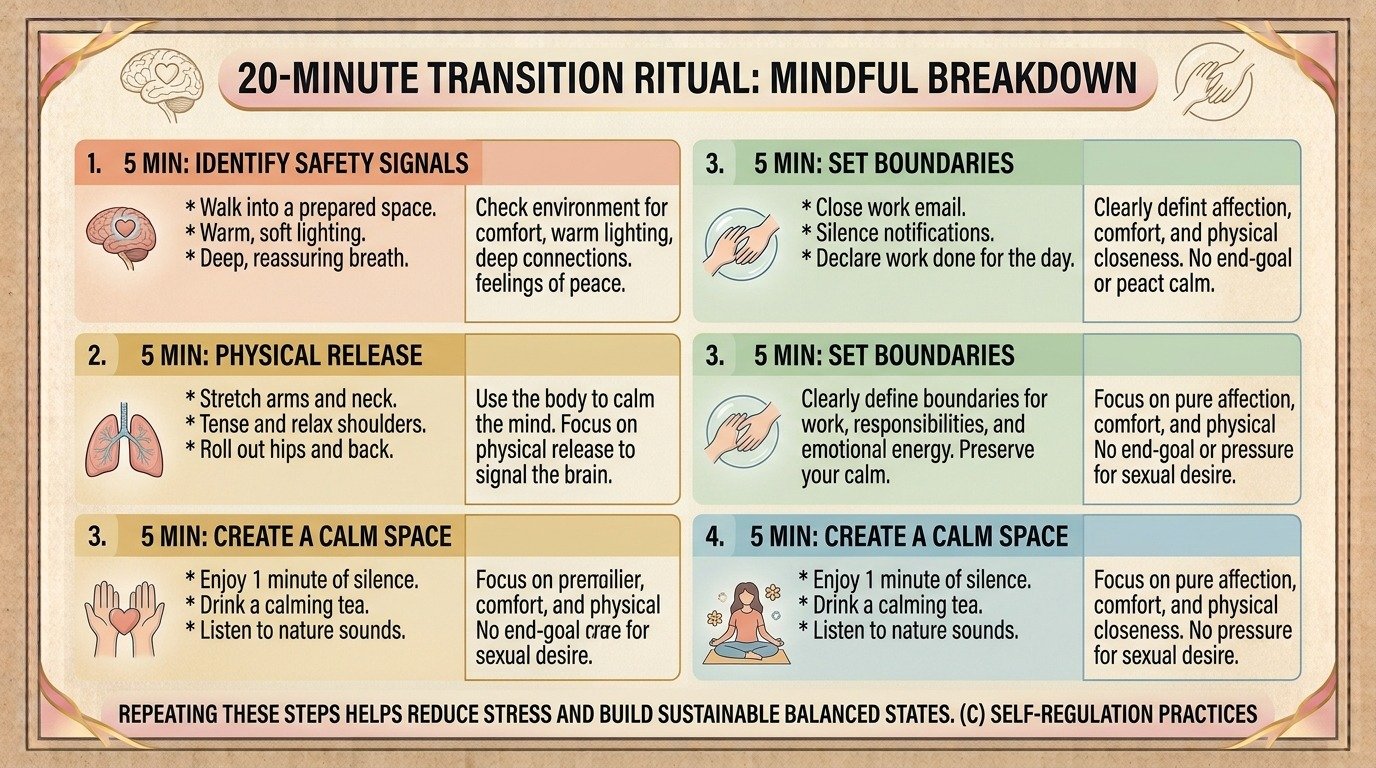
Step 2: Create a Pre-Intimacy Transition Ritual
How do you transition from work mode to intimacy? Most women try to make this leap instantly. That’s like expecting a car to go from 0 to 60 in one second.
Your body needs a transition ritual—a bridge that signals nervous system safety and allows your physiology to shift gradually.
Creating Your Ritual:
- Set a timeframe: 15-30 minutes before you want to be intimate
- Choose 2-3 practices from your safety signals list
- Make it non-negotiable: This is as important as brushing your teeth
- Communicate it to your partner: “I need 20 minutes to transition before I can be present for intimacy”
Example Ritual:
- 5 minutes: Change into comfortable clothes, dim the lights
- 5 minutes: Practice physiological sigh breathing (see Step 3)
- 5 minutes: Gentle stretching or a warm shower
- 5 minutes: Cuddle or talk with no agenda
Your ritual isn’t foreplay. It’s nervous system regulation. It’s the bridge from stress to softness where responsive desire can emerge.
Step 3: Practice the Physiological Sigh for Immediate Calm
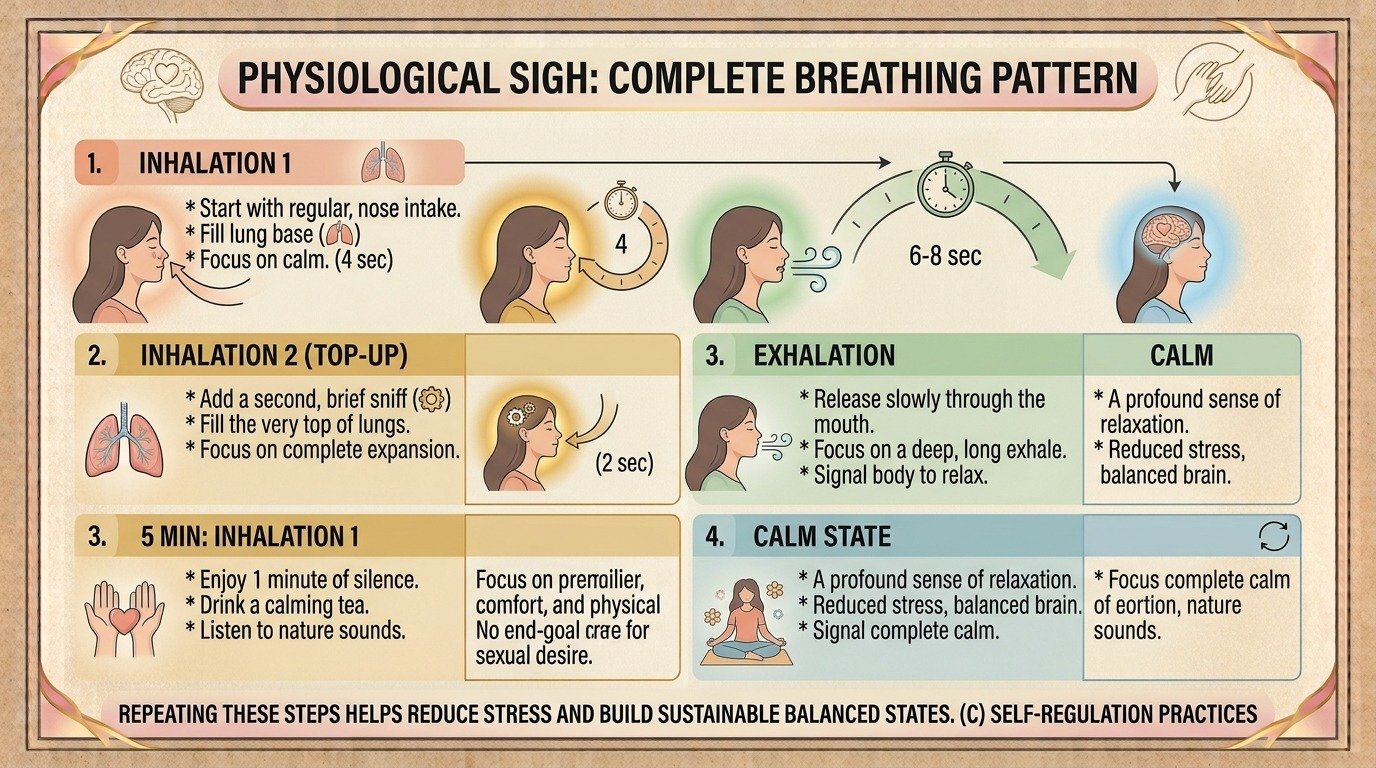
The physiological sigh is one of the fastest, most effective ways to activate your parasympathetic state and create nervous system safety. Research by Dr. Andrew Huberman and others shows this breathing pattern rapidly reduces stress and anxiety.
How to Practice the Physiological Sigh:
- Inhale deeply through your nose until your lungs are about 70% full
- Take a second, shorter inhale through your nose to fully fill your lungs
- Exhale slowly and completely through your mouth, making a soft “whoosh” sound
- Repeat 2-3 times, or for 2-3 minutes
Why It Works:
The double inhale fully inflates your lungs, opening tiny air sacs (alveoli) that improve oxygen exchange. The long exhale stimulates your vagus nerve, signaling safety to your nervous system. This pattern rapidly shifts you from sympathetic activation to parasympathetic state.
Step 4: Set Boundaries That Create Safety
How do you ask for space without guilt? Boundary setting is essential for nervous system safety. When your body knows it has the freedom to say no, it becomes exponentially safer to say “yes.”
This doesn’t mean rejecting your partner. It means creating conditions where intimacy can happen without pressure, resentment, or obligation.
Boundary-Setting Scripts:
- “I want to connect with you, but I need 20 minutes to transition first.”
- “I’m feeling overwhelmed right now. Can we slow down and just cuddle?”
- “I need to say no to sex tonight, but I’d love to spend time together in another way.”
- “Can we agree that either of us can pause or stop at any time, no questions asked?”
Key Principles:
- Be clear and direct: Vague boundaries create anxiety
- Offer alternatives: “No to this, yes to that”
- No apologies needed: You’re allowed to have needs
- Consistency matters: Boundaries only create safety if they’re respected
When you set boundaries that honor your nervous system’s needs, you’re creating the emotional safety where authentic desire can flourish.
Step 5: Invite Touch Without Expectations
What does “touch without expectations” mean? It’s physical contact that has no agenda beyond connection and comfort. No pressure for it to lead to sex. No performance expectations. Just presence and warmth.
For women whose nervous systems are overwhelmed, this type of touch is often the bridge to responsive desire. It signals nervous system safety without demand.
Examples of Touch Without Expectations:
- A 10-minute back rub with no expectation of reciprocation
- Cuddling while watching a movie
- Holding hands during a walk
- A warm hug that lasts 20+ seconds (this stimulates oxytocin release)
- Gentle scalp massage or foot rub
How to Request It:
Try saying: “I’d love some closeness tonight, but I need it to be without pressure for anything more. Could we just cuddle or give each other a massage?”
Or: “My body needs safety first. Can we spend 20 minutes just being close, with no agenda?”
Why It Works:
When touch has no expectation, your nervous system can relax into it. You’re not scanning for “what comes next” or worrying about performance. This creates the parasympathetic state where desire can naturally emerge.
Quick Somatic Exercises: 2-Minute Resets for Busy Women
What are somatic exercises for low libido? They’re simple, quick practices that help you reconnect with your body and regulate your nervous system. You don’t need hours—just 2-5 minutes can create a shift.
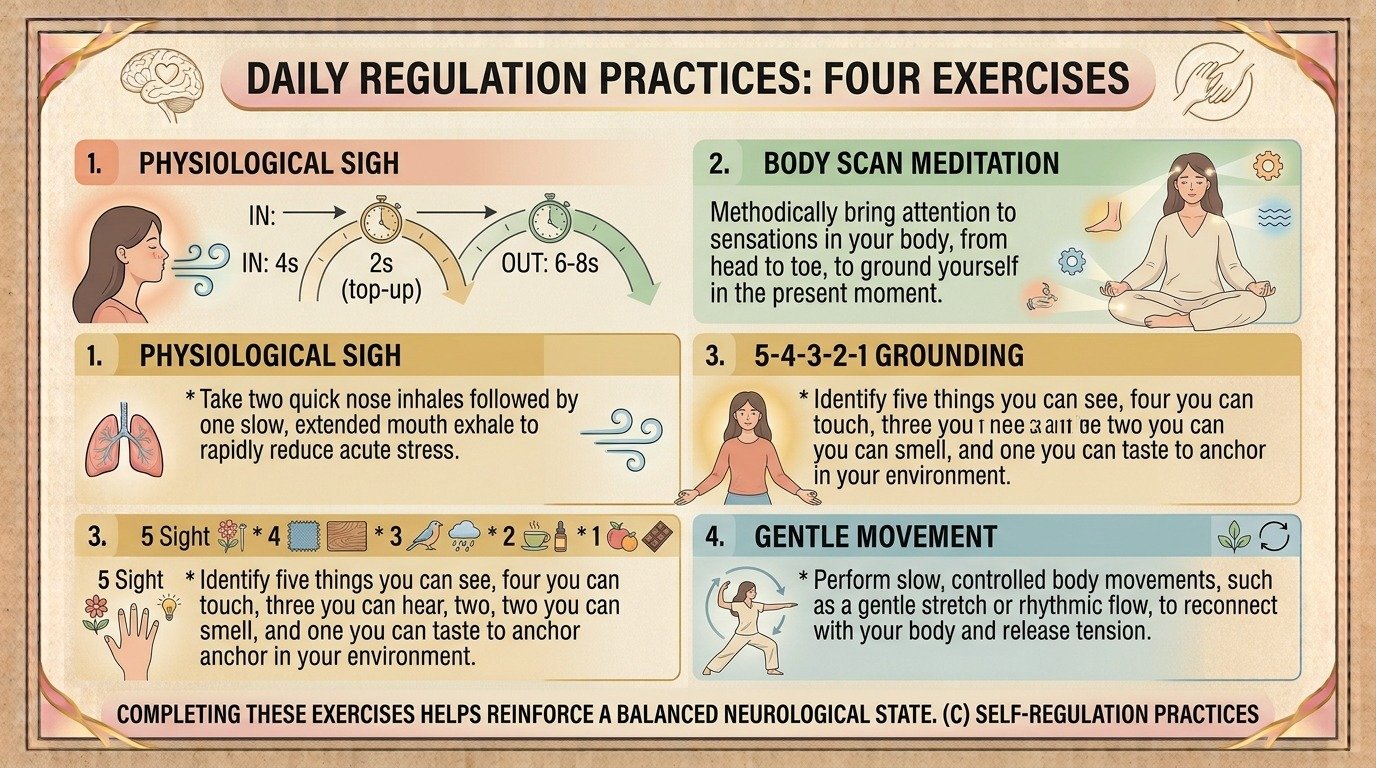
Here are two powerful exercises you can do anywhere, anytime:
The 60-Second Body Scan for Tension Release
This exercise helps you quickly release physical tension and reconnect with sensation.
How to Do It:
- Close your eyes or soften your gaze
- Take one deep breath
- Starting at your head, mentally scan down through your body:
- Forehead: Notice any tension, invite it to soften
- Jaw: Unclench your teeth, let your tongue rest
- Shoulders: Drop them away from your ears
- Chest: Notice your breath, let it deepen slightly
- Belly: Soften any tightness
- Pelvis: Release any holding
- Legs and feet: Feel their weight, let them relax
- Take one more deep breath and notice how you feel
When to Use It:
- Before intimacy
- When you feel “touched out”
- During your transition ritual
- Anytime you notice tension building
This isn’t about achieving perfect relaxation. It’s about creating momentary nervous system safety that can accumulate over time.
The 5-4-3-2-1 Grounding Technique for Anxiety
When overwhelm is high, this grounding technique brings you back to the present moment and activates nervous system safety.
How to Do It:
Notice:
- 5 things you can see (name them silently or out loud)
- 4 things you can touch (feel the texture, temperature, weight)
- 3 things you can hear (listen for distant and close sounds)
- 2 things you can smell (or 2 scents you like)
- 1 thing you can taste (or take a sip of water)
Why It Works:
This exercise engages your senses, pulling you out of racing thoughts and into your body. It activates your vagus nerve and shifts you from sympathetic activation toward parasympathetic state.
Use this when anxiety is high, when your mind won’t quiet, or when you feel disconnected from your body. It’s a quick reset that creates space for nervous system safety.
Communication Scripts: Talking to Your Partner About Needing Space
How do I talk to my partner about needing space without guilt? Clear, kind communication is essential for emotional safety. Your partner can’t read your mind, and unspoken needs often create resentment on both sides.
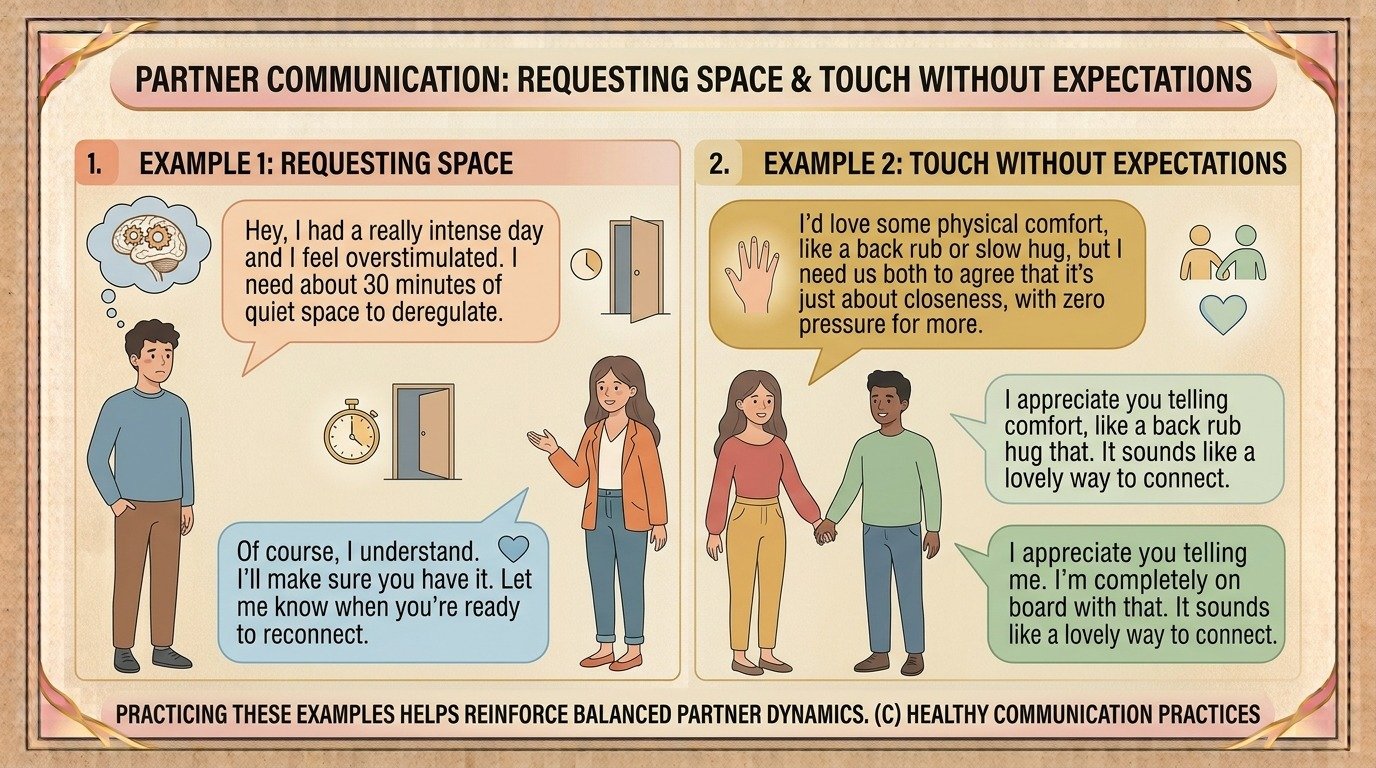
Here are scripts you can adapt for your situation:
What to Say When You’re Too Tired for Intimacy
Declining intimacy kindly requires honesty without blame. These scripts help you communicate your needs while honoring your relationship:
Script 1: “I love you and I’m attracted to you, but I’m completely drained tonight. My body needs rest more than anything else. Can we cuddle and just be close instead?”
Script 2: “I want to be intimate with you, but I’m feeling overwhelmed right now. I need about 20 minutes to transition and reset. Can we plan for that?”
Script 3: “I’m noticing my body feels closed off tonight, and I don’t want to push through that. Can we talk about what’s coming up for me? I think I need emotional connection before physical connection.”
Key Principles:
- Lead with love: Affirm your care for your partner
- State your need clearly: No vague hints
- Offer an alternative: “No to this, yes to that”
- No over-explaining: You don’t owe a detailed justification
Remember: saying no to sex isn’t saying no to your partner. It’s saying yes to your nervous system’s needs, which ultimately creates the foundation for authentic intimacy.
How to Request “Touch Without Expectations”
Asking for non-sexual touch can feel vulnerable, but it’s often the bridge to responsive desire. Here’s how to make that request:
Script 1: “I’d love some physical closeness tonight, but I need it to be without pressure for anything more. Could we just cuddle or give each other a massage for 15 minutes?”
Script 2: “My body needs safety first. Can we spend 20 minutes just being close—holding each other, no agenda? That would help me feel more connected.”
Script 3: “I’m feeling touched out from the day, but I still want connection. Could we sit close and just breathe together for a few minutes?”
Why This Matters:
When you request touch without expectations, you’re teaching your nervous system that intimacy can be safe and pressure-free. You’re also helping your partner understand your needs without making them feel rejected.
Clear, kind communication like this builds emotional safety for both of you. It creates the conditions where nervous system safety and desire can naturally emerge.
Case Study: How Renata Rebuilt Her Desire Through Nervous System Safety
Can nervous system safety really restore desire? Let’s look at an anonymized case study that illustrates how small, consistent changes can create profound shifts.
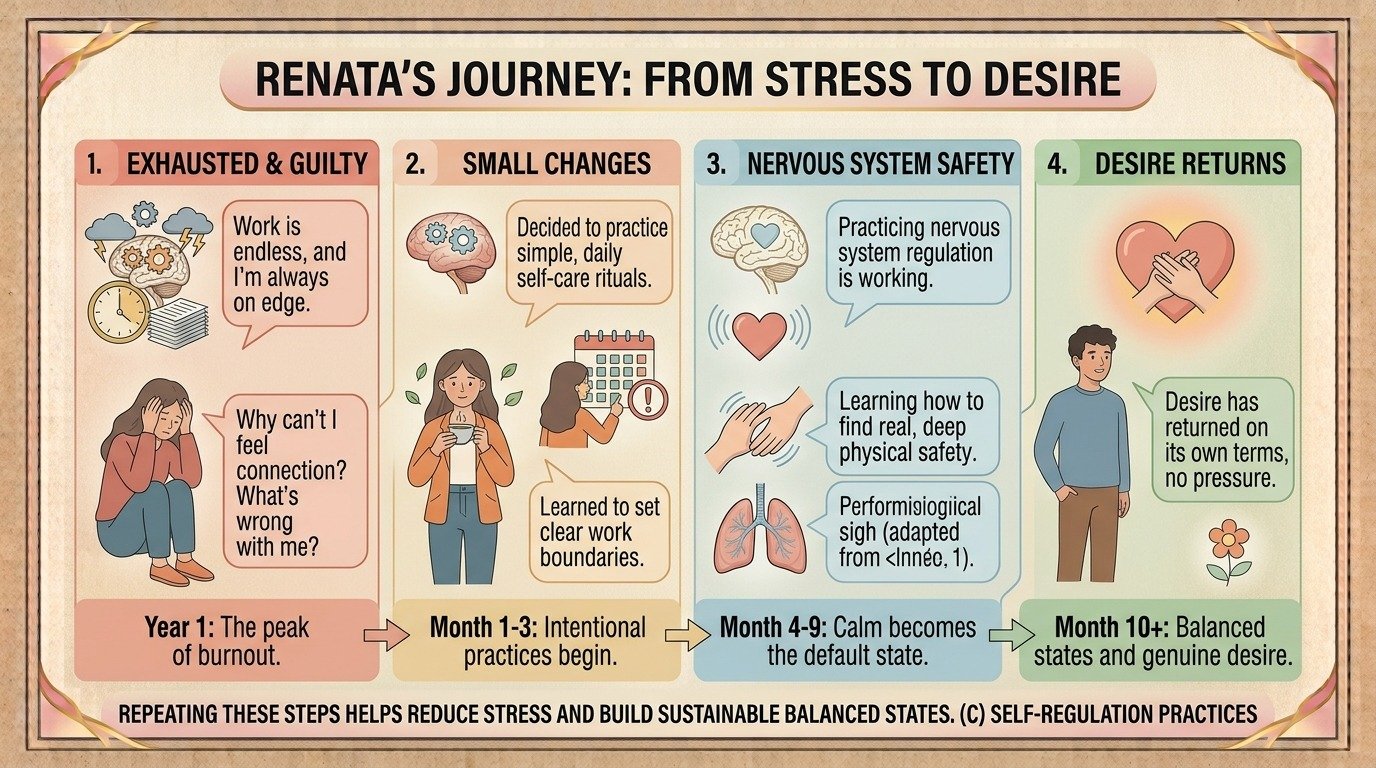
Note: “Renata” is a pseudonym. This case study reflects common patterns observed in women working with nervous system-based approaches to intimacy. Individual results vary.
Renata’s Starting Point: Exhaustion and Guilt
Renata, 38, came to us feeling broken. She loved her husband deeply but hadn’t felt desire for intimacy in over a year. Every time he initiated, she felt pressure, guilt, and resentment—even though logically she wanted to want it.
Her typical day:
- Up at 6 AM with the kids
- Work emails starting at 7:30 AM
- Full workday plus managing household logistics
- Kids’ bedtime routine until 8:30 PM
- Collapse into bed by 10 PM, exhausted
When her husband wanted intimacy, it felt like “one more demand” on an already overwhelmed system. She’d think: “Why can’t I just relax? What’s wrong with me?”
Her body was in constant sympathetic activation—racing mind, shallow breathing, chronic tension. There was no bridge from her day to intimacy, no nervous system safety, no space where desire could emerge.
The Small Changes That Made a Big Difference
Renata’s transformation didn’t happen overnight. It happened through small, consistent practices that gradually rebuilt nervous system safety:
Week 1-2: Awareness
- Started asking herself: “What does my body need right now?”
- Noticed she felt most calm after a warm shower
- Recognized that serious conversations after 9 PM kept her wired
Week 3-4: Boundaries
- Set a rule: no serious conversations after 9 PM
- Asked her husband to handle bedtime routine 3 nights/week
- Requested 15 minutes alone after work before family time
Week 5-6: Transition Ritual
- Created a 20-minute pre-intimacy ritual:
- 5 min: Warm shower
- 5 min: Physiological sigh breathing
- 10 min: Cuddling with no agenda
- Communicated clearly: “I need this transition time to feel present”
Week 7-8: Touch Without Expectations
- Agreed with her husband on “connection nights” with no expectation of sex
- Started enjoying physical closeness again without pressure
- Noticed her body beginning to relax into touch
The Shift:
Around week 6, Renata noticed something surprising. During their cuddle time, she felt a flicker of warmth, curiosity, even desire. It wasn’t spontaneous—it came after safety, warmth, and connection. It was responsive desire, and it felt natural, not forced.
By week 8, intimacy had transformed. It wasn’t perfect every time, but it was no longer impossible. Her nervous system’s starting point had lowered. She had tools to create nervous system safety. Desire stopped feeling like a broken part of her and started feeling like a natural response to the right conditions.
What Renata’s Story Teaches Us:
- Small, consistent safety signals compound over time
- Responsive desire is real and valid
- Transition rituals and boundaries aren’t selfish—they’re essential
- Nervous system safety is the foundation where desire can flourish
When Nervous System Safety Isn’t Enough: Knowing When to Seek Help
While nervous system safety practices can be profoundly helpful, they’re not always sufficient on their own. Knowing when to seek professional support is an important part of honoring your needs.
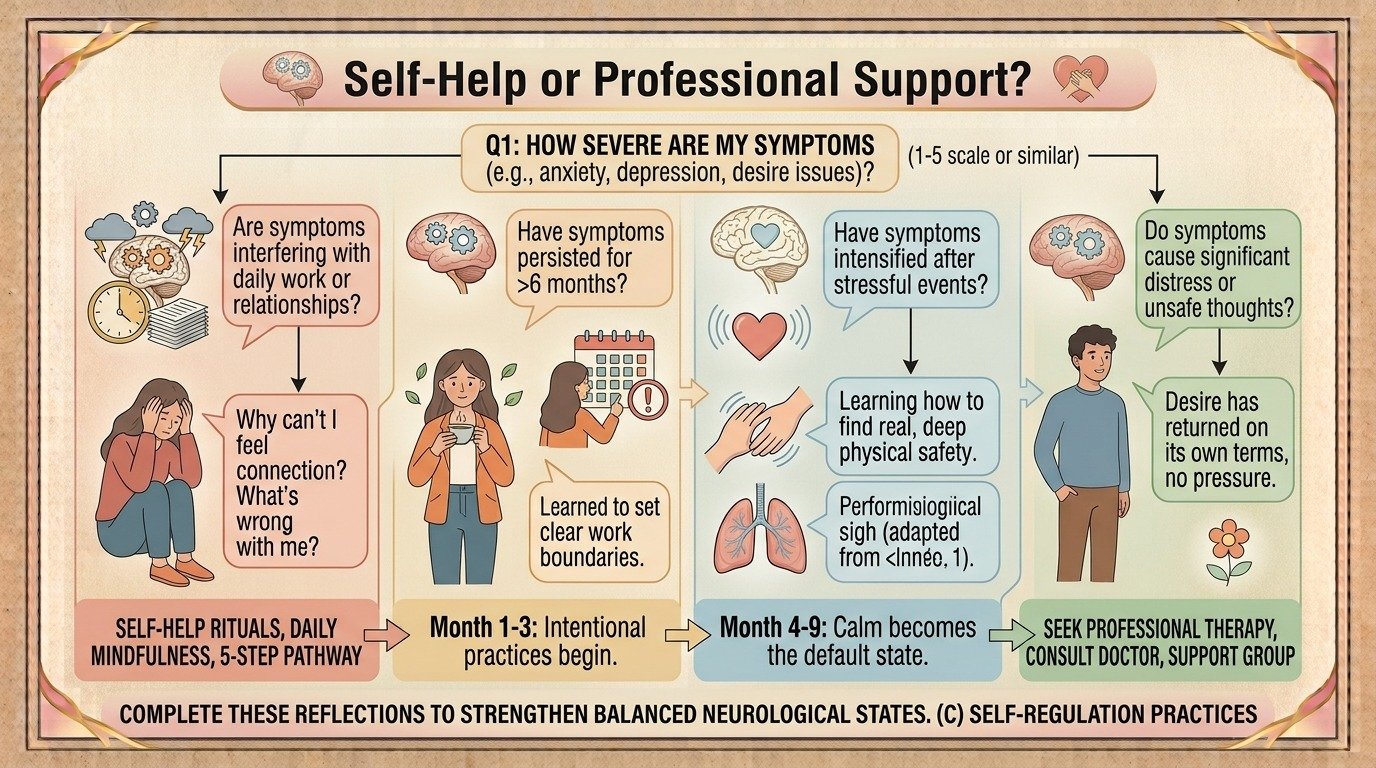
Consider professional support if:
- Self-help strategies aren’t working after 6-8 weeks of consistent practice
- You suspect trauma or past abuse is affecting your intimacy
- You’re experiencing significant relationship conflict
- Low desire is causing severe distress or relationship crisis
- You want deeper, personalized guidance
Seeking help isn’t failure. It’s wisdom.
Medical Conditions That Can Affect Desire
Before assuming low desire is purely stress-related, it’s important to rule out medical causes. Conditions that can affect libido include:
- Hormonal imbalances: Thyroid disorders, low testosterone, estrogen fluctuations
- Medication side effects: Antidepressants (SSRIs), birth control, blood pressure medications
- Chronic health conditions: Diabetes, cardiovascular disease, chronic pain
- Mental health conditions: Depression, anxiety, PTSD
- Sleep disorders: Insomnia, sleep apnea
- Substance use: Alcohol, recreational drugs
If you suspect a medical issue, consult with your healthcare provider. A thorough evaluation can identify treatable causes and ensure you’re getting the right support.
Finding the Right Professional Support
If you decide to seek professional help, look for providers trained in nervous system regulation and sexual health:
- Certified Sex Therapist (AASECT-certified): Specialized training in sexual concerns. Can address desire issues, intimacy barriers, and relationship dynamics. Find one through the American Association of Sexuality Educators, Counselors and Therapists (AASECT).
- Somatic Therapist: Focuses on body-based healing. Helps release stored trauma and tension, working directly with nervous system regulation.
- Couples Counselor: Addresses relationship dynamics affecting intimacy. Helps both partners understand and support each other, creating a safe space for difficult conversations.
- Pelvic Floor Physical Therapist: Addresses physical pain or tension affecting intimacy. Works with pelvic floor dysfunction, which can be essential if pain is present.
Therapy complements self-practice; it doesn’t replace it. The most effective approach often combines professional support with daily nervous system safety practices.
Building Long-Term Nervous System Resilience for Sustained Intimacy
Creating nervous system safety isn’t a one-time fix. It’s an ongoing practice that builds resilience over time. How do you maintain nervous system safety long-term?
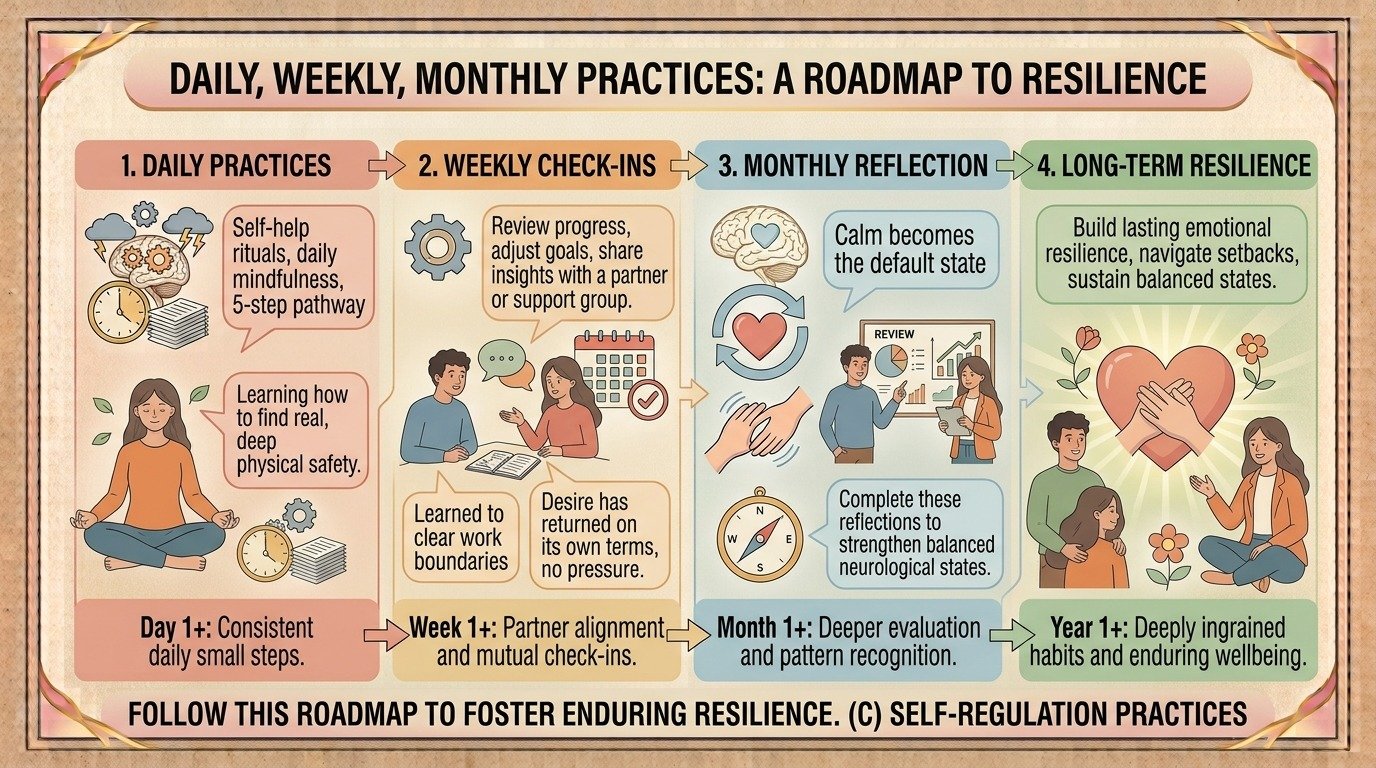
The goal isn’t perfection. It’s building a nervous system that can more easily shift from survival mode to connection mode, even amid life’s inevitable stresses.
Daily Practices for Nervous System Regulation
Daily habits that support nervous system safety:
- Morning check-in: 2 minutes to notice your state and set intentions
- Breath breaks: 3-5 physiological sighs throughout the day
- Movement: Gentle yoga, walking, or stretching
- Boundaries: Saying no to non-essential demands
- Connection: Warm interaction with safe people
- Sleep hygiene: Consistent bedtime, dark room, no screens before bed
- Pleasure: Doing something enjoyable daily, even if small
These practices aren’t luxuries. They’re essential maintenance for a nervous system that’s been conditioned toward stress. Somatic exercises like body scans, grounding techniques, and breathwork should become as routine as brushing your teeth.
Weekly Check-Ins: The Safety Question Ritual
How do you regularly assess your nervous system needs? Create a weekly check-in ritual using “The Safety Question”:
Once a week, ask yourself:
“What condition does my body need before desire can wake up?”
Then reflect:
- How stressed has my nervous system been this week?
- What safety signals have I received?
- What’s been missing?
- What do I need more of next week?
Possible answers:
- More sleep
- Less stimulation
- Emotional warmth
- Help with responsibilities
- Time alone
- Touch without expectations
- One night with no serious conversations
This weekly ritual keeps you connected to your body’s needs. It prevents the slow accumulation of stress that leads to complete shutdown. It’s proactive nervous system safety, not reactive crisis management.
Write your answers down. Share them with your partner if that feels safe. Use them to adjust your practices and boundaries.
Your Next Steps: From Understanding to Action
You now have the knowledge and tools to restore nervous system safety and reclaim desire. But knowledge alone isn’t enough. Action creates change.

What should you do now to improve your intimacy? Here are your options:
Start with the Free Safety Question Practice
What can you do right now for free? Start tonight.
Ask yourself: “What condition does my body need before desire can wake up?”
Then choose one small supportive action:
- Ten minutes alone
- An earlier bedtime
- A slower transition after work
- One honest conversation
- Help with a household task
- Touch with no expectation
- Permission to say no without guilt
Don’t wait for the perfect moment. Don’t try to overhaul everything at once. Start with one small safety signal tonight.
These moments compound. One small shift leads to another. Over time, your nervous system’s default setting changes.
Deepen Your Practice with the Confidence & Intimacy Reset Workbook
How can the workbook help you? If you’re ready for deeper support, structured guidance can accelerate your progress.
The Confidence & Intimacy Reset For Women eBook and companion workbook provide:
- Structured reflection: Guided exercises that go deeper than this article
- Worksheets: Practical tools to identify your patterns and create your plan
- Action prompts: Step-by-step guidance for implementing change
- Deeper exploration: How stress, self-talk, physiology, and desire interconnect
- Body confidence rebuilding: Practices to reconnect with your body without shame
- Pleasure and desire education: Understanding your unique response patterns
This isn’t about quick fixes. It’s about turning self-knowledge into lasting trust and connection. It’s about creating a sustainable path where nervous system safety becomes your foundation, not an occasional luxury.
Available formats:
- Main eBook
- Workbook (A4 Size)
- Workbook (US Letter Size)
- Main Book & Workbook Bundle (best value)
Choose the format that works for you. Start where you are. Your body is waiting to feel safe again.
Frequently Asked Questions About Nervous System Safety and Desire
You likely have questions. Here are answers to the most common ones about nervous system safety and desire.
How do I know if my low libido is from stress?
If you love your partner but feel physically closed off, exhausted, or tense when intimacy is expected, stress may be blocking desire. Other signs include: your mind races with unfinished tasks, you need sleep more than closeness, you feel “touched out,” or your body feels stuck in work mode. These patterns suggest your nervous system needs safety before desire can return.
What are quick ways to regulate the nervous system before intimacy?
Try the physiological sigh (two quick inhales through the nose, one long exhale through the mouth) for 2-3 minutes. Practice a 60-second body scan to release tension. Use the 5-4-3-2-1 grounding technique. Create a 15-minute transition ritual between work and intimacy. These practices activate your parasympathetic nervous system, signaling safety to your body.
Can nervous system safety improve low desire permanently?
Yes, when nervous system safety becomes a consistent practice, it can create lasting change. However, it requires ongoing attention to stress management, boundaries, and body awareness. The goal isn’t perfection but building resilience so your body can more easily shift from survival mode to connection. Structured programs like workbooks can help establish these patterns.
How does nervous system safety improve low desire?
Nervous system safety activates the parasympathetic state, which allows blood flow, sensation, and oxytocin release—all essential for desire. When your body feels safe, it shifts from asking “What problem needs solving?” to “What would feel good?” This creates the physiological conditions where responsive desire can emerge naturally, without force or pressure.
Is responsive desire normal?
Absolutely. Research shows many women experience responsive desire—desire that appears after warmth, safety, and connection are already present. This is as normal as spontaneous desire. The Dual Control Model of sexual response confirms that some bodies need a bridge from stress to softness before desire can wake up. It’s not broken; it’s biology.
How long does it take to restore nervous system safety?
Some women notice shifts within days of practicing simple techniques like the physiological sigh or setting boundaries. Deeper, sustained change typically takes 4-8 weeks of consistent practice. The timeline depends on your stress load, support system, and whether you’re using structured tools like workbooks. Small, consistent safety signals compound over time.
Why can’t I just relax before intimacy?
“Just relax” doesn’t work because stress is physiological, not just mental. Your body has been in sympathetic activation (fight-or-flight) all day, with elevated cortisol, shallow breathing, and muscle tension. Shifting to parasympathetic state requires active regulation—like breathing exercises, movement, or touch—not just willpower. Your body needs concrete safety signals, not commands.
What is the difference between spontaneous and responsive desire?
Spontaneous desire appears suddenly, often without obvious triggers. Responsive desire emerges after warmth, safety, connection, or physical touch are already present. Neither is better—both are normal. Many women experience responsive desire, especially when stressed. Understanding this reduces shame and helps you create the conditions (the “bridge”) your body needs for desire to wake up.
How do I ask for touch without expectations?
Try saying: “I’d love some closeness tonight, but I need it to be without pressure for anything more. Could we just cuddle or give each other a massage?” Or: “My body needs safety first. Can we spend 20 minutes just being close, with no agenda?” Clear, kind communication helps your partner understand this isn’t rejection—it’s a pathway to deeper connection.
Should I see a therapist for low desire from stress?
Consider professional support if: self-help strategies aren’t working after 6-8 weeks, you suspect trauma or past abuse, you’re experiencing relationship conflict, or you want deeper guidance. Look for a certified sex therapist, somatic therapist, or couples counselor trained in nervous system regulation. Therapy complements self-practice; it doesn’t replace it.